

50
Coastal Engineering: Theory and Practice
A model developed by Losada et al. [1982] balances driving and résistance ter ms (gradients of radiation and turbulent Reynolds stresses and
bottom friction) to get a general expression for the velocity. This équation
shows explicitly the influence of Iribarren’s parameter on longshore current
génération. It has been tested with field and laboratory data, obtaining
a reasonable fit to measured values. The resulting longshore momentum
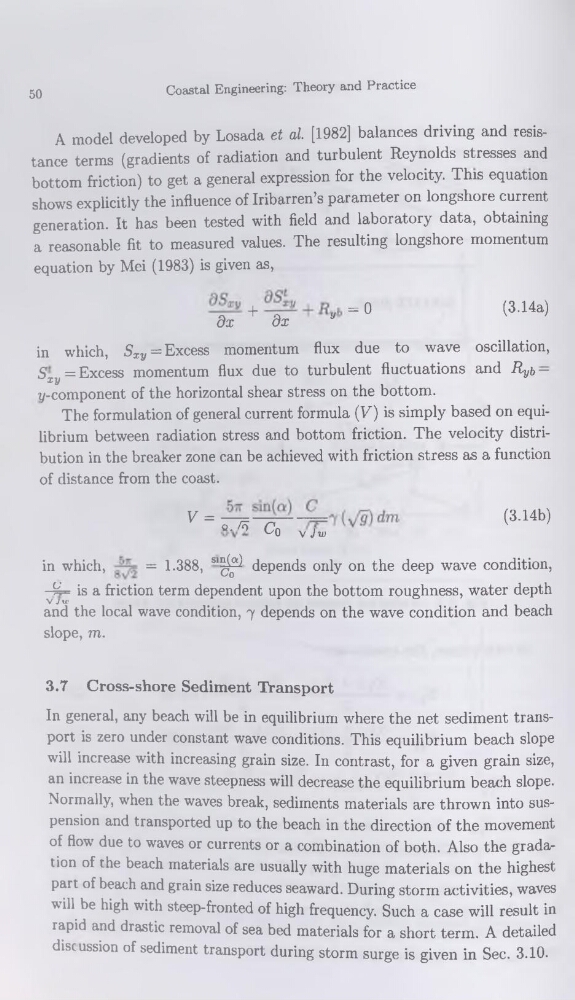
équation by Mei (1983) is given as,
+
= 0
(3.14a)
dx
dx
y
in which, SIy=Excess momentum flux due to wave oscillation,
5'æy=Excess momentum flux due to turbulent fluctuations and Ryb —
i/-component of the horizontal shear stress on the bottom.
The formulation of general current formula (V) is simply based on equilibrium between radiation stress and bottom friction. The velocity distribution in the breaker zone can be achieved with friction stress as a function
of distance from the coast.
V = 7æ r
(3.14b)
^0 y Jvj
in which,
= 1.388, S1^ dépends only on the deep wave condition,
-U= is a friction term dépendent upon the bottom roughness, water depth
V Jw
and the local wave condition, 7 dépends on the wave condition and beach
slope, m.
3.7 Cross-shore Sédiment Transport
In general, any beach will be in equilibrium where the net sédiment transport is zéro under constant wave conditions. This equilibrium beach slope
will increase with increasing grain size. In contrast, for a given grain size,
an increase in the wave steepness will decrease the equilibrium beach slope.
Xormally, when the waves break, sédiments materials are thrown into suspension and transported up to the beach in the direction of the movement
of flow due to waves or currents or a combination of both. Also the gradation of the beach materials are usually with huge materials on the highest
part of beach and grain size reduces seaward. During storm activities, waves
will be high with steep-fronted of high frequency. Such a case will resuit in
rapid and drastic removal of sea bed materials for a short term. A detailed
dise ussion of sédiment transport during storm surge is given in Sec. 3.10.
Coastal Engineering: Theory and Practice
A model developed by Losada et al. [1982] balances driving and résistance ter ms (gradients of radiation and turbulent Reynolds stresses and
bottom friction) to get a general expression for the velocity. This équation
shows explicitly the influence of Iribarren’s parameter on longshore current
génération. It has been tested with field and laboratory data, obtaining
a reasonable fit to measured values. The resulting longshore momentum
équation by Mei (1983) is given as,
+
= 0
(3.14a)
dx
dx
y
in which, SIy=Excess momentum flux due to wave oscillation,
5'æy=Excess momentum flux due to turbulent fluctuations and Ryb —
i/-component of the horizontal shear stress on the bottom.
The formulation of general current formula (V) is simply based on equilibrium between radiation stress and bottom friction. The velocity distribution in the breaker zone can be achieved with friction stress as a function
of distance from the coast.
V = 7æ r
(3.14b)
^0 y Jvj
in which,
= 1.388, S1^ dépends only on the deep wave condition,
-U= is a friction term dépendent upon the bottom roughness, water depth
V Jw
and the local wave condition, 7 dépends on the wave condition and beach
slope, m.
3.7 Cross-shore Sédiment Transport
In general, any beach will be in equilibrium where the net sédiment transport is zéro under constant wave conditions. This equilibrium beach slope
will increase with increasing grain size. In contrast, for a given grain size,
an increase in the wave steepness will decrease the equilibrium beach slope.
Xormally, when the waves break, sédiments materials are thrown into suspension and transported up to the beach in the direction of the movement
of flow due to waves or currents or a combination of both. Also the gradation of the beach materials are usually with huge materials on the highest
part of beach and grain size reduces seaward. During storm activities, waves
will be high with steep-fronted of high frequency. Such a case will resuit in
rapid and drastic removal of sea bed materials for a short term. A detailed
dise ussion of sédiment transport during storm surge is given in Sec. 3.10.