

46
Coastal Engineering: Theory and Practice
The value of Sxx, defined in Eq. (3.5), can be calculated from any wave
theory. When we carry ont this intégration
it is a considérable task
over the depth on a plane perpendicular to the X-axis, the resuit is then
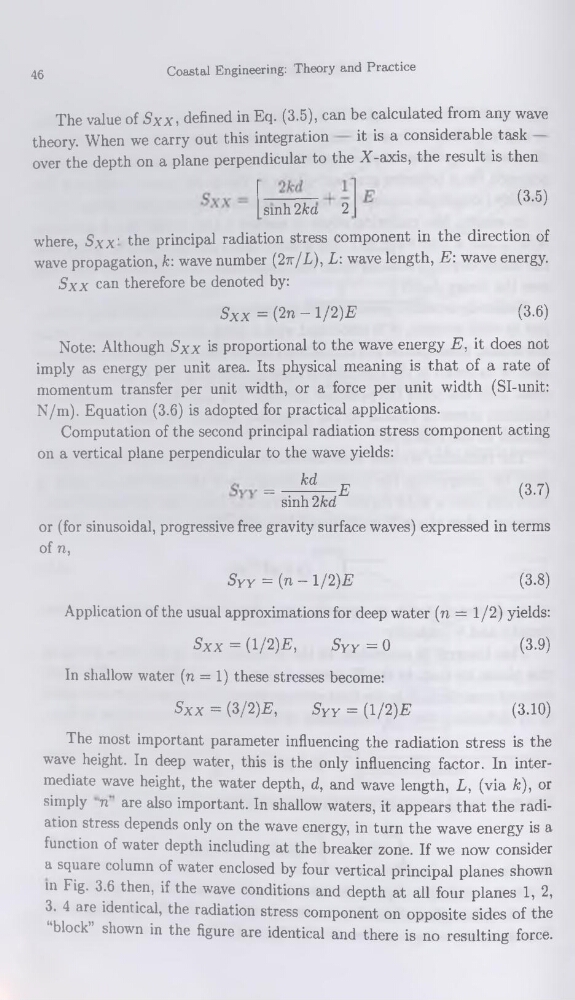
(3'5)
smh2fca 2
where, Sxx' the principal radiation stress component in the direction of
wave propagation, k: wave number (2tt/L), L: wave length, E: wave energy.
Sxx can therefore be denoted by:
Sxx = (2n-1/2)E
(3.6)
Note: Although Sxx is proportional to the wave energy E, it does not
imply as energy per unit area. Its physical meaning is that of a rate of
momentum transfer per unit width, or a force per unit width (Sl-unit:
N/m). Equation (3.6) is adopted for practical applications.
Computation of the second principal radiation stress component acting
on a vertical plane perpendicular to the wave yields:
-^dE
(37)
or (for sinusoïdal, progressive free gravity surface waves) expressed in terms
of n,
Syy = (n- 1/2) JE1
(3.8)
Application of the usual approximations for deep water (n = 1 /2) yields:
Sxx = (1/2)E,
Syy = 0
(3.9)
In shallow water (n = 1) these stresses become:
Sxx = (3/2)E,
Syy = (1/2)E
(3.10)
The most important parameter influencing the radiation stress is the
wave height. In deep water, this is the only influencing factor. In intermediate wave height, the water depth, d, and wave length, L, (via E), or
simply n are also important. In shallow waters, it appears that the radiation stress dépends only on the wave energy, in turn the wave energy is a
function of water depth including at the breaker zone. If we now consider
a square column of water enclosed by four vertical principal planes shown
in Fig. 3.6 then, if the wave conditions and depth at ail four planes 1, 2,
3. 4 are identical, the radiation stress component on opposite sides of the
“block” shown in the figure are identical and there is no resulting force.
Coastal Engineering: Theory and Practice
The value of Sxx, defined in Eq. (3.5), can be calculated from any wave
theory. When we carry ont this intégration
it is a considérable task
over the depth on a plane perpendicular to the X-axis, the resuit is then
(3'5)
smh2fca 2
where, Sxx' the principal radiation stress component in the direction of
wave propagation, k: wave number (2tt/L), L: wave length, E: wave energy.
Sxx can therefore be denoted by:
Sxx = (2n-1/2)E
(3.6)
Note: Although Sxx is proportional to the wave energy E, it does not
imply as energy per unit area. Its physical meaning is that of a rate of
momentum transfer per unit width, or a force per unit width (Sl-unit:
N/m). Equation (3.6) is adopted for practical applications.
Computation of the second principal radiation stress component acting
on a vertical plane perpendicular to the wave yields:
-^dE
(37)
or (for sinusoïdal, progressive free gravity surface waves) expressed in terms
of n,
Syy = (n- 1/2) JE1
(3.8)
Application of the usual approximations for deep water (n = 1 /2) yields:
Sxx = (1/2)E,
Syy = 0
(3.9)
In shallow water (n = 1) these stresses become:
Sxx = (3/2)E,
Syy = (1/2)E
(3.10)
The most important parameter influencing the radiation stress is the
wave height. In deep water, this is the only influencing factor. In intermediate wave height, the water depth, d, and wave length, L, (via E), or
simply n are also important. In shallow waters, it appears that the radiation stress dépends only on the wave energy, in turn the wave energy is a
function of water depth including at the breaker zone. If we now consider
a square column of water enclosed by four vertical principal planes shown
in Fig. 3.6 then, if the wave conditions and depth at ail four planes 1, 2,
3. 4 are identical, the radiation stress component on opposite sides of the
“block” shown in the figure are identical and there is no resulting force.