

3. Sédiment Transport
39
3.2.2 Description of the threshold of movement
A perfectly round object or sphere will readily move on minimum horizontal
force if it is resting on a fiat smooth horizontal surface. In the real case,
the area of an erodible boundary, the sédiment particles are not flawlessly
round and it is of non-uniform sizes, on the other hand the seabed is not
fiat or horizontal and it may be of some slope too. In such a case, the
application of horizontal force will lift the sédiment particles only when
the force is greater than the resisting force by the sédiment particles due to
such natural résistance. A fluid in motion applies shear force at the point of
interface to the sédiments. This implies that a considérable amount of force
is applied to the top layer of materials. Based on experimental observations
by many researchers, it is found that when the shear force is gradually
increased from zéro, a point is reached at which particle movements can be
observed at a number of small areas over the bed. A further small increase in
shear force is usually sufficient to generate a widespread sédiment motion as
the bed load type. This defines the “threshold of motion” and the associated
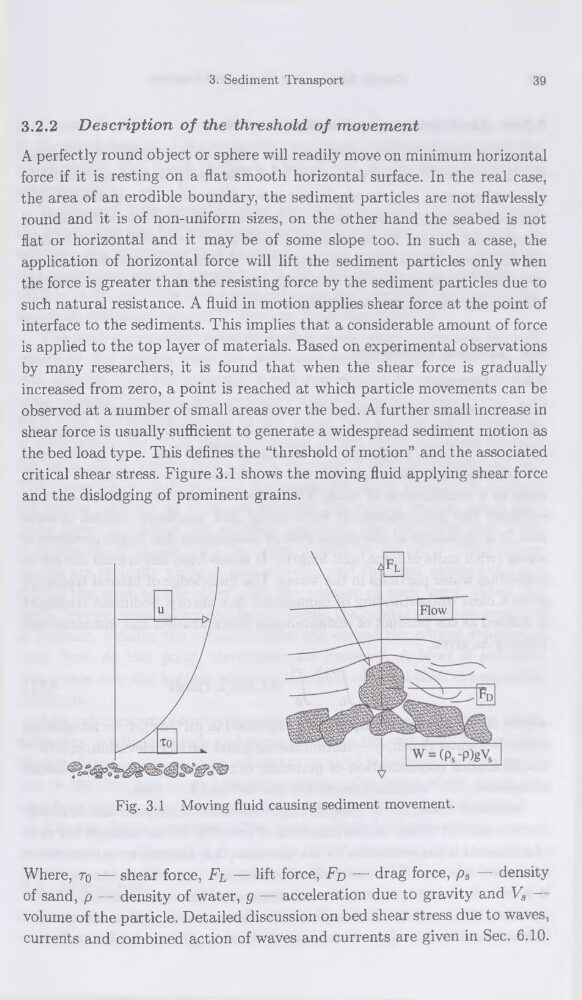
critical shear stress. Figure 3.1 shows the moving fluid applying shear force
and the dislodging of prominent grains.
Fig. 3.1 Moving fluid causing sédiment movement.
Where, tq — shear force, Fl — lift force, Fl> — drag force, ps — density
of sand, p — density of water, g — accélération due to gravity and Vs —
volume of the particle. Detailed discussion on bed shear stress due to waves,
currents and combined action of waves and currents are given in Sec. 6.10.
39
3.2.2 Description of the threshold of movement
A perfectly round object or sphere will readily move on minimum horizontal
force if it is resting on a fiat smooth horizontal surface. In the real case,
the area of an erodible boundary, the sédiment particles are not flawlessly
round and it is of non-uniform sizes, on the other hand the seabed is not
fiat or horizontal and it may be of some slope too. In such a case, the
application of horizontal force will lift the sédiment particles only when
the force is greater than the resisting force by the sédiment particles due to
such natural résistance. A fluid in motion applies shear force at the point of
interface to the sédiments. This implies that a considérable amount of force
is applied to the top layer of materials. Based on experimental observations
by many researchers, it is found that when the shear force is gradually
increased from zéro, a point is reached at which particle movements can be
observed at a number of small areas over the bed. A further small increase in
shear force is usually sufficient to generate a widespread sédiment motion as
the bed load type. This defines the “threshold of motion” and the associated
critical shear stress. Figure 3.1 shows the moving fluid applying shear force
and the dislodging of prominent grains.
Fig. 3.1 Moving fluid causing sédiment movement.
Where, tq — shear force, Fl — lift force, Fl> — drag force, ps — density
of sand, p — density of water, g — accélération due to gravity and Vs —
volume of the particle. Detailed discussion on bed shear stress due to waves,
currents and combined action of waves and currents are given in Sec. 6.10.