

10. Numerical Modelling
317
there may be a case of existence of multiple solutions. Hence, numerical
solution is not a substitute for experiments, without which the numerical
models cannot be validated, but can dispense with its shortcomings. The
computer simulation of a numerical model provides a more refined dataset
which better represents the reality.
10.3 Mathematical Description of Flows:
Governing Equations
The concepts of describing the fluid dynamics are built on the fundamental
conservation laws namely, the équations of conservation of mass, conservation of energy and conservation of momentum. It is from these concepts that
a practical situation is assigned a corresponding governing équation, which
is further approximated using numerical methods to a numerical model.
These governing équations are listed as below.
(i) Continuity équation based on the principle of mass conservation.
(ii) Energy équation in adhérence with the principle of conservation of
energy.
(iii) Momentum équation following Newton’s second law, F — ma.
10.3. 1 Continuity équation
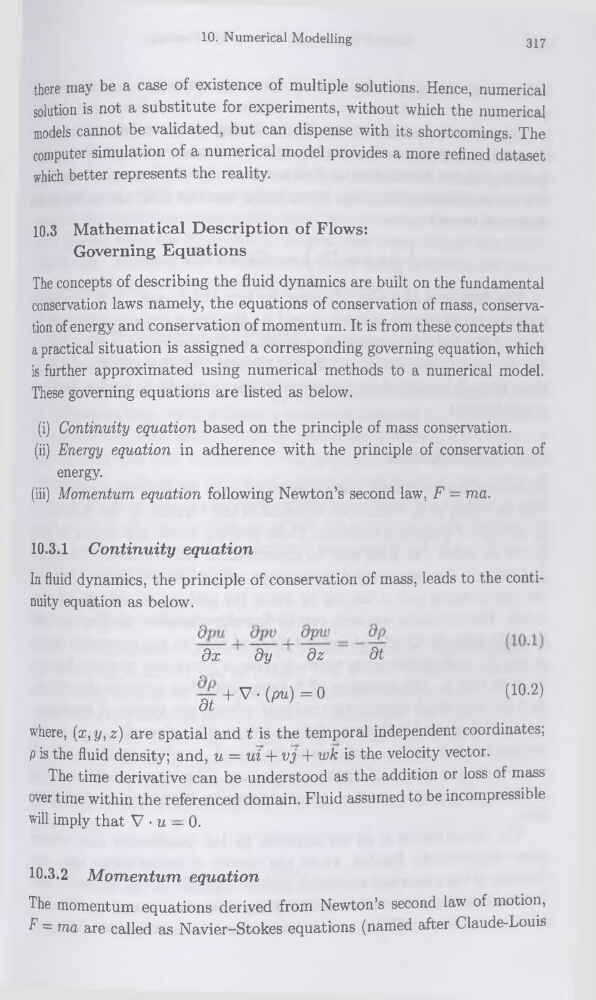
In fluid dynamics, the principle of conservation of mass, leads to the continuity équation as below.
dx
dy
dz
dt
+ V • (pu) = 0
(10.2)
dt
’
where, (x, y,z) are spatial and t is the temporal independent coordinates;
p is the fluid density; and, u = ui 4- vj + wk is the velocity vector.
The time dérivative can be understood as the addition or loss of mass
over time within the referenced domain. Fluid assumed to be incompressible
will imply that V • u — 0.
10.3. 2 Momentum équation
The momentum équations derived from Newton’s second law of motion,
F = ma are called as Navier-Stokes équations (named after Claude-Louis
317
there may be a case of existence of multiple solutions. Hence, numerical
solution is not a substitute for experiments, without which the numerical
models cannot be validated, but can dispense with its shortcomings. The
computer simulation of a numerical model provides a more refined dataset
which better represents the reality.
10.3 Mathematical Description of Flows:
Governing Equations
The concepts of describing the fluid dynamics are built on the fundamental
conservation laws namely, the équations of conservation of mass, conservation of energy and conservation of momentum. It is from these concepts that
a practical situation is assigned a corresponding governing équation, which
is further approximated using numerical methods to a numerical model.
These governing équations are listed as below.
(i) Continuity équation based on the principle of mass conservation.
(ii) Energy équation in adhérence with the principle of conservation of
energy.
(iii) Momentum équation following Newton’s second law, F — ma.
10.3. 1 Continuity équation
In fluid dynamics, the principle of conservation of mass, leads to the continuity équation as below.
dx
dy
dz
dt
+ V • (pu) = 0
(10.2)
dt
’
where, (x, y,z) are spatial and t is the temporal independent coordinates;
p is the fluid density; and, u = ui 4- vj + wk is the velocity vector.
The time dérivative can be understood as the addition or loss of mass
over time within the referenced domain. Fluid assumed to be incompressible
will imply that V • u — 0.
10.3. 2 Momentum équation
The momentum équations derived from Newton’s second law of motion,
F = ma are called as Navier-Stokes équations (named after Claude-Louis