

298
Coastal Engineering: Theory and Practice
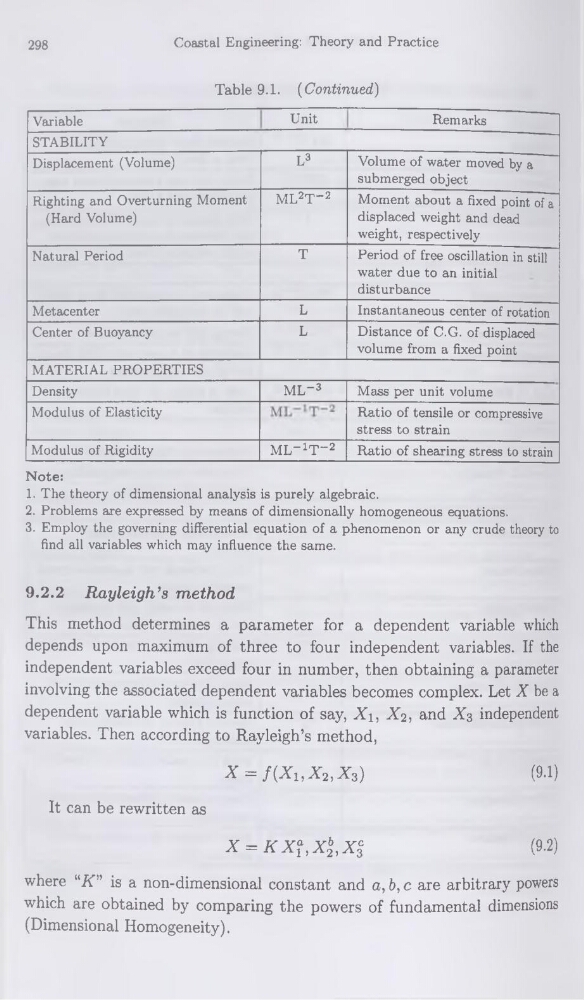
Table 9.1. (Continued)
Variable
Unit
Remarks
STABILITY
_____
Displacement (Volume)
L3
Volume of water moved by a
submerged object
Righting and Overturning Moment
(Hard Volume)
ml2t~2
Moment about a fixed point of a
displaced weight and dead
weight, respectively
Natural Period
T
Period of free oscillation in still
water due to an initial
disturbance
Metacenter
L
Instantaneous center of rotation
Center of Buoyancy
L
Distance of C.G. of displaced
volume from a fixed point
MATERIAL PROPERTIES
Density
ML~3
Mass per unit volume
Modulus of Elasticity
Ratio of tensile or compressive
stress to strain
Modulus of Rigidity
ML~XT~2
Ratio of shearing stress to strain
Note:
1. The theory of dimensional analysis is purely algebraic.
2. Problems are expressed by means of dimensionally homogeneous équations.
3. Employ the governing differential équation of a phenomenon or any crude theory to
find ail variables which may influence the same.
9.2.2 Rayleigh’s method
This method détermines a parameter for a dépendent variable which
dépends upon maximum of three to four independent variables. If the
independent variables exceed four in number, then obtaining a parameter
involving the associated dépendent variables becomes complex. Let X be a
dépendent variable which is function of say, Xi, X2, and X3 independent
variables. Then according to Rayleigh’s method,
X = f(X1,X2,X3)
It can be rewritten as
X = KX?,Xb 2,X%
(9.1)
(9-2)
where “Æ” is a non-dimensional constant and a, b, c are arbitrary powers
which are obtained by comparing the powers of fundamental dimensions
(Dimensional Homogeneity).
Coastal Engineering: Theory and Practice
Table 9.1. (Continued)
Variable
Unit
Remarks
STABILITY
_____
Displacement (Volume)
L3
Volume of water moved by a
submerged object
Righting and Overturning Moment
(Hard Volume)
ml2t~2
Moment about a fixed point of a
displaced weight and dead
weight, respectively
Natural Period
T
Period of free oscillation in still
water due to an initial
disturbance
Metacenter
L
Instantaneous center of rotation
Center of Buoyancy
L
Distance of C.G. of displaced
volume from a fixed point
MATERIAL PROPERTIES
Density
ML~3
Mass per unit volume
Modulus of Elasticity
Ratio of tensile or compressive
stress to strain
Modulus of Rigidity
ML~XT~2
Ratio of shearing stress to strain
Note:
1. The theory of dimensional analysis is purely algebraic.
2. Problems are expressed by means of dimensionally homogeneous équations.
3. Employ the governing differential équation of a phenomenon or any crude theory to
find ail variables which may influence the same.
9.2.2 Rayleigh’s method
This method détermines a parameter for a dépendent variable which
dépends upon maximum of three to four independent variables. If the
independent variables exceed four in number, then obtaining a parameter
involving the associated dépendent variables becomes complex. Let X be a
dépendent variable which is function of say, Xi, X2, and X3 independent
variables. Then according to Rayleigh’s method,
X = f(X1,X2,X3)
It can be rewritten as
X = KX?,Xb 2,X%
(9.1)
(9-2)
where “Æ” is a non-dimensional constant and a, b, c are arbitrary powers
which are obtained by comparing the powers of fundamental dimensions
(Dimensional Homogeneity).