

288
Coastal Engineering: Theory and Practice
Pa (at point B) = 0
To find a
Pa (@ A) = ffi(Kp -Ka) xa
35.75 = 9.75 x (1.625 - 0.307) x a
a = 2.782 m
Calculating the passive earth pressure
Pp (at point C) = ffi(Kp — Ka) x dl = 12.85dl kN/m2
By solving active and passive pressure we get, dl = 4 m
r) = dl+a = 4 + 2.782 = 6.782 « 6.8 m
Increase it by 20% - 40%, provide depth 9 m
Section modulus Z' = 2866.5 cm3
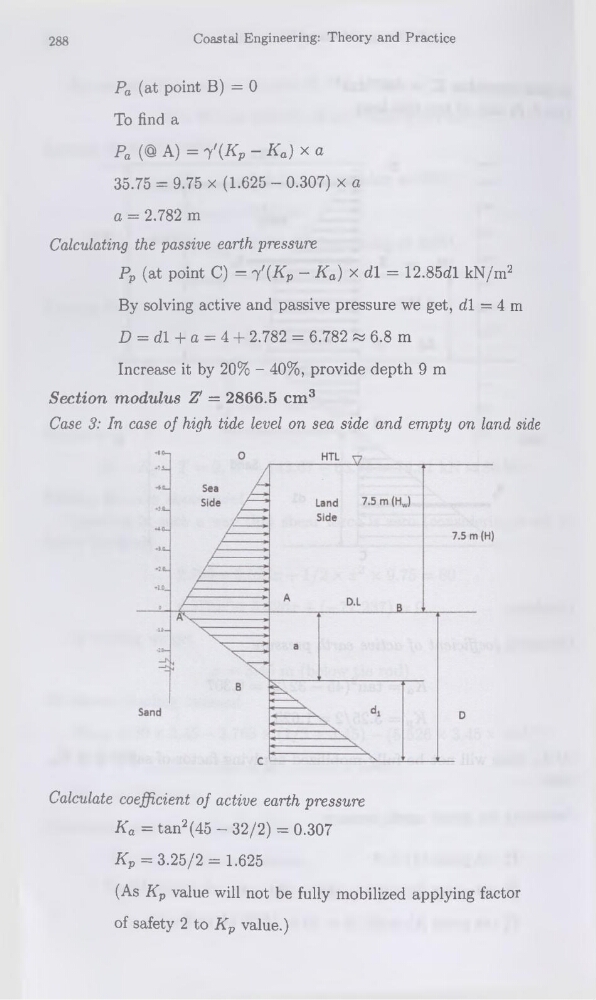
Case 3: In case of high tide level on sea side and empty on land side
Calculate coefficient of active earth pressure
Ka = tan2(45 - 32/2) = 0.307
Kp = 3.25/2 = 1.625
(As Kp value will not be fully mobilized applying factor
of safety 2 to Kp value.)
Coastal Engineering: Theory and Practice
Pa (at point B) = 0
To find a
Pa (@ A) = ffi(Kp -Ka) xa
35.75 = 9.75 x (1.625 - 0.307) x a
a = 2.782 m
Calculating the passive earth pressure
Pp (at point C) = ffi(Kp — Ka) x dl = 12.85dl kN/m2
By solving active and passive pressure we get, dl = 4 m
r) = dl+a = 4 + 2.782 = 6.782 « 6.8 m
Increase it by 20% - 40%, provide depth 9 m
Section modulus Z' = 2866.5 cm3
Case 3: In case of high tide level on sea side and empty on land side
Calculate coefficient of active earth pressure
Ka = tan2(45 - 32/2) = 0.307
Kp = 3.25/2 = 1.625
(As Kp value will not be fully mobilized applying factor
of safety 2 to Kp value.)