

278
Coastal Engineering: Theory and Practice
Hence, the structure should be designed for non-breaking wave condition
having a design wave height {Hdes) of 7 m.
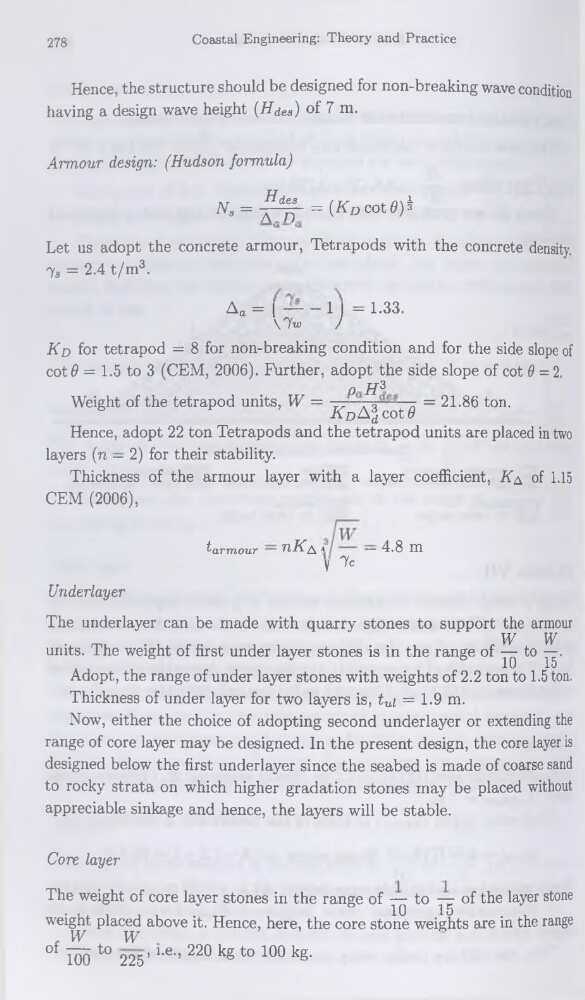
Armour design: (Hudson formula)
N, = )f%- = (KD col 8)*
Let us adopt the concrète armour, Tetrapods with the concrète density.
7s = 2.4 t/m3.
Aa = ( — — 1 ) = 1.33.
\7w
/
Kd for tetrapod = 8 for non-breaking condition and for the side slope of
cot# = 1.5 to 3 (CEM, 2006). Further, adopt the side slope of cot 0 = 2.
o H3
Weight of the tetrapod units, W =
„ = 21.86 ton.
6
ÆDA^cot0
Hence, adopt 22 ton Tetrapods and the tetrapod units are placed in two
layers (n — 2) for their stability.
Thickness of the armour layer with a layer coefficient, K& of 1.15
CEM (2006),
l
armour ~ nK^ \
— 4.8 m
y 7c
Underlayer
The underlayer can be made with quarry stones to support the armour
W
W
units. The weight of first under layer stones is in the range of — to —.
10
15
Adopt, the range of under layer stones with weights of 2.2 ton to 1.5 ton.
Thickness of under layer for two layers is, tui = 1.9 m.
Now, either the choice of adopting second underlayer or extending the
range of core layer may be designed. In the présent design, the core layer is
designed below the first underlayer since the seabed is made of coarse sand
to rocky strata on which higher gradation stones may be placed without
appréciable sinkage and hence, the layers will be stable.
Core layer
The weight of core layer stones in the range of — to — of the layer stone
• 1. 1 11
. TT
10
l^
• 1
weight placed above it. Hence, here, the core stone weights are m the range
.WW
°f ÏÔÔ t0 225’ Le-’ 220 kg to 100 kg-
Coastal Engineering: Theory and Practice
Hence, the structure should be designed for non-breaking wave condition
having a design wave height {Hdes) of 7 m.
Armour design: (Hudson formula)
N, = )f%- = (KD col 8)*
Let us adopt the concrète armour, Tetrapods with the concrète density.
7s = 2.4 t/m3.
Aa = ( — — 1 ) = 1.33.
\7w
/
Kd for tetrapod = 8 for non-breaking condition and for the side slope of
cot# = 1.5 to 3 (CEM, 2006). Further, adopt the side slope of cot 0 = 2.
o H3
Weight of the tetrapod units, W =
„ = 21.86 ton.
6
ÆDA^cot0
Hence, adopt 22 ton Tetrapods and the tetrapod units are placed in two
layers (n — 2) for their stability.
Thickness of the armour layer with a layer coefficient, K& of 1.15
CEM (2006),
l
armour ~ nK^ \
— 4.8 m
y 7c
Underlayer
The underlayer can be made with quarry stones to support the armour
W
W
units. The weight of first under layer stones is in the range of — to —.
10
15
Adopt, the range of under layer stones with weights of 2.2 ton to 1.5 ton.
Thickness of under layer for two layers is, tui = 1.9 m.
Now, either the choice of adopting second underlayer or extending the
range of core layer may be designed. In the présent design, the core layer is
designed below the first underlayer since the seabed is made of coarse sand
to rocky strata on which higher gradation stones may be placed without
appréciable sinkage and hence, the layers will be stable.
Core layer
The weight of core layer stones in the range of — to — of the layer stone
• 1. 1 11
. TT
10
l^
• 1
weight placed above it. Hence, here, the core stone weights are m the range
.WW
°f ÏÔÔ t0 225’ Le-’ 220 kg to 100 kg-