

7. Scour Around Marine Structures
213
7.2.3 Scour due to steady current
The principal flow feature and its situation can be described by considering
a circulai cylinder mounted normal to a plane surface. When the incoming
flow velocity is intercepted by the seabed, the flow velocity decreases from
a maximum at the free surface to zéro at the seabed due to the presence of
obstruction. This results in development of stagnation pressure (pwt/2/2)
that decreases with depth from the water surface. This pressure différence
drives the flow and causes a strong vertical fluid jet, which descends along
the upstream face of the obstruction (i.e. towards the decreasing velocity).
A recirculating eddy (primary vortex) is formed when the flow impinges
on the sea bed, the resulting vortex System wraps around the cylinder
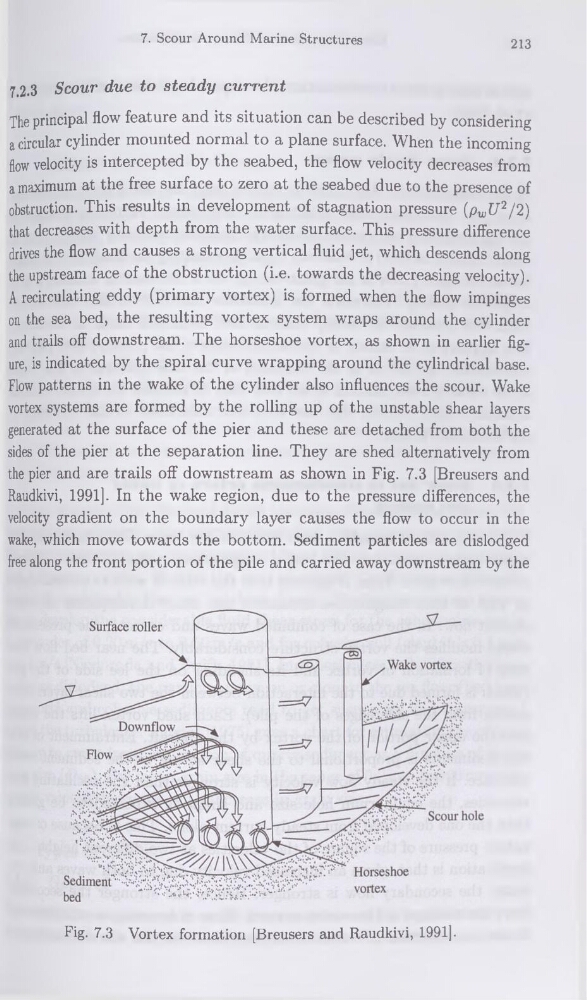
and trails off downstream. The horseshoe vortex, as shown in earlier figure, is indicated by the spiral curve wrapping around the cylindrical base.
Flow patterns in the wake of the cylinder also influences the scour. Wake
vortex Systems are formed by the rolling up of the unstable shear layers
generated at the surface of the pier and these are detached from both the
sides of the pier at the séparation line. They are shed alternatively from
the pier and are trails off downstream as shown in Fig. 7.3 [Breusers and
Raudkivi, 1991]. In the wake région, due to the pressure différences, the
velocity gradient on the boundary layer causes the flow to occur in the
wake, which move towards the bottom. Sédiment particles are dislodged
free along the front portion of the pile and carried away downstream by the
Fig. 7.3 Vortex formation [Breusers and Raudkivi, 1991].
213
7.2.3 Scour due to steady current
The principal flow feature and its situation can be described by considering
a circulai cylinder mounted normal to a plane surface. When the incoming
flow velocity is intercepted by the seabed, the flow velocity decreases from
a maximum at the free surface to zéro at the seabed due to the presence of
obstruction. This results in development of stagnation pressure (pwt/2/2)
that decreases with depth from the water surface. This pressure différence
drives the flow and causes a strong vertical fluid jet, which descends along
the upstream face of the obstruction (i.e. towards the decreasing velocity).
A recirculating eddy (primary vortex) is formed when the flow impinges
on the sea bed, the resulting vortex System wraps around the cylinder
and trails off downstream. The horseshoe vortex, as shown in earlier figure, is indicated by the spiral curve wrapping around the cylindrical base.
Flow patterns in the wake of the cylinder also influences the scour. Wake
vortex Systems are formed by the rolling up of the unstable shear layers
generated at the surface of the pier and these are detached from both the
sides of the pier at the séparation line. They are shed alternatively from
the pier and are trails off downstream as shown in Fig. 7.3 [Breusers and
Raudkivi, 1991]. In the wake région, due to the pressure différences, the
velocity gradient on the boundary layer causes the flow to occur in the
wake, which move towards the bottom. Sédiment particles are dislodged
free along the front portion of the pile and carried away downstream by the
Fig. 7.3 Vortex formation [Breusers and Raudkivi, 1991].