

6. Wave Run-up and Overtopping
203
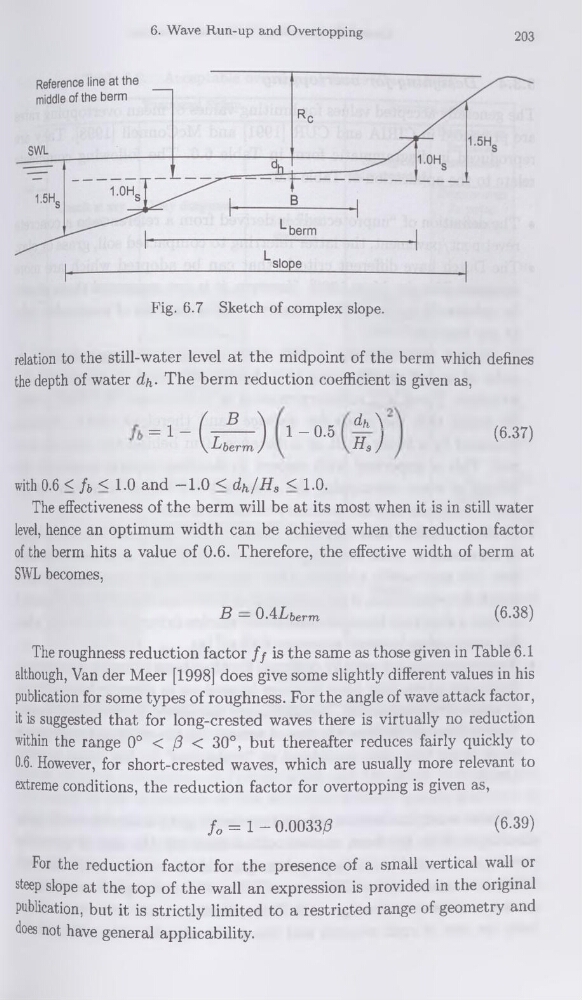
Fig. 6.7 Sketch of complex slope.
relation to the still-water level at the midpoint of the berm which defines
the depth of water dh- The berm réduction coefficient is given as,
1-0.5
dh\
Hs)
(6.37)
with 0.6 < fb < 1.0 and —1.0 < dh/Hs < 1.0.
The effectiveness of the berm will be at its most when it is in still water
level, hence an optimum width can be achieved when the réduction factor
of the berm hits a value of 0.6. Therefore, the effective width of berm at
SWL becomes,
B — 0.4:Lberm
(6.38)
The roughness réduction factor ff is the same as those given in Table 6.1
although, Van der Meer [1998] does give some slightly different values in his
publication for some types of roughness. For the angle of wave attack factor,
it is suggested that for long-crested waves there is virtually no réduction
within the range 0° < (3 < 30°, but thereafter reduces fairly quickly to
0.6. However, for short-crested waves, which are usually more relevant to
extreme conditions, the réduction factor for overtopping is given as,
fo = 1 - 0.0033/3
(6-39)
For the réduction factor for the presence of a small vertical wall or
steep slope at the top of the wall an expression is provided in the original
publication, but it is strictly limited to a restricted range of geometry and
does not hâve general applicability.
203
Fig. 6.7 Sketch of complex slope.
relation to the still-water level at the midpoint of the berm which defines
the depth of water dh- The berm réduction coefficient is given as,
1-0.5
dh\
Hs)
(6.37)
with 0.6 < fb < 1.0 and —1.0 < dh/Hs < 1.0.
The effectiveness of the berm will be at its most when it is in still water
level, hence an optimum width can be achieved when the réduction factor
of the berm hits a value of 0.6. Therefore, the effective width of berm at
SWL becomes,
B — 0.4:Lberm
(6.38)
The roughness réduction factor ff is the same as those given in Table 6.1
although, Van der Meer [1998] does give some slightly different values in his
publication for some types of roughness. For the angle of wave attack factor,
it is suggested that for long-crested waves there is virtually no réduction
within the range 0° < (3 < 30°, but thereafter reduces fairly quickly to
0.6. However, for short-crested waves, which are usually more relevant to
extreme conditions, the réduction factor for overtopping is given as,
fo = 1 - 0.0033/3
(6-39)
For the réduction factor for the presence of a small vertical wall or
steep slope at the top of the wall an expression is provided in the original
publication, but it is strictly limited to a restricted range of geometry and
does not hâve general applicability.