

190
Coastal Engineering: Theory and Practice
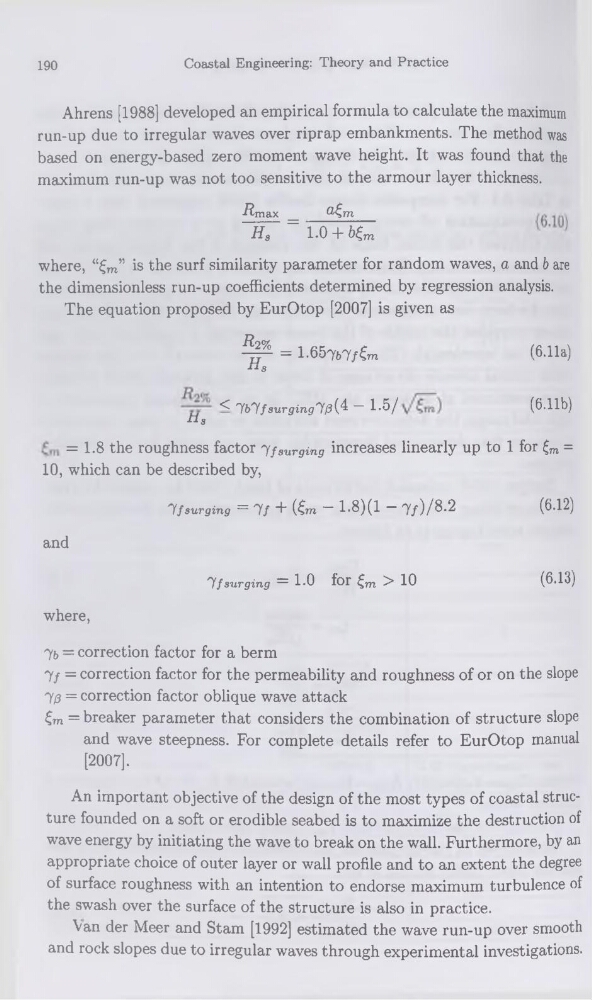
Ahrens [1988] developed an empirical formula to calculate the maximum
run-up due to irregular waves over riprap embankments. The method was
based on energy-based zéro moment wave height. It was found that the
maximum run-up was not too sensitive to the armour layer thickness.
■Rmax _
aCm
"HT “ l.O + ÔCm
where, “Cm” is the surf similarity parameter for random waves, a and b are
the dimensionless run-up coefficients determined by régression analysis.
The équation proposed by EurOtop [2007] is given as
4^ = 1.6571,7/U
(6.11a)
• “s
< 7k7/™rSi„97/î(4 - 1.5/
(6.11b)
H-s
= 1.8 the roughness factor ^fsurging increases linearly up to 1 for Cm =
10, which can be described by,
7fsurgin g = 7/ T (€m — 1-8)(1 — 7/)/8«2
(6-12)
and
7fsurging = 1-0 for Cm > 10
(6.13)
where,
7b = correction factor for a berm
7/ = correction factor for the permeability and roughness of or on the slope
7/3 = correction factor oblique wave attack
Cm = breaker parameter that considers the combination of structure slope
and wave steepness. For complété details refer to EurOtop manual
[2007].
An important objective of the design of the most types of coastal structure founded on a soft or erodible seabed is to maximize the destruction of
wave energy by initiating the wave to break on the wall. Furthermore, by an
appropriate choice of outer layer or wall profile and to an extent the degree
of surface roughness with an intention to endorse maximum turbulence of
the swash over the surface of the structure is also in practice.
Van der Meer and Stam [1992] estimated the wave run-up over smooth
and rock slopes due to irregular waves through experimental investigations.
Coastal Engineering: Theory and Practice
Ahrens [1988] developed an empirical formula to calculate the maximum
run-up due to irregular waves over riprap embankments. The method was
based on energy-based zéro moment wave height. It was found that the
maximum run-up was not too sensitive to the armour layer thickness.
■Rmax _
aCm
"HT “ l.O + ÔCm
where, “Cm” is the surf similarity parameter for random waves, a and b are
the dimensionless run-up coefficients determined by régression analysis.
The équation proposed by EurOtop [2007] is given as
4^ = 1.6571,7/U
(6.11a)
• “s
< 7k7/™rSi„97/î(4 - 1.5/
(6.11b)
H-s
= 1.8 the roughness factor ^fsurging increases linearly up to 1 for Cm =
10, which can be described by,
7fsurgin g = 7/ T (€m — 1-8)(1 — 7/)/8«2
(6-12)
and
7fsurging = 1-0 for Cm > 10
(6.13)
where,
7b = correction factor for a berm
7/ = correction factor for the permeability and roughness of or on the slope
7/3 = correction factor oblique wave attack
Cm = breaker parameter that considers the combination of structure slope
and wave steepness. For complété details refer to EurOtop manual
[2007].
An important objective of the design of the most types of coastal structure founded on a soft or erodible seabed is to maximize the destruction of
wave energy by initiating the wave to break on the wall. Furthermore, by an
appropriate choice of outer layer or wall profile and to an extent the degree
of surface roughness with an intention to endorse maximum turbulence of
the swash over the surface of the structure is also in practice.
Van der Meer and Stam [1992] estimated the wave run-up over smooth
and rock slopes due to irregular waves through experimental investigations.