

3. Sédiment Transport
87
Problem V
Based on LEO observations, the following values are assessed. Wave height,
Hsb = 1 m, longshore current velocity, Vleo = 0.20 m/s, width of surf zone,
W = 50 m and distance of dye patch from the shoreline is, X — 18 m. Find
longshore energy flux factor P[s.
Solution
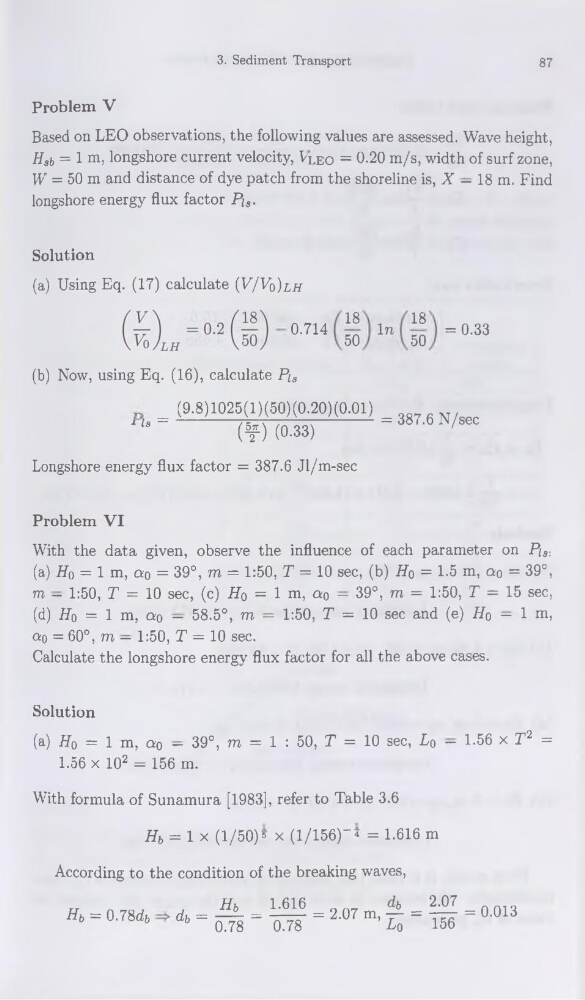
(a) Using Eq. (17) calculate (V/Vo)lh
0.714
18
50
In
18
50
= 0.33
(b) Now, using Eq. (16), calculate Pis
_ (9.8)1025(l)(50)(0.20)(0.01)
■Lis —
= 387.6 N/sec
(Ÿ) (0-33)
Longshore energy flux factor = 387.6 Jl/m-sec
Problem VI
With the data given, observe the influence of each parameter on P/s:
(a) Hq = 1 m, cto = 39°, m = 1:50, T = 10 sec, (b) Hq = 1.5 m, cto = 39°,
m — 1:50, T = 10 sec, (c) Hq = 1 m, cto — 39°, m = 1:50, T = 15 sec,
(d) Hq = 1 m, cto — 58.5°, m — 1:50, T = 10 sec and (e) Hq — 1 m,
cto = 60°, m — 1:50, T = 10 sec.
Calculate the longshore energy flux factor for ail the above cases.
Solution
(a) Hq = 1 m, cto — 39°, m = 1 : 50, T = 10 sec, Lq — 1.56 x T2 =
1.56 x 102 = 156 m.
With formula of Sunamura [1983], refer to Table 3.6
Hb = 1 x (1/50)* x (1/156)-* = 1.616 m
According to the condition of the breaking waves,
Hb = 0.78dt
4 = ^ = ^ = 2-07 m, g = ^ = 0.013
87
Problem V
Based on LEO observations, the following values are assessed. Wave height,
Hsb = 1 m, longshore current velocity, Vleo = 0.20 m/s, width of surf zone,
W = 50 m and distance of dye patch from the shoreline is, X — 18 m. Find
longshore energy flux factor P[s.
Solution
(a) Using Eq. (17) calculate (V/Vo)lh
0.714
18
50
In
18
50
= 0.33
(b) Now, using Eq. (16), calculate Pis
_ (9.8)1025(l)(50)(0.20)(0.01)
■Lis —
= 387.6 N/sec
(Ÿ) (0-33)
Longshore energy flux factor = 387.6 Jl/m-sec
Problem VI
With the data given, observe the influence of each parameter on P/s:
(a) Hq = 1 m, cto = 39°, m = 1:50, T = 10 sec, (b) Hq = 1.5 m, cto = 39°,
m — 1:50, T = 10 sec, (c) Hq = 1 m, cto — 39°, m = 1:50, T = 15 sec,
(d) Hq = 1 m, cto — 58.5°, m — 1:50, T = 10 sec and (e) Hq — 1 m,
cto = 60°, m — 1:50, T = 10 sec.
Calculate the longshore energy flux factor for ail the above cases.
Solution
(a) Hq = 1 m, cto — 39°, m = 1 : 50, T = 10 sec, Lq — 1.56 x T2 =
1.56 x 102 = 156 m.
With formula of Sunamura [1983], refer to Table 3.6
Hb = 1 x (1/50)* x (1/156)-* = 1.616 m
According to the condition of the breaking waves,
Hb = 0.78dt
4 = ^ = ^ = 2-07 m, g = ^ = 0.013