

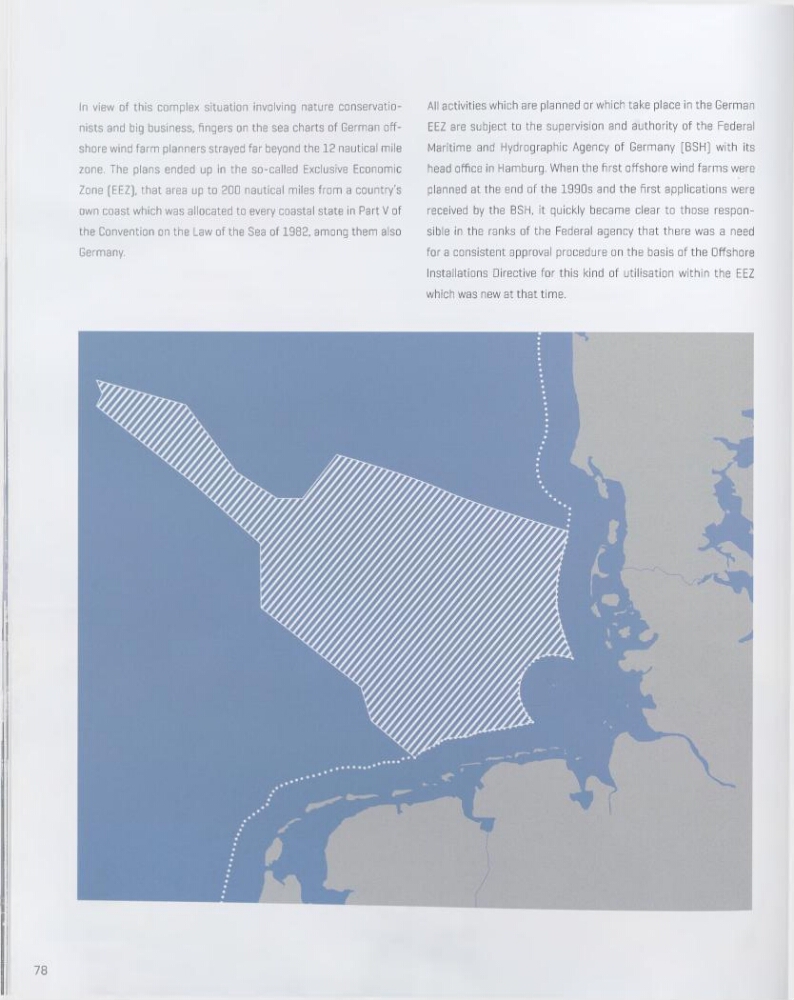
In view of this complex situation involving nature conservationists and big business, fingers on the sea charts of German offshore wind farm planners strayed far beyond the 12 nautical mile
zone. The plans ended up in the so-called Exclusive Economie
Zone [EEZ], that area up to 200 nautical miles from a country's
own coast which was allocated to every Coastal State in Part V of
the Convention on the Law of the Sea of 1982, among them also
Germany.
Ail activities which are planned orwhich take place in the German
EEZ are subject to the supervision and authority of the Fédéral
Maritime and Hydrographie Agency of Germany [BSH] with its
head office in Hamburg. When the first offshore wind farms were
planned at the end of the 1990s and the first applications were
received by the BSH, it quickly became clear to those responsible in the ranks of the Fédéral agency that there was a need
for a consistent approval procedure on the basis of the Offshore
Installations Directive for this kind of utilisation within the EEZ
which was new at that time.
78
zone. The plans ended up in the so-called Exclusive Economie
Zone [EEZ], that area up to 200 nautical miles from a country's
own coast which was allocated to every Coastal State in Part V of
the Convention on the Law of the Sea of 1982, among them also
Germany.
Ail activities which are planned orwhich take place in the German
EEZ are subject to the supervision and authority of the Fédéral
Maritime and Hydrographie Agency of Germany [BSH] with its
head office in Hamburg. When the first offshore wind farms were
planned at the end of the 1990s and the first applications were
received by the BSH, it quickly became clear to those responsible in the ranks of the Fédéral agency that there was a need
for a consistent approval procedure on the basis of the Offshore
Installations Directive for this kind of utilisation within the EEZ
which was new at that time.
78