

The Large-Scale Thermohaline Structure of the Ross Gyre
83
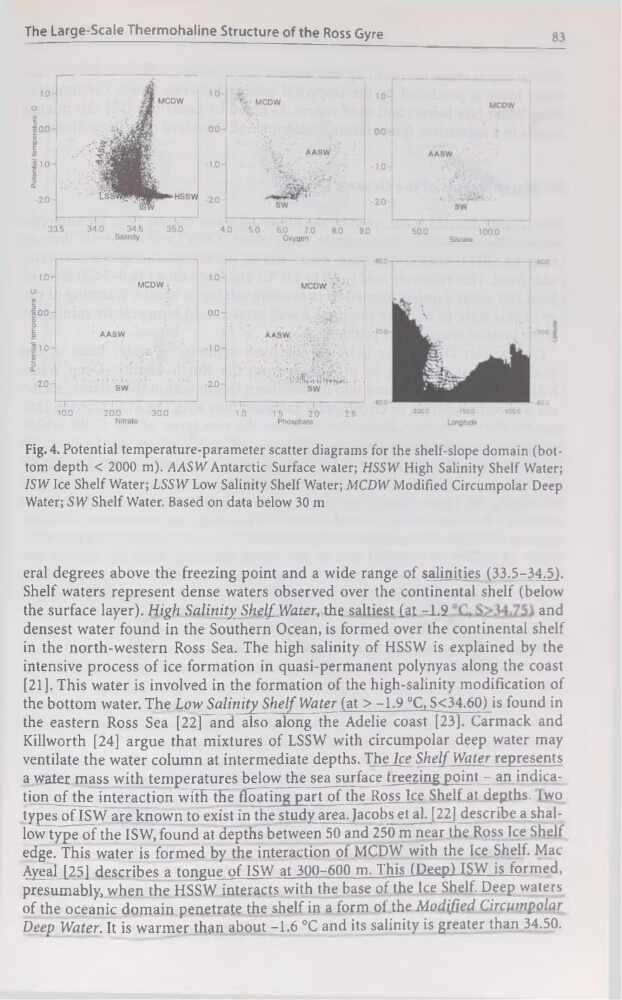
Fig. 4. Potential temperature-parameter scatter diagrams for the shelf-slope domain (bottom depth < 2000 m). AASW Antarctic Surface water; HSSW High Salinity Shelf Water;
ISW Ice Shelf Water; LSSW Low Salinity Shelf Water; MCDW Modified Circumpolar Deep
Water; SW Shelf Water. Based on data below 30 m
eral degrees above the freezing point and a wide range of salinities (33.5-34.5).
Shelf waters represent dense waters observed over the continental shelf (below
the surface layer). High Salinity Shelf Water, the saltiest fat -1.9
and
densest water found in the Southern Océan, is formed over the continental shelf
in the north-western Ross Sea. The high salinity of HSSW is explained by the
intensive process of ice formation in quasi-permanent polynyas along the coast
[21]. This water is involved in the formation of the high-salinity modification of
the bottom water. The Low Salinity Shelf Water (at > -1.9 °C, S<34.60) is found in
the eastern Ross Sea [22] and also along the Adelie coast [23]. Carmack and
Killworth [24] argue that mixtures of LSSW with circumpolar deep water may
ventilate the water column at intermediate depths. The Ice Shelf Water represents
a.water mass with températures below the sea surface treezing point - an indication of the interaction with the floating part of the Ross Ice Shelf at depths. Iwo
types of ISW are known to exist in the study area. Jacobs et al. [22] describe a shallow type of the ISW, found at depths between 50 and 250 m near the Ross Ice Shelf
edge. This water is formed by the interaction of MCDW with the Ice Shelf. Mac
Ayeal [25] describes a tongue of ISW at 300-600 m. This (De£pXJSWJs_formed,
presumably, when the HSSW interacts with the base of the Ice Shelf. Deep waters
of the oceanic domain penetrate the shelf in a form of the Modified Circiitnpolar
Deep Water. It is warmer than about -1.6 °C and its salinity is greater than 34.50.
83
Fig. 4. Potential temperature-parameter scatter diagrams for the shelf-slope domain (bottom depth < 2000 m). AASW Antarctic Surface water; HSSW High Salinity Shelf Water;
ISW Ice Shelf Water; LSSW Low Salinity Shelf Water; MCDW Modified Circumpolar Deep
Water; SW Shelf Water. Based on data below 30 m
eral degrees above the freezing point and a wide range of salinities (33.5-34.5).
Shelf waters represent dense waters observed over the continental shelf (below
the surface layer). High Salinity Shelf Water, the saltiest fat -1.9
and
densest water found in the Southern Océan, is formed over the continental shelf
in the north-western Ross Sea. The high salinity of HSSW is explained by the
intensive process of ice formation in quasi-permanent polynyas along the coast
[21]. This water is involved in the formation of the high-salinity modification of
the bottom water. The Low Salinity Shelf Water (at > -1.9 °C, S<34.60) is found in
the eastern Ross Sea [22] and also along the Adelie coast [23]. Carmack and
Killworth [24] argue that mixtures of LSSW with circumpolar deep water may
ventilate the water column at intermediate depths. The Ice Shelf Water represents
a.water mass with températures below the sea surface treezing point - an indication of the interaction with the floating part of the Ross Ice Shelf at depths. Iwo
types of ISW are known to exist in the study area. Jacobs et al. [22] describe a shallow type of the ISW, found at depths between 50 and 250 m near the Ross Ice Shelf
edge. This water is formed by the interaction of MCDW with the Ice Shelf. Mac
Ayeal [25] describes a tongue of ISW at 300-600 m. This (De£pXJSWJs_formed,
presumably, when the HSSW interacts with the base of the Ice Shelf. Deep waters
of the oceanic domain penetrate the shelf in a form of the Modified Circiitnpolar
Deep Water. It is warmer than about -1.6 °C and its salinity is greater than 34.50.