

Mapping the Thickness of Pancake Ice Using Océan Wave Dispersion...
33
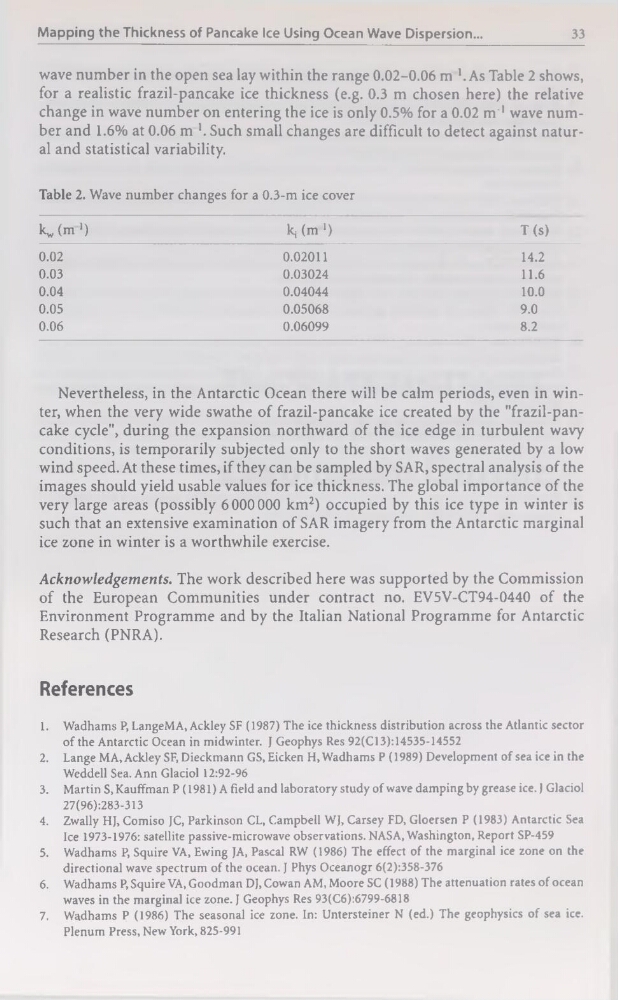
wave number in the open sea lay within the range 0.02-0.06 m1. As Table 2 shows,
for a realistic frazil-pancake ice thickness (e.g. 0.3 m chosen here) the relative
change in wave number on entering the ice is only 0.5% for a 0.02 m'1 wave number and 1.6% at 0.06 m1. Such small changes are difficult to detect against natural and statistical variability.
Table 2. Wave number changes for a 0.3-m ice cover
kw (m1)
Mm1)
T (s)
0.02
0.03
0.04
0.05
0.06
0.02011
14.2
0.03024
11.6
0.04044
10.0
0.05068
9.0
0.06099
8.2
Nevertheless, in the Antarctic Océan there will be calm periods, even in winter, when the very wide swathe of frazil-pancake ice created by the "frazil-pancake cycle", during the expansion northward of the ice edge in turbulent wavy
conditions, is temporarily subjected only to the short waves generated by a low
wind speed. At these times, if they can be sampled by SAR, spectral analysis of the
images should yield usable values for ice thickness. The global importance of the
very large areas (possibly 6000000 km2) occupied by this ice type in winter is
such that an extensive examination of SAR imagery from the Antarctic marginal
ice zone in winter is a worthwhile exercise.
Acknowledgements. The work described here was supported by the Commission
of the European Communities under contract no. EV5V-CT94-0440 of the
Environment Programme and by the Italian National Programme for Antarctic
Research (PNRA).
References
1. Wadhams P, LangeMA, Ackley SF (1987) The ice thickness distribution across the Atlantic sector
of the Antarctic Océan in midwinter. J Geophys Res 92(C13): 14535-14552
2. Lange MA, Ackley SF, Dieckmann GS, Eicken H, Wadhams P (1989) Development of sea ice in the
Weddell Sea. Ann Glaciol 12:92-96
3. Martin S, Kauffman P ( 1981 ) A field and laboratory study of wave damping by grease ice. ] Glaciol
27(96):283-313
4. Zwally HJ, Comiso JC, Parkinson CL, Campbell WJ, Carsey FD, Gloersen P (1983) Antarctic Sea
Ice 1973-1976: satellite passive-microwave observations. NASA, Washington, Report SP-459
5. Wadhams P, Squire VA, Ewing JA, Pascal RW (1986) The effect of the marginal ice zone on the
directional wave spectrum of the océan. J Phys Oceanogr 6(2):358-376
6. Wadhams P, Squire VA, Goodman DJ, Cowan AM, Moore SC (1988) The atténuation rates of océan
waves in the marginal ice zone. J Geophys Res 93(C6):6799-6818
7. Wadhams P (1986) The seasonal ice zone. In: Untersteiner N (ed.) The geophysics of sea ice.
Plénum Press, New York, 825-991
33
wave number in the open sea lay within the range 0.02-0.06 m1. As Table 2 shows,
for a realistic frazil-pancake ice thickness (e.g. 0.3 m chosen here) the relative
change in wave number on entering the ice is only 0.5% for a 0.02 m'1 wave number and 1.6% at 0.06 m1. Such small changes are difficult to detect against natural and statistical variability.
Table 2. Wave number changes for a 0.3-m ice cover
kw (m1)
Mm1)
T (s)
0.02
0.03
0.04
0.05
0.06
0.02011
14.2
0.03024
11.6
0.04044
10.0
0.05068
9.0
0.06099
8.2
Nevertheless, in the Antarctic Océan there will be calm periods, even in winter, when the very wide swathe of frazil-pancake ice created by the "frazil-pancake cycle", during the expansion northward of the ice edge in turbulent wavy
conditions, is temporarily subjected only to the short waves generated by a low
wind speed. At these times, if they can be sampled by SAR, spectral analysis of the
images should yield usable values for ice thickness. The global importance of the
very large areas (possibly 6000000 km2) occupied by this ice type in winter is
such that an extensive examination of SAR imagery from the Antarctic marginal
ice zone in winter is a worthwhile exercise.
Acknowledgements. The work described here was supported by the Commission
of the European Communities under contract no. EV5V-CT94-0440 of the
Environment Programme and by the Italian National Programme for Antarctic
Research (PNRA).
References
1. Wadhams P, LangeMA, Ackley SF (1987) The ice thickness distribution across the Atlantic sector
of the Antarctic Océan in midwinter. J Geophys Res 92(C13): 14535-14552
2. Lange MA, Ackley SF, Dieckmann GS, Eicken H, Wadhams P (1989) Development of sea ice in the
Weddell Sea. Ann Glaciol 12:92-96
3. Martin S, Kauffman P ( 1981 ) A field and laboratory study of wave damping by grease ice. ] Glaciol
27(96):283-313
4. Zwally HJ, Comiso JC, Parkinson CL, Campbell WJ, Carsey FD, Gloersen P (1983) Antarctic Sea
Ice 1973-1976: satellite passive-microwave observations. NASA, Washington, Report SP-459
5. Wadhams P, Squire VA, Ewing JA, Pascal RW (1986) The effect of the marginal ice zone on the
directional wave spectrum of the océan. J Phys Oceanogr 6(2):358-376
6. Wadhams P, Squire VA, Goodman DJ, Cowan AM, Moore SC (1988) The atténuation rates of océan
waves in the marginal ice zone. J Geophys Res 93(C6):6799-6818
7. Wadhams P (1986) The seasonal ice zone. In: Untersteiner N (ed.) The geophysics of sea ice.
Plénum Press, New York, 825-991