

262
S. Ferrarese et al.
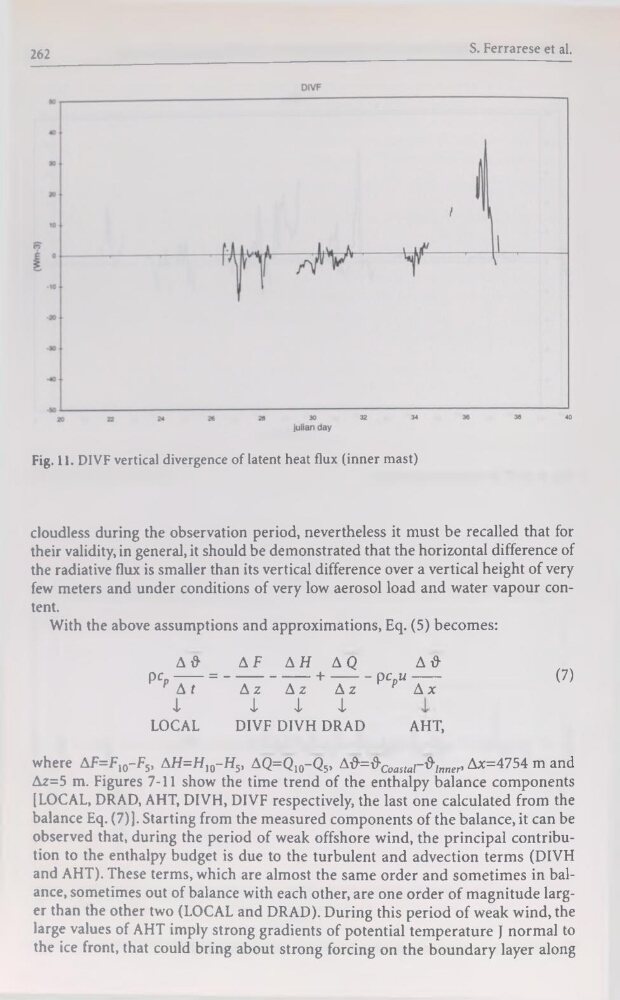
Fig. 11. DIVF vertical divergence of latent heat flux (inner mast)
cloudless during the observation period, nevertheless it must be recalled that for
their validity, in general, it should be demonstrated that the horizontal différence of
the radiative flux is smaller than its vertical différence over a vertical height of very
few meters and under conditions of very low aérosol load and water vapour content.
With the above assumptions and approximations, Eq. (5) becomes:
Ad
PG,----- =
AF
AH AQ
----------------- 1-------Ad
pCpU ----(7)
p A t
A z
A z
A z
p àx
X
4^
J.
Jz
LOCAL
DIVF DIVH DRAD
AHT,
where AF=F10-F5, &H=H}Q-H5, AQ=Q10-Q5, Ad=dCoas(a/-d/nner, Ax=4754 m and
Az=5 m. Figures 7-11 show the time trend of the enthalpy balance components
[LOCAL, DRAD, AHT, DIVH, DIVF respectively, the last one calculated from the
balance Eq. (7)]. Starting from the measured components of the balance, it can be
observed that, during the period of weak offshore wind, the principal contribution to the enthalpy budget is due to the turbulent and advection terms (DIVH
and AHT). These terms, which are almost the same order and sometimes in balance, sometimes out of balance with each other, are one order of magnitude larger than the other two (LOCAL and DRAD). During this period of weak wind, the
large values of AHT imply strong gradients of potential température J normal to
the ice front, that could bring about strong forcing on the boundary layer along
S. Ferrarese et al.
Fig. 11. DIVF vertical divergence of latent heat flux (inner mast)
cloudless during the observation period, nevertheless it must be recalled that for
their validity, in general, it should be demonstrated that the horizontal différence of
the radiative flux is smaller than its vertical différence over a vertical height of very
few meters and under conditions of very low aérosol load and water vapour content.
With the above assumptions and approximations, Eq. (5) becomes:
Ad
PG,----- =
AF
AH AQ
----------------- 1-------Ad
pCpU ----(7)
p A t
A z
A z
A z
p àx
X
4^
J.
Jz
LOCAL
DIVF DIVH DRAD
AHT,
where AF=F10-F5, &H=H}Q-H5, AQ=Q10-Q5, Ad=dCoas(a/-d/nner, Ax=4754 m and
Az=5 m. Figures 7-11 show the time trend of the enthalpy balance components
[LOCAL, DRAD, AHT, DIVH, DIVF respectively, the last one calculated from the
balance Eq. (7)]. Starting from the measured components of the balance, it can be
observed that, during the period of weak offshore wind, the principal contribution to the enthalpy budget is due to the turbulent and advection terms (DIVH
and AHT). These terms, which are almost the same order and sometimes in balance, sometimes out of balance with each other, are one order of magnitude larger than the other two (LOCAL and DRAD). During this period of weak wind, the
large values of AHT imply strong gradients of potential température J normal to
the ice front, that could bring about strong forcing on the boundary layer along