

Thermohaline Data and Océan Circulation on the Ross Sea Continental Shelf
13
nated from summer température and salinity measurements. MCDW may
extend for some distance beneath the ice shelf, as current measurements accompanying the stations in Fig. 4a revealed inflow and outflow, respectively, in the
eastern and western “cores” defined by the -1.2 °C contours. This recirculation
appears to be persistent, and may account for a slight thinning of the ice shelf in
this région [10,16].
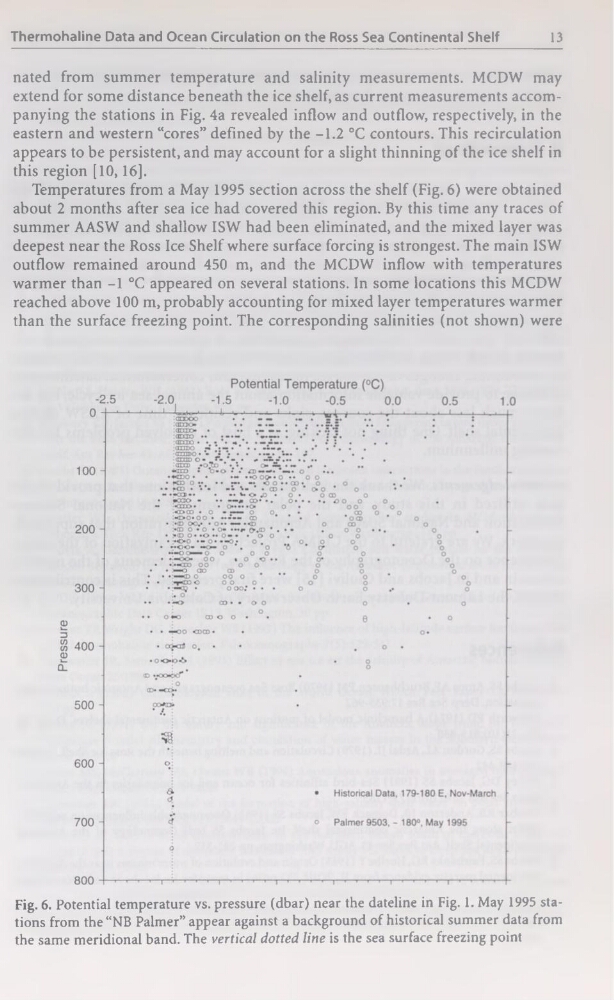
Températures from a May 1995 section across the shelf (Fig. 6) were obtained
about 2 months after sea ice had covered this région. By this time any traces of
summer AASW and shallow ISW had been eliminated, and the mixed layer was
deepest near the Ross Ice Shelf where surface forcing is strongest. The main ISW
outflow remained around 450 m, and the MCDW inflow with températures
warmer than -1 °C appeared on several stations. In some locations this MCDW
reached above 100 m, probably accounting for mixed layer températures warmer
than the surface freezing point. The corresponding salinities (not shown) were
Fig. 6. Potential température vs. pressure (dbar) near the dateline in Fig. 1. May 1995 stations from the “NB Palmer” appear against a background of historical summer data from
the same méridional band. The vertical dotted line is the sea surface freezing point
13
nated from summer température and salinity measurements. MCDW may
extend for some distance beneath the ice shelf, as current measurements accompanying the stations in Fig. 4a revealed inflow and outflow, respectively, in the
eastern and western “cores” defined by the -1.2 °C contours. This recirculation
appears to be persistent, and may account for a slight thinning of the ice shelf in
this région [10,16].
Températures from a May 1995 section across the shelf (Fig. 6) were obtained
about 2 months after sea ice had covered this région. By this time any traces of
summer AASW and shallow ISW had been eliminated, and the mixed layer was
deepest near the Ross Ice Shelf where surface forcing is strongest. The main ISW
outflow remained around 450 m, and the MCDW inflow with températures
warmer than -1 °C appeared on several stations. In some locations this MCDW
reached above 100 m, probably accounting for mixed layer températures warmer
than the surface freezing point. The corresponding salinities (not shown) were
Fig. 6. Potential température vs. pressure (dbar) near the dateline in Fig. 1. May 1995 stations from the “NB Palmer” appear against a background of historical summer data from
the same méridional band. The vertical dotted line is the sea surface freezing point