

228
S. Gremes Cordero, E. Salusti
density différence A. After some time, e can no longer be considered nil. So one
is led to investigate perturbative solutions of Eq. (4) in e and v such as
h' = f(x-Vt, Et) = f(y, Et) with y = x -Vt.
(5)
Using the following substitutions [2]
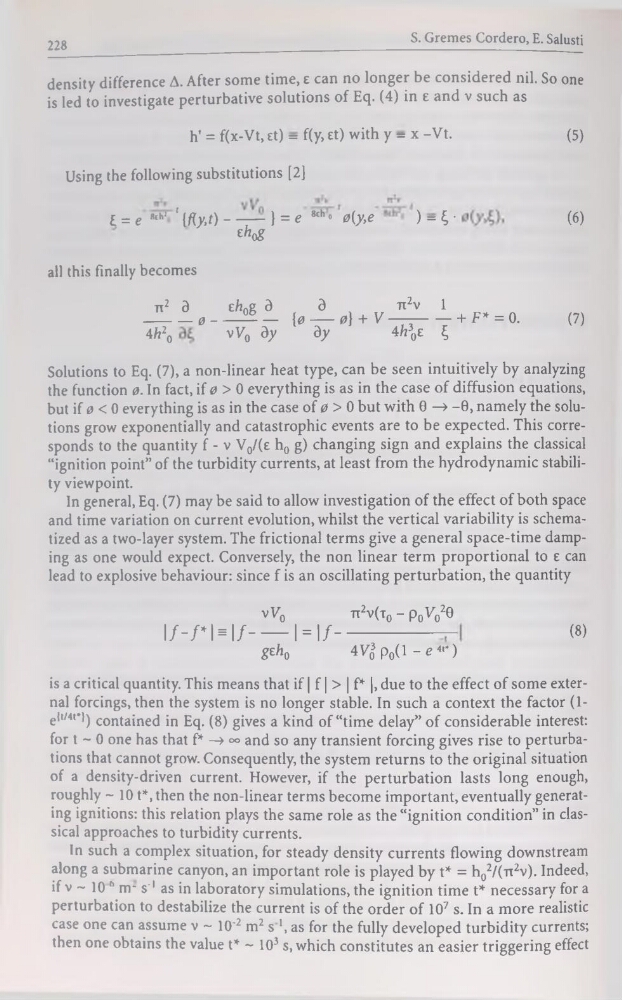
£ = e 8th: ' {fty.t)------ - } = e 8àl° 0(y>e
) = § '
(6)
^og
ail this finally becomes
tt2 d
eM ô
--------------------- 0
4h2o-------- Wo ôy
d
{0---- 0} + V
dy
tt2v
4/i30e
1
— + F* = 0.
§
(7)
Solutions to Eq. (7), a non-linear heat type, can be seen intuitively by analyzing
the function 0. In fact, if 0 > 0 everything is as in the case of diffusion équations,
but if 0 < 0 everything is as in the case of 0 > 0 but with 6 -» -0, namely the solutions grow exponentially and catastrophic events are to be expected. This corresponds to the quantity f - v V0/(e h0 g) changing sign and explains the classical
“ignition point” of the turbidity currents, at least from the hydrodynamic stability viewpoint.
In general, Eq. (7) may be said to allow investigation of the effect of both space
and time variation on current évolution, whilst the vertical variability is schematized as a two-layer System. The frictional terms give a general space-time damping as one would expect. Conversely, the non linear term proportional to e can
lead to explosive behaviour: since f is an oscillating perturbation, the quantity
vV0
tt2v(t0 - p0V026
If-/* h I/- — I = 1/------------- -
gE/i0
4V0 3 p0(l - e4t’)
(8)
is a critical quantity. This means that if | f | > | f* |, due to the effect of some external forcings, then the System is no longer stable. In such a context the factor (1e,t/4t’1) contained in Eq. (8) gives a kind of “time delay” of considérable interest:
for t ~ 0 one has that f* —» æ and so any transient forcing gives rise to perturbations that cannot grow. Consequently, the System returns to the original situation
of a density-driven current. However, if the perturbation lasts long enough,
roughly ~ 10 t*,then the non-linear terms become important, eventually generating ignitions: this relation plays the same rôle as the “ignition condition” in classical approaches to turbidity currents.
In such a complex situation, for steady density currents flowing downstream
along a submarine canyon, an important rôle is played by t* = h02/(n2v). Indeed,
if v ~ 10 6 m- s’1 as in laboratory simulations, the ignition time t* necessary for a
perturbation to destabilize the current is of the order of 107 s. In a more realistic
case one can assume v ~ 10‘2 m2 s1, as for the fully developed turbidity currents;
then one obtains the value t* ~ 103 s, which constitutes an easier triggering effect
S. Gremes Cordero, E. Salusti
density différence A. After some time, e can no longer be considered nil. So one
is led to investigate perturbative solutions of Eq. (4) in e and v such as
h' = f(x-Vt, Et) = f(y, Et) with y = x -Vt.
(5)
Using the following substitutions [2]
£ = e 8th: ' {fty.t)------ - } = e 8àl° 0(y>e
) = § '
(6)
^og
ail this finally becomes
tt2 d
eM ô
--------------------- 0
4h2o-------- Wo ôy
d
{0---- 0} + V
dy
tt2v
4/i30e
1
— + F* = 0.
§
(7)
Solutions to Eq. (7), a non-linear heat type, can be seen intuitively by analyzing
the function 0. In fact, if 0 > 0 everything is as in the case of diffusion équations,
but if 0 < 0 everything is as in the case of 0 > 0 but with 6 -» -0, namely the solutions grow exponentially and catastrophic events are to be expected. This corresponds to the quantity f - v V0/(e h0 g) changing sign and explains the classical
“ignition point” of the turbidity currents, at least from the hydrodynamic stability viewpoint.
In general, Eq. (7) may be said to allow investigation of the effect of both space
and time variation on current évolution, whilst the vertical variability is schematized as a two-layer System. The frictional terms give a general space-time damping as one would expect. Conversely, the non linear term proportional to e can
lead to explosive behaviour: since f is an oscillating perturbation, the quantity
vV0
tt2v(t0 - p0V026
If-/* h I/- — I = 1/------------- -
gE/i0
4V0 3 p0(l - e4t’)
(8)
is a critical quantity. This means that if | f | > | f* |, due to the effect of some external forcings, then the System is no longer stable. In such a context the factor (1e,t/4t’1) contained in Eq. (8) gives a kind of “time delay” of considérable interest:
for t ~ 0 one has that f* —» æ and so any transient forcing gives rise to perturbations that cannot grow. Consequently, the System returns to the original situation
of a density-driven current. However, if the perturbation lasts long enough,
roughly ~ 10 t*,then the non-linear terms become important, eventually generating ignitions: this relation plays the same rôle as the “ignition condition” in classical approaches to turbidity currents.
In such a complex situation, for steady density currents flowing downstream
along a submarine canyon, an important rôle is played by t* = h02/(n2v). Indeed,
if v ~ 10 6 m- s’1 as in laboratory simulations, the ignition time t* necessary for a
perturbation to destabilize the current is of the order of 107 s. In a more realistic
case one can assume v ~ 10‘2 m2 s1, as for the fully developed turbidity currents;
then one obtains the value t* ~ 103 s, which constitutes an easier triggering effect