

216
M. Ravaioli et al.
Sites
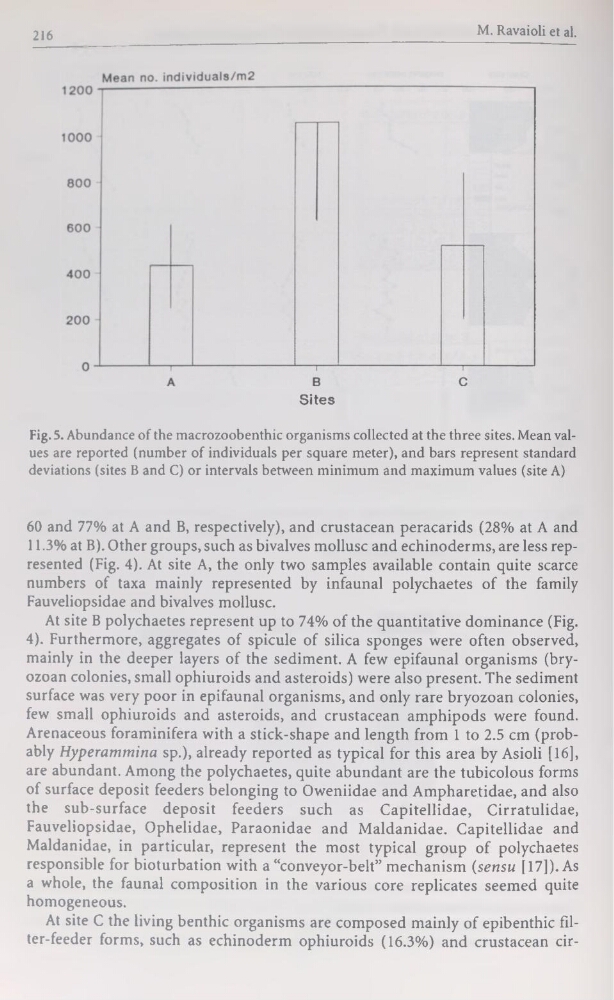
Fig. 5. Abundance of the macrozoobenthic organisms collected at the three sites. Mean values are reported (number of individuals per square meter), and bars represent standard
déviations (sites B and C) or intervals between minimum and maximum values (site A)
60 and 77% at A and B, respectively), and crustacean peracarids (28% at A and
11.3% at B). Other groups, such as bivalves mollusc and echinoderms, are less represented (Fig. 4). At site A, the only two samples available contain quite scarce
numbers of taxa mainly represented by infaunal polychaetes of the family
Fauveliopsidae and bivalves mollusc.
At site B polychaetes represent up to 74% of the quantitative dominance (Fig.
4). Furthermore, aggregates of spiculé of silica sponges were often observed,
mainly in the deeper layers of the sédiment. A few epifaunal organisms (bryozoan colonies, small ophiuroids and asteroids) were also présent. The sédiment
surface was very poor in epifaunal organisms, and only rare bryozoan colonies,
few small ophiuroids and asteroids, and crustacean amphipods were found.
Arenaceous foraminifera with a stick-shape and length from 1 to 2.5 cm (probably Hyperammina sp.), already reported as typical for this area by Asioli [16],
are abundant. Among the polychaetes, quite abundant are the tubicolous forms
of surface deposit feeders belonging to Oweniidae and Ampharetidae, and also
the sub-surface deposit feeders such as Capitellidae, Cirratulidae,
Fauveliopsidae, Ophelidae, Paraonidae and Maldanidae. Capitellidae and
Maldanidae, in particular, represent the most typical group of polychaetes
responsible for bioturbation with a “conveyor-belt” mechanism (sensu [17]). As
a whole, the faunal composition in the various core replicates seemed quite
homogeneous.
At site C the living benthic organisms are composed mainly of epibenthic filter-feeder forms, such as echinoderm ophiuroids (16.3%) and crustacean cir-
M. Ravaioli et al.
Sites
Fig. 5. Abundance of the macrozoobenthic organisms collected at the three sites. Mean values are reported (number of individuals per square meter), and bars represent standard
déviations (sites B and C) or intervals between minimum and maximum values (site A)
60 and 77% at A and B, respectively), and crustacean peracarids (28% at A and
11.3% at B). Other groups, such as bivalves mollusc and echinoderms, are less represented (Fig. 4). At site A, the only two samples available contain quite scarce
numbers of taxa mainly represented by infaunal polychaetes of the family
Fauveliopsidae and bivalves mollusc.
At site B polychaetes represent up to 74% of the quantitative dominance (Fig.
4). Furthermore, aggregates of spiculé of silica sponges were often observed,
mainly in the deeper layers of the sédiment. A few epifaunal organisms (bryozoan colonies, small ophiuroids and asteroids) were also présent. The sédiment
surface was very poor in epifaunal organisms, and only rare bryozoan colonies,
few small ophiuroids and asteroids, and crustacean amphipods were found.
Arenaceous foraminifera with a stick-shape and length from 1 to 2.5 cm (probably Hyperammina sp.), already reported as typical for this area by Asioli [16],
are abundant. Among the polychaetes, quite abundant are the tubicolous forms
of surface deposit feeders belonging to Oweniidae and Ampharetidae, and also
the sub-surface deposit feeders such as Capitellidae, Cirratulidae,
Fauveliopsidae, Ophelidae, Paraonidae and Maldanidae. Capitellidae and
Maldanidae, in particular, represent the most typical group of polychaetes
responsible for bioturbation with a “conveyor-belt” mechanism (sensu [17]). As
a whole, the faunal composition in the various core replicates seemed quite
homogeneous.
At site C the living benthic organisms are composed mainly of epibenthic filter-feeder forms, such as echinoderm ophiuroids (16.3%) and crustacean cir-