

Particle Fluxes at the Edge of the Ross Ice Shelf: the Rôle of Physical Forcing
191
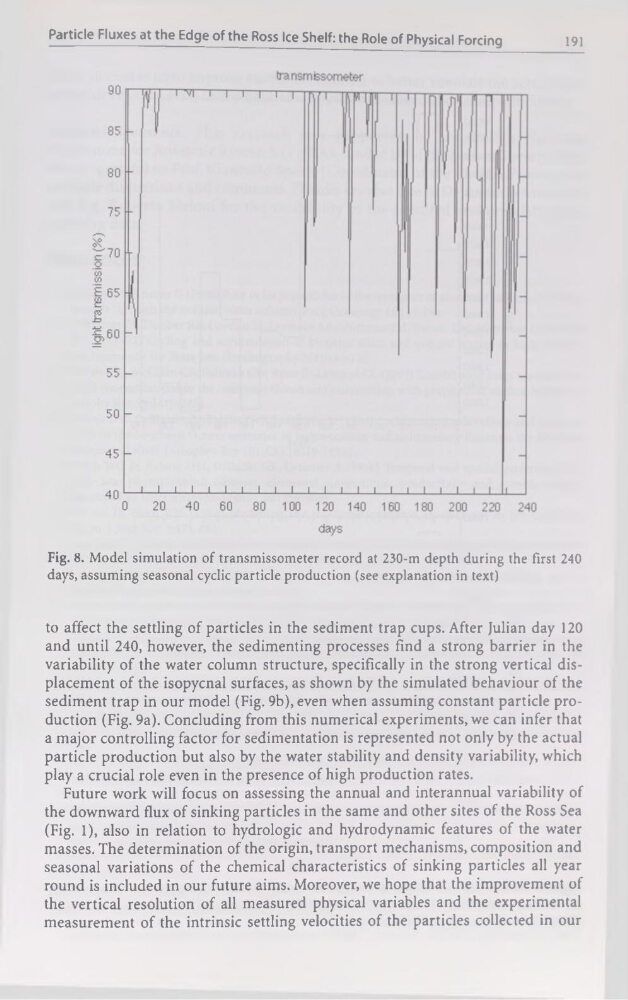
Fig. 8. Model simulation of transmissometer record at 230-m depth during the first 240
days, assuming seasonal cyclic particle production (see explanation in text)
to affect the settling of particles in the sédiment trap cups. After Julian day 120
and until 240, however, the sedimenting processes find a strong barrier in the
variability of the water column structure, specifically in the strong vertical displacement of the isopycnal surfaces, as shown by the simulated behaviour of the
sédiment trap in our model (Fig. 9b), even when assuming constant particle production (Fig. 9a). Concluding from this numerical experiments, we can infer that
a major controlling factor for sédimentation is represented not only by the actual
particle production but also by the water stability and density variability, which
play a crucial rôle even in the presence of high production rates.
Future work will focus on assessing the annual and interannual variability of
the downward flux of sinking particles in the same and other sites of the Ross Sea
(Fig. 1), also in relation to hydrologie and hydrodynamic features of the water
masses. The détermination of the origin, transport mechanisms, composition and
seasonal variations of the Chemical characteristics of sinking particles ail year
round is included in our future aims. Moreover, we hope that the improvement of
the vertical resolution of ail measured physical variables and the experimental
measurement of the intrinsic settling velocities of the particles collected in our
191
Fig. 8. Model simulation of transmissometer record at 230-m depth during the first 240
days, assuming seasonal cyclic particle production (see explanation in text)
to affect the settling of particles in the sédiment trap cups. After Julian day 120
and until 240, however, the sedimenting processes find a strong barrier in the
variability of the water column structure, specifically in the strong vertical displacement of the isopycnal surfaces, as shown by the simulated behaviour of the
sédiment trap in our model (Fig. 9b), even when assuming constant particle production (Fig. 9a). Concluding from this numerical experiments, we can infer that
a major controlling factor for sédimentation is represented not only by the actual
particle production but also by the water stability and density variability, which
play a crucial rôle even in the presence of high production rates.
Future work will focus on assessing the annual and interannual variability of
the downward flux of sinking particles in the same and other sites of the Ross Sea
(Fig. 1), also in relation to hydrologie and hydrodynamic features of the water
masses. The détermination of the origin, transport mechanisms, composition and
seasonal variations of the Chemical characteristics of sinking particles ail year
round is included in our future aims. Moreover, we hope that the improvement of
the vertical resolution of ail measured physical variables and the experimental
measurement of the intrinsic settling velocities of the particles collected in our