

188
A. Accornero et al.
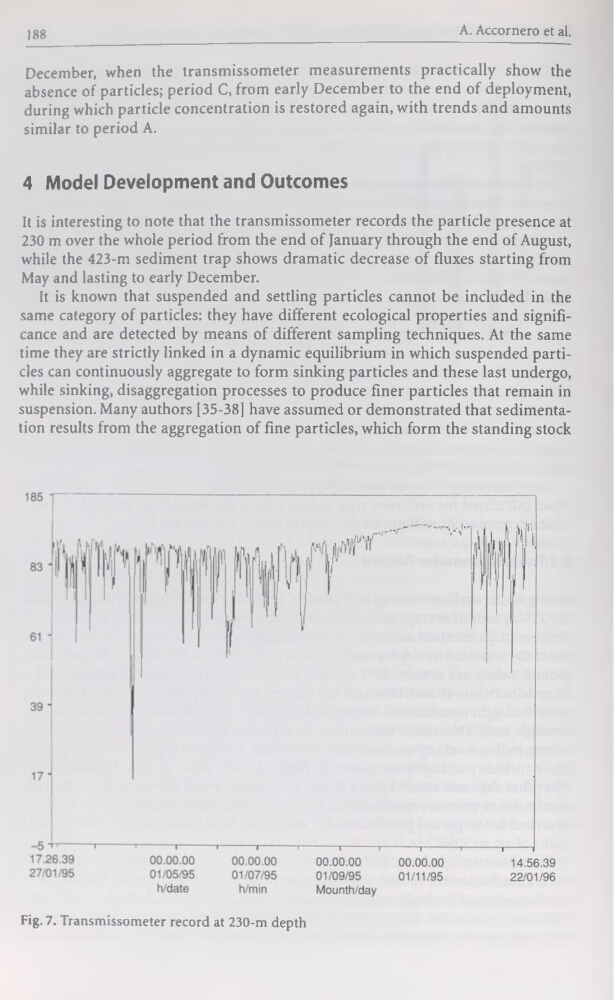
December, when the transmissometer measurements practically show the
absence of particles; period C, from early December to the end of deployment,
during which particle concentration is restored again, with trends and amounts
similar to period A.
4 Model Development and Outcomes
It is interesting to note that the transmissometer records the particle presence at
230 m over the whole period from the end of January through the end of August,
while the 423-m sédiment trap shows dramatic decrease of fluxes starting from
May and lasting to early December.
It is known that suspended and settling particles cannot be included in the
same category of particles: they hâve different ecological properties and significance and are detected by means of different sampling techniques. At the same
time they are strictly linked in a dynamic equilibrium in which suspended particles can continuously aggregate to form sinking particles and these last undergo,
while sinking, disaggregation processes to produce finer particles that remain in
suspension. Many authors [35-38] hâve assumed or demonstrated that sédimentation results from the aggregation of fine particles, which form the standing stock
Fig. 7. Transmissometer record at 230-m depth
A. Accornero et al.
December, when the transmissometer measurements practically show the
absence of particles; period C, from early December to the end of deployment,
during which particle concentration is restored again, with trends and amounts
similar to period A.
4 Model Development and Outcomes
It is interesting to note that the transmissometer records the particle presence at
230 m over the whole period from the end of January through the end of August,
while the 423-m sédiment trap shows dramatic decrease of fluxes starting from
May and lasting to early December.
It is known that suspended and settling particles cannot be included in the
same category of particles: they hâve different ecological properties and significance and are detected by means of different sampling techniques. At the same
time they are strictly linked in a dynamic equilibrium in which suspended particles can continuously aggregate to form sinking particles and these last undergo,
while sinking, disaggregation processes to produce finer particles that remain in
suspension. Many authors [35-38] hâve assumed or demonstrated that sédimentation results from the aggregation of fine particles, which form the standing stock
Fig. 7. Transmissometer record at 230-m depth