

G.M.R. Manzella et al.
172
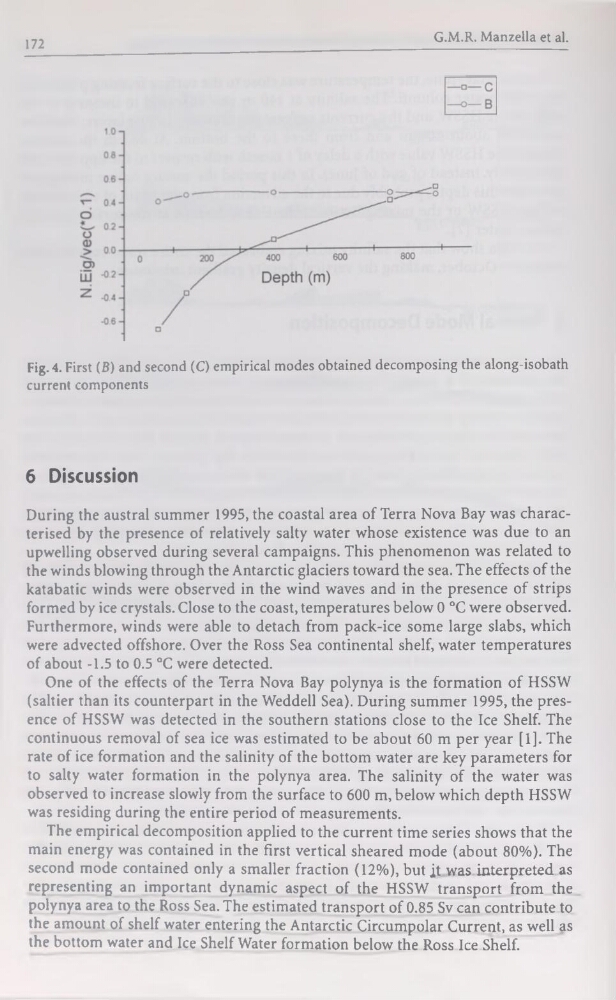
Fig. 4. First (B) and second (C) empirical modes obtained decomposing the along-isobath
current components
6 Discussion
During the austral summer 1995, the Coastal area of Terra Nova Bay was characterised by the presence of relatively salty water whose existence was due to an
upwelling observed during several campaigns. This phenomenon was related to
the winds blowing through the Antarctic glaciers toward the sea. The effects of the
katabatic winds were observed in the wind waves and in the presence of strips
formed by ice crystals. Close to the coast, températures below 0 °C were observed.
Furthermore, winds were able to detach from pack-ice some large slabs, which
were advected offshore. Over the Ross Sea continental shelf, water températures
of about -1.5 to 0.5 °C were detected.
One of the effects of the Terra Nova Bay polynya is the formation of HSSW
(saltier than its counterpart in the Weddell Sea). During summer 1995, the presence of HSSW was detected in the Southern stations close to the Ice Shelf. The
continuous removal of sea ice was estimated to be about 60 m per year [1], The
rate of ice formation and the salinity of the bottom water are key parameters for
to salty water formation in the polynya area. The salinity of the water was
observed to increase slowly from the surface to 600 m, below which depth HSSW
was residing during the entire period of measurements.
The empirical décomposition applied to the current time sériés shows that the
main energy was contained in the first vertical sheared mode (about 80%). The
second mode contained only a smaller fraction (12%), butjt was interpreted as
representing an important dynamic aspect of the HSSW transport from the
polynya area to the Ross Sea. The estimated transport of 0.85 Sv can contribute to
the amount of shelf water entering the Antarctic Circumpolar Current, as well as
the bottom water and Ice Shelf Water formation below the Ross Ice Shelf.
172
Fig. 4. First (B) and second (C) empirical modes obtained decomposing the along-isobath
current components
6 Discussion
During the austral summer 1995, the Coastal area of Terra Nova Bay was characterised by the presence of relatively salty water whose existence was due to an
upwelling observed during several campaigns. This phenomenon was related to
the winds blowing through the Antarctic glaciers toward the sea. The effects of the
katabatic winds were observed in the wind waves and in the presence of strips
formed by ice crystals. Close to the coast, températures below 0 °C were observed.
Furthermore, winds were able to detach from pack-ice some large slabs, which
were advected offshore. Over the Ross Sea continental shelf, water températures
of about -1.5 to 0.5 °C were detected.
One of the effects of the Terra Nova Bay polynya is the formation of HSSW
(saltier than its counterpart in the Weddell Sea). During summer 1995, the presence of HSSW was detected in the Southern stations close to the Ice Shelf. The
continuous removal of sea ice was estimated to be about 60 m per year [1], The
rate of ice formation and the salinity of the bottom water are key parameters for
to salty water formation in the polynya area. The salinity of the water was
observed to increase slowly from the surface to 600 m, below which depth HSSW
was residing during the entire period of measurements.
The empirical décomposition applied to the current time sériés shows that the
main energy was contained in the first vertical sheared mode (about 80%). The
second mode contained only a smaller fraction (12%), butjt was interpreted as
representing an important dynamic aspect of the HSSW transport from the
polynya area to the Ross Sea. The estimated transport of 0.85 Sv can contribute to
the amount of shelf water entering the Antarctic Circumpolar Current, as well as
the bottom water and Ice Shelf Water formation below the Ross Ice Shelf.