

G.M.R. Manzella et al.
166
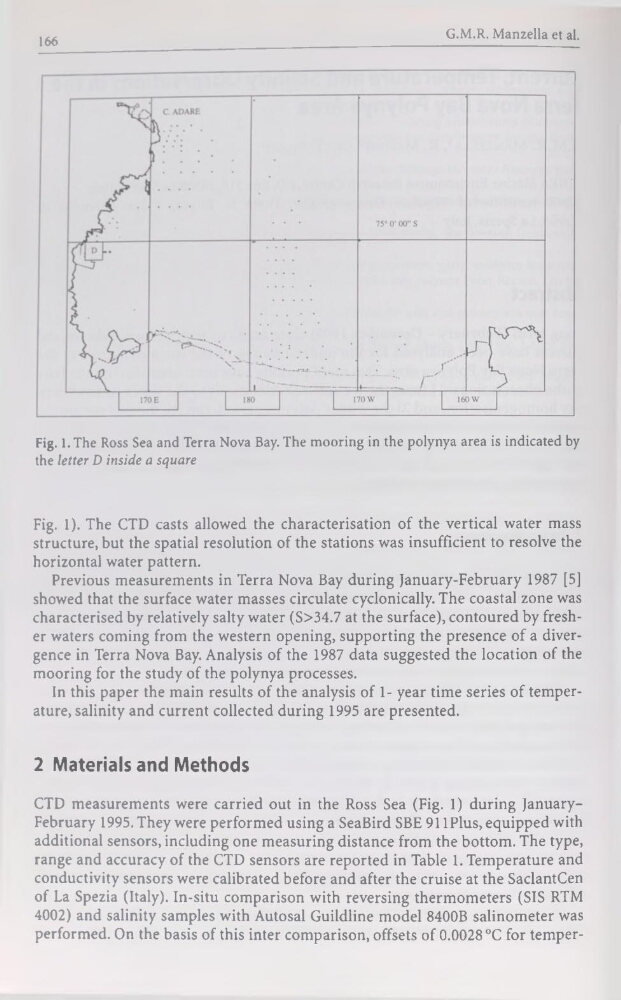
Fig. l.The Ross Sea and Terra Nova Bay. The mooring in the polynya area is indicated by
the letter D inside a square
Fig. 1). The CTD casts allowed the characterisation of the vertical water mass
structure, but the spatial resolution of the stations was insufficient to résolve the
horizontal water pattern.
Previous measurements in Terra Nova Bay during January-February 1987 [5]
showed that the surface water masses circulate cyclonically. The Coastal zone was
characterised by relatively salty water (S>34.7 at the surface), contoured by fresher waters coming from the western opening, supporting the presence of a divergence in Terra Nova Bay. Analysis of the 1987 data suggested the location of the
mooring for the study of the polynya processes.
In this paper the main results of the analysis of 1- year time sériés of température, salinity and current collected during 1995 are presented.
2 Materials and Methods
CTD measurements were carried out in the Ross Sea (Fig. 1) during JanuaryFebruary 1995. They were performed using a SeaBird SBE 911 Plus, equipped with
additional sensors, including one measuring distance from the bottom. The type,
range and accuracy of the CTD sensors are reported in Table 1. Température and
conductivity sensors were calibrated before and after the cruise at the SaclantCen
of La Spezia (Italy). In-situ comparison with reversing thermometers (SIS RTM
4002) and salinity samples with Autosal Guildline model 8400B salinometer was
performed. On the basis of this inter comparison, offsets of 0.0028 °C for temper-
166
Fig. l.The Ross Sea and Terra Nova Bay. The mooring in the polynya area is indicated by
the letter D inside a square
Fig. 1). The CTD casts allowed the characterisation of the vertical water mass
structure, but the spatial resolution of the stations was insufficient to résolve the
horizontal water pattern.
Previous measurements in Terra Nova Bay during January-February 1987 [5]
showed that the surface water masses circulate cyclonically. The Coastal zone was
characterised by relatively salty water (S>34.7 at the surface), contoured by fresher waters coming from the western opening, supporting the presence of a divergence in Terra Nova Bay. Analysis of the 1987 data suggested the location of the
mooring for the study of the polynya processes.
In this paper the main results of the analysis of 1- year time sériés of température, salinity and current collected during 1995 are presented.
2 Materials and Methods
CTD measurements were carried out in the Ross Sea (Fig. 1) during JanuaryFebruary 1995. They were performed using a SeaBird SBE 911 Plus, equipped with
additional sensors, including one measuring distance from the bottom. The type,
range and accuracy of the CTD sensors are reported in Table 1. Température and
conductivity sensors were calibrated before and after the cruise at the SaclantCen
of La Spezia (Italy). In-situ comparison with reversing thermometers (SIS RTM
4002) and salinity samples with Autosal Guildline model 8400B salinometer was
performed. On the basis of this inter comparison, offsets of 0.0028 °C for temper-