

Wintertime Expansion and Contraction of the Terra Nova Bay Polynya
159
For a typical wintertime température of -25 °C, a wind speed of 16 m s'1 (Table 1 ),
and a cloud fraction of 50%, a ±5 °C change (Table 1 ) in température gives rise to
a 2.5-km change in polynya width. In contrast, a ±7 m s'1 change in wind speed
(Table 1) only produces a 1.0-km change in polynya width. Thus, although wind
speed variations are important in determining polynya extent, Terra Nova Bay
polynya extent is more than twice as sensitive to a 1-s change in température as
it is to a 1 <7 change in wind speed.
4.3 Extrême Polynya Events
A recurring resuit of this study is the inability for the polynya models to reproduce the large polynya expansions during May, June, and August 1988 and July
1989. Wind speeds and air températures were near normal for the time of year
(Table 1; Fig. 2) and varying the cloud cover over its observed range could not
reproduce the observed fluctuations. Carrasco and Bromwich [42] examined several case studies of katabatic outflow from southern Marie Byrd Land extending
out across the Ross Ice Shelf. For the period June 2 through June 5,1988, surface
air températures rose from -35.6 to -19.2 °C and wind speed increased by 8.2 m
s’1 for one site on the Ross Ice Shelf. Associated with this warm air outflow was a
major polynya event along the northwest edge of the Ross Ice Shelf. The models
in this study examined the response of the polynya to local offshore winds at
Terra Nova Bay. However, it appears that the largest unexplained changes in
polynya extent are the resuit of the polynya responding to the régional forcing of
the southwestern Ross Sea. In particular, the strong winds coming off the Ross Ice
Shelf could set up generally northward movement of the Ross Sea Pack, which is
not modeled in this study. Kurtz and Bromwich [24] argued that both katabatic
winds and régional geostrophic winds are responsible for the quasi-periodic areal
fluctuations in polynya extent. This study suggests rather that it is both the local
katabatic winds at Terra Nova Bay and the régional katabatic winds blowing off
the Ross Ice Shelf that give rise to the large fluctuations in polynya extent.
The apparent sensitivity of polynya extent to subtle changes in air température, wind speed, and cloud fraction, typical of wintertime conditions at lerra
Nova Bay, as well as the apparent sensitivity to both local and régional meteorological conditions could explain some of the difficulty that Campbell and his men
had in understanding the paradoxical fluctuations in open water fraction at Terra
Nova Bay (e.g. [21]).
5 Ice Production and Océanographie Conséquences
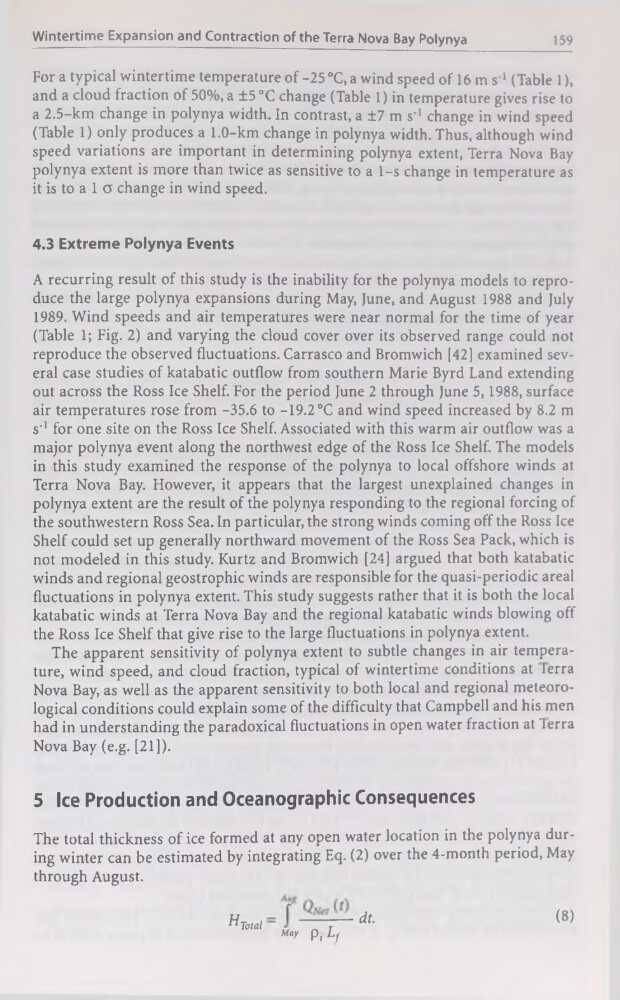
The total thickness of ice formed at any open water location in the polynya during winter can be estimated by integrating Eq. (2) over the 4-month period, May
through August.
H Total
May p( Lf
dt.
(8)
159
For a typical wintertime température of -25 °C, a wind speed of 16 m s'1 (Table 1 ),
and a cloud fraction of 50%, a ±5 °C change (Table 1 ) in température gives rise to
a 2.5-km change in polynya width. In contrast, a ±7 m s'1 change in wind speed
(Table 1) only produces a 1.0-km change in polynya width. Thus, although wind
speed variations are important in determining polynya extent, Terra Nova Bay
polynya extent is more than twice as sensitive to a 1-s change in température as
it is to a 1 <7 change in wind speed.
4.3 Extrême Polynya Events
A recurring resuit of this study is the inability for the polynya models to reproduce the large polynya expansions during May, June, and August 1988 and July
1989. Wind speeds and air températures were near normal for the time of year
(Table 1; Fig. 2) and varying the cloud cover over its observed range could not
reproduce the observed fluctuations. Carrasco and Bromwich [42] examined several case studies of katabatic outflow from southern Marie Byrd Land extending
out across the Ross Ice Shelf. For the period June 2 through June 5,1988, surface
air températures rose from -35.6 to -19.2 °C and wind speed increased by 8.2 m
s’1 for one site on the Ross Ice Shelf. Associated with this warm air outflow was a
major polynya event along the northwest edge of the Ross Ice Shelf. The models
in this study examined the response of the polynya to local offshore winds at
Terra Nova Bay. However, it appears that the largest unexplained changes in
polynya extent are the resuit of the polynya responding to the régional forcing of
the southwestern Ross Sea. In particular, the strong winds coming off the Ross Ice
Shelf could set up generally northward movement of the Ross Sea Pack, which is
not modeled in this study. Kurtz and Bromwich [24] argued that both katabatic
winds and régional geostrophic winds are responsible for the quasi-periodic areal
fluctuations in polynya extent. This study suggests rather that it is both the local
katabatic winds at Terra Nova Bay and the régional katabatic winds blowing off
the Ross Ice Shelf that give rise to the large fluctuations in polynya extent.
The apparent sensitivity of polynya extent to subtle changes in air température, wind speed, and cloud fraction, typical of wintertime conditions at lerra
Nova Bay, as well as the apparent sensitivity to both local and régional meteorological conditions could explain some of the difficulty that Campbell and his men
had in understanding the paradoxical fluctuations in open water fraction at Terra
Nova Bay (e.g. [21]).
5 Ice Production and Océanographie Conséquences
The total thickness of ice formed at any open water location in the polynya during winter can be estimated by integrating Eq. (2) over the 4-month period, May
through August.
H Total
May p( Lf
dt.
(8)