

146
M.L. Van Woert
These studies hâve largely treated the ice production rates in the polynya and the
size of the polynya as independent quantities. However, results from simple analytical models that describe polynya dynamics [8-10] suggest that polynya size, and
hence open water fraction, is maintained through a délicate balance between ice
edge advection at the polynya boundary and ice production within the polynya.
Here we examine the relationship between open water fraction derived from
satellite observations and estimâtes of polynya size simulated with a one-dimensional polynya model driven by time-coincident atmospheric flux data from Terra
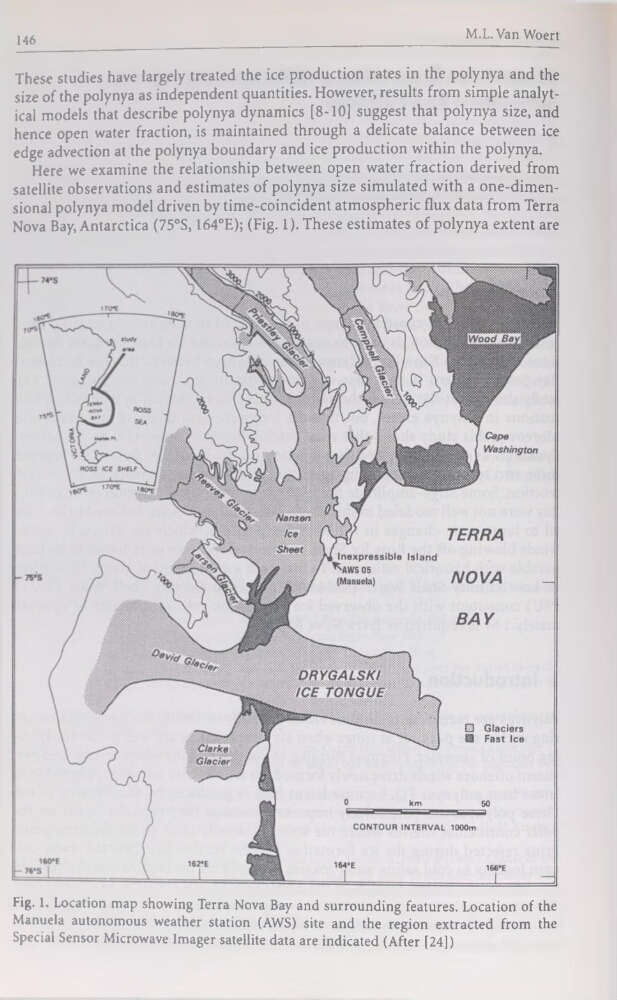
Nova Bay, Antarctica (75°S, 164°E); (Fig. 1). These estimâtes of polynya extent are
Fig. 1. Location map showing Terra Nova Bay and surrounding features. Location of the
Manuela autonomous weather station (AWS) site and the région extracted from the
Spécial Sensor Microwave Imager satellite data are indicated (After [24])
M.L. Van Woert
These studies hâve largely treated the ice production rates in the polynya and the
size of the polynya as independent quantities. However, results from simple analytical models that describe polynya dynamics [8-10] suggest that polynya size, and
hence open water fraction, is maintained through a délicate balance between ice
edge advection at the polynya boundary and ice production within the polynya.
Here we examine the relationship between open water fraction derived from
satellite observations and estimâtes of polynya size simulated with a one-dimensional polynya model driven by time-coincident atmospheric flux data from Terra
Nova Bay, Antarctica (75°S, 164°E); (Fig. 1). These estimâtes of polynya extent are
Fig. 1. Location map showing Terra Nova Bay and surrounding features. Location of the
Manuela autonomous weather station (AWS) site and the région extracted from the
Spécial Sensor Microwave Imager satellite data are indicated (After [24])