

Reconstructing the General Circulation of the Ross Sea (Antarctica).
129
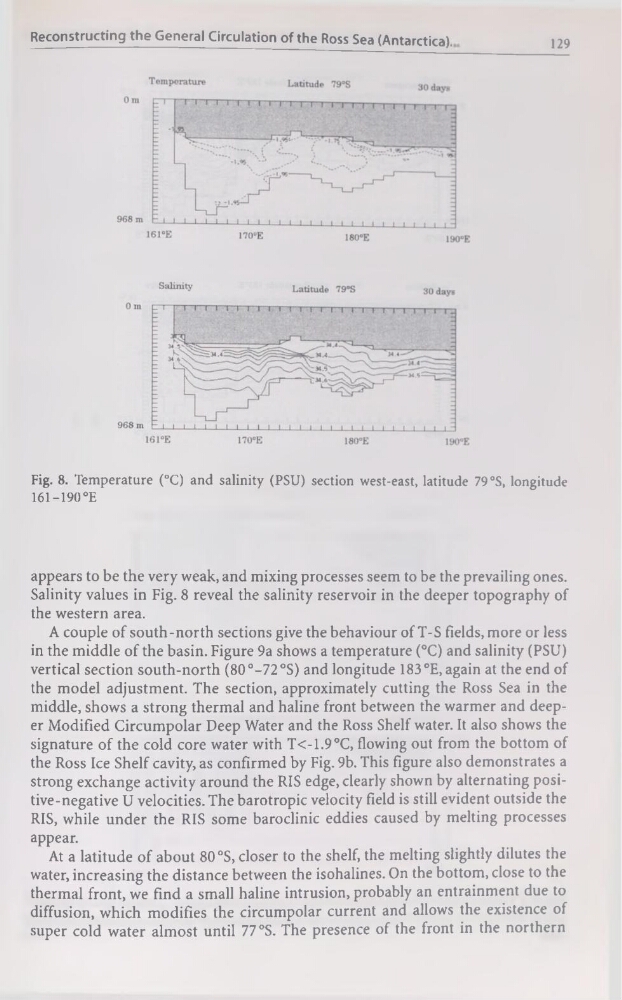
Fig. 8. Température (°C) and salinity (PSU) section west-east, latitude 79 °S, longitude
161-190°E
appears to be the very weak, and mixing processes seem to be the prevailing ones.
Salinity values in Fig. 8 reveal the salinity réservoir in the deeper topography of
the western area.
A couple of south-north sections give the behaviour of T-S fields, more or less
in the middle of the basin. Figure 9a shows a température (°C) and salinity (PSU)
vertical section south-north (80°-72°S) and longitude 183 °E, again at the end of
the model adjustment. The section, approximately cutting the Ross Sea in the
middle, shows a strong thermal and haline front between the warmer and deeper Modified Circumpolar Deep Water and the Ross Shelf water. It also shows the
signature of the cold core water with T<-1.9°C, flowing out from the bottom of
the Ross Ice Shelf cavity, as confirmed by Fig. 9b. This figure also demonstrates a
strong exchange activity around the RIS edge, clearly shown by alternating positive-negative U velocities. The barotropic velocity field is still évident outside the
RIS, while under the RIS some baroclinie eddies caused by melting processes
appear.
At a latitude of about 80 °S, doser to the shelf, the melting slightly dilutes the
water, increasing the distance between the isohalines. On the bottom, close to the
thermal front, we fïnd a small haline intrusion, probably an entrainment due to
diffusion, which modifies the circumpolar current and allows the existence of
super cold water almost until 77 °S. The presence of the front in the northern
129
Fig. 8. Température (°C) and salinity (PSU) section west-east, latitude 79 °S, longitude
161-190°E
appears to be the very weak, and mixing processes seem to be the prevailing ones.
Salinity values in Fig. 8 reveal the salinity réservoir in the deeper topography of
the western area.
A couple of south-north sections give the behaviour of T-S fields, more or less
in the middle of the basin. Figure 9a shows a température (°C) and salinity (PSU)
vertical section south-north (80°-72°S) and longitude 183 °E, again at the end of
the model adjustment. The section, approximately cutting the Ross Sea in the
middle, shows a strong thermal and haline front between the warmer and deeper Modified Circumpolar Deep Water and the Ross Shelf water. It also shows the
signature of the cold core water with T<-1.9°C, flowing out from the bottom of
the Ross Ice Shelf cavity, as confirmed by Fig. 9b. This figure also demonstrates a
strong exchange activity around the RIS edge, clearly shown by alternating positive-negative U velocities. The barotropic velocity field is still évident outside the
RIS, while under the RIS some baroclinie eddies caused by melting processes
appear.
At a latitude of about 80 °S, doser to the shelf, the melting slightly dilutes the
water, increasing the distance between the isohalines. On the bottom, close to the
thermal front, we fïnd a small haline intrusion, probably an entrainment due to
diffusion, which modifies the circumpolar current and allows the existence of
super cold water almost until 77 °S. The presence of the front in the northern