

Temporal Variability of Currents in the Ross Sea (Antarctica)
115
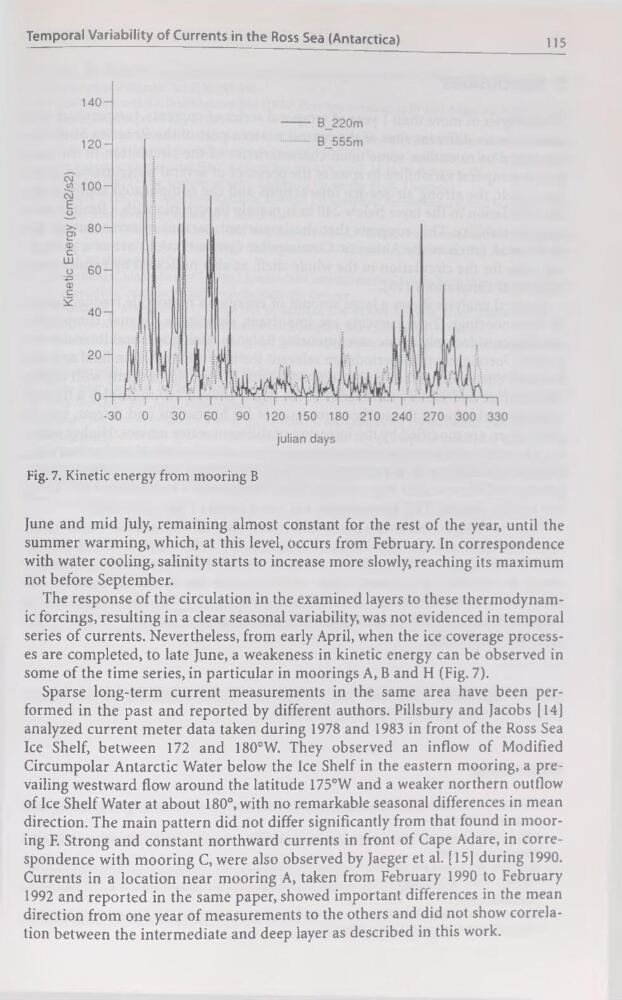
Fig. 7. Kinetic energy from mooring B
June and mid July, remaining almost constant for the rest of the year, until the
summer warming, which, at this level, occurs from February. In correspondence
with water cooling, salinity starts to increase more slowly, reaching its maximum
not before September.
The response of the circulation in the examined layers to these thermodynamic forcings, resulting in a clear seasonal variability, was not evidenced in temporal
sériés of currents. Nevertheless, from early April, when the ice coverage processes are completed, to late June, a weakeness in kinetic energy can be observed in
some of the time sériés, in particular in moorings A, B and H (Fig. 7).
Sparse long-term current measurements in the same area hâve been performed in the past and reported by different authors. Pillsbury and Jacobs [14]
analyzed current meter data taken during 1978 and 1983 in front of the Ross Sea
Ice Shelf, between 172 and 180°W. They observed an inflow of Modified
Circumpolar Antarctic Water below the Ice Shelf in the eastern mooring, a prevailing westward flow around the latitude 175°W and a weaker northern outflow
of Ice Shelf Water at about 180°, with no remarkable seasonal différences in mean
direction. The main pattern did not differ significantly from that found in mooring F. Strong and constant northward currents in front of Cape Adare, in correspondence with mooring C, were also observed by Jaeger et al. [15] during 1990.
Currents in a location near mooring A, taken from February 1990 to February
1992 and reported in the same paper, showed important différences in the mean
direction from one year of measurements to the others and did not show corrélation between the intermediate and deep layer as described in this work.
115
Fig. 7. Kinetic energy from mooring B
June and mid July, remaining almost constant for the rest of the year, until the
summer warming, which, at this level, occurs from February. In correspondence
with water cooling, salinity starts to increase more slowly, reaching its maximum
not before September.
The response of the circulation in the examined layers to these thermodynamic forcings, resulting in a clear seasonal variability, was not evidenced in temporal
sériés of currents. Nevertheless, from early April, when the ice coverage processes are completed, to late June, a weakeness in kinetic energy can be observed in
some of the time sériés, in particular in moorings A, B and H (Fig. 7).
Sparse long-term current measurements in the same area hâve been performed in the past and reported by different authors. Pillsbury and Jacobs [14]
analyzed current meter data taken during 1978 and 1983 in front of the Ross Sea
Ice Shelf, between 172 and 180°W. They observed an inflow of Modified
Circumpolar Antarctic Water below the Ice Shelf in the eastern mooring, a prevailing westward flow around the latitude 175°W and a weaker northern outflow
of Ice Shelf Water at about 180°, with no remarkable seasonal différences in mean
direction. The main pattern did not differ significantly from that found in mooring F. Strong and constant northward currents in front of Cape Adare, in correspondence with mooring C, were also observed by Jaeger et al. [15] during 1990.
Currents in a location near mooring A, taken from February 1990 to February
1992 and reported in the same paper, showed important différences in the mean
direction from one year of measurements to the others and did not show corrélation between the intermediate and deep layer as described in this work.