

Free surface flows 81
In natural systems, free surface flows are mainly turbulent and thus independent of the Reynolds number (R e ). On the other hand, the behaviour of
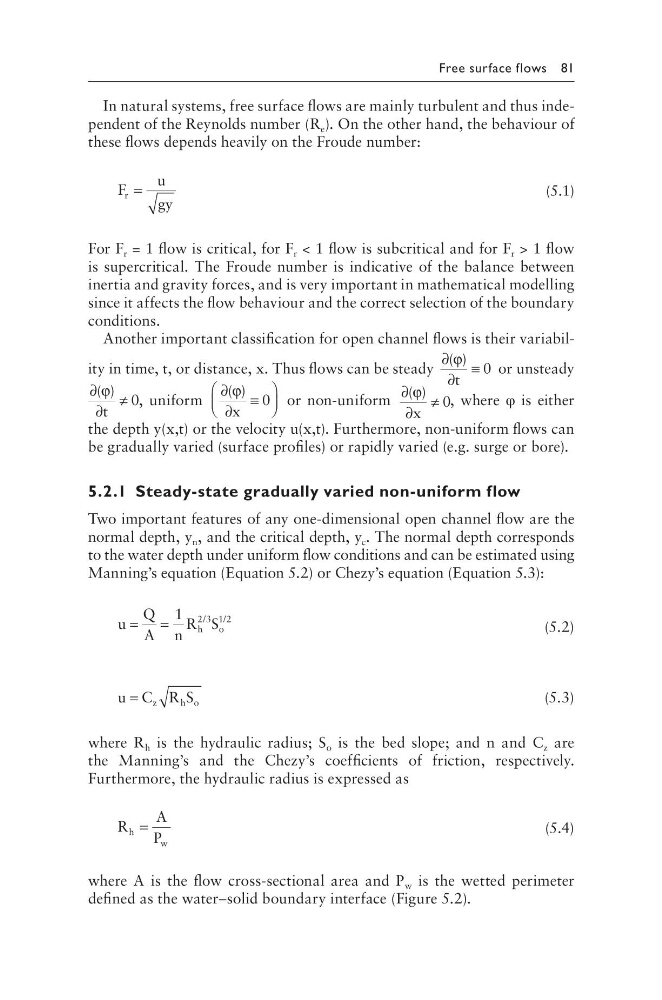
these flows depends heavily on the Froude number:
F
u
gy
r =
(5.1)
For F r = 1 flow is critical, for F r < 1 flow is subcritical and for F r > 1 flow
is supercritical. The Froude number is indicative of the balance between
inertia and gravity forces, and is very important in mathematical modelling
since it affects the flow behaviour and the correct selection of the boundary
conditions.
Another important classification for open channel flows is their variability in time, t, or distance, x. Thus flows can be steady
∂
∂
≡
( )
ϕ
t
0 or unsteady
∂
∂
≠
( )
ϕ
t
0, uniform
∂
∂
≡
( )
ϕ
x
0 or non-uniform
∂
∂
≠
( )
ϕ
x
0 , where φ is either
the depth y(x,t) or the velocity u(x,t). Furthermore, non-uniform flows can
be gradually varied (surface profiles) or rapidly varied (e.g. surge or bore).
5.2.1 Steady-state gradually varied non-uniform flow
Two important features of any one-dimensional open channel flow are the
normal depth, y n , and the critical depth, y c . The normal depth corresponds
to the water depth under uniform flow conditions and can be estimated using
Manning’s equation (Equation 5.2) or Chezy’s equation (Equation 5.3):
u
Q
A n
R S
h
o
=
=
1 2 3 1 2
/
/
(5.2)
u C R S
z
h o
=
(5.3)
where R h is the hydraulic radius; S o is the bed slope; and n and C z are
the Manning’s and the Chezy’s coefficients of friction, respectively.
Furthermore, the hydraulic radius is expressed as
R
A
P
h
w
=
(5.4)
where A is the flow cross-sectional area and P w is the wetted perimeter
defined as the water–solid boundary interface (Figure 5.2).
In natural systems, free surface flows are mainly turbulent and thus independent of the Reynolds number (R e ). On the other hand, the behaviour of
these flows depends heavily on the Froude number:
F
u
gy
r =
(5.1)
For F r = 1 flow is critical, for F r < 1 flow is subcritical and for F r > 1 flow
is supercritical. The Froude number is indicative of the balance between
inertia and gravity forces, and is very important in mathematical modelling
since it affects the flow behaviour and the correct selection of the boundary
conditions.
Another important classification for open channel flows is their variability in time, t, or distance, x. Thus flows can be steady
∂
∂
≡
( )
ϕ
t
0 or unsteady
∂
∂
≠
( )
ϕ
t
0, uniform
∂
∂
≡
( )
ϕ
x
0 or non-uniform
∂
∂
≠
( )
ϕ
x
0 , where φ is either
the depth y(x,t) or the velocity u(x,t). Furthermore, non-uniform flows can
be gradually varied (surface profiles) or rapidly varied (e.g. surge or bore).
5.2.1 Steady-state gradually varied non-uniform flow
Two important features of any one-dimensional open channel flow are the
normal depth, y n , and the critical depth, y c . The normal depth corresponds
to the water depth under uniform flow conditions and can be estimated using
Manning’s equation (Equation 5.2) or Chezy’s equation (Equation 5.3):
u
Q
A n
R S
h
o
=
=
1 2 3 1 2
/
/
(5.2)
u C R S
z
h o
=
(5.3)
where R h is the hydraulic radius; S o is the bed slope; and n and C z are
the Manning’s and the Chezy’s coefficients of friction, respectively.
Furthermore, the hydraulic radius is expressed as
R
A
P
h
w
=
(5.4)
where A is the flow cross-sectional area and P w is the wetted perimeter
defined as the water–solid boundary interface (Figure 5.2).