

62 Computational Modelling in Hydraulic and Coastal Engineering
4.2.3 Hardy Cross method
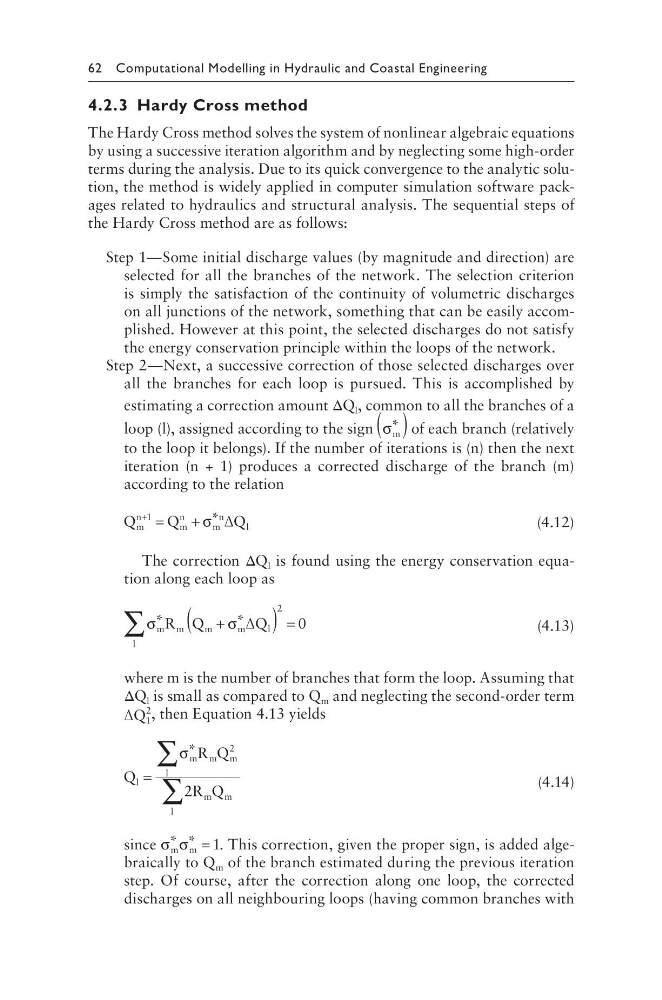
The Hardy Cross method solves the system of nonlinear algebraic equations
by using a successive iteration algorithm and by neglecting some high-order
terms during the analysis. Due to its quick convergence to the analytic solution, the method is widely applied in computer simulation software packages related to hydraulics and structural analysis. The sequential steps of
the Hardy Cross method are as follows:
Step 1—Some initial discharge values (by magnitude and direction) are
selected for all the branches of the network. The selection criterion
is simply the satisfaction of the continuity of volumetric discharges
on all junctions of the network, something that can be easily accomplished. However at this point, the selected discharges do not satisfy
the energy conservation principle within the loops of the network.
Step 2—Next, a successive correction of those selected discharges over
all the branches for each loop is pursued. This is accomplished by
estimating a correction amount ΔQ l , common to all the branches of a
loop (l), assigned according to the sign σ m
*
( ) of each branch (relatively
to the loop it belongs). If the number of iterations is (n) then the next
iteration (n + 1) produces a corrected discharge of the branch (m)
according to the relation
Q
Q
Q
m
n
m
n
m
n
l
+
=
+
1
σ * ∆
(4.12)
The correction ΔQ l is found using the energy conservation equation along each loop as
σ
σ
m m
l
m
m
l
R Q
Q
*
*
∑
+
(
)=
∆
2
0
(4.13)
where m is the number of branches that form the loop. Assuming that
ΔQ l is small as compared to Q m and neglecting the second-order term
∆Q 1
2
, then Equation 4.13 yields
Q
R Q
R Q
l
m
l
m m
m m
l
=
∑
∑
σ *
2
2
(4.14)
since σ σ
m m
* * = 1. This correction, given the proper sign, is added algebraically to Q m of the branch estimated during the previous iteration
step. Of course, after the correction along one loop, the corrected
discharges on all neighbouring loops (having common branches with
4.2.3 Hardy Cross method
The Hardy Cross method solves the system of nonlinear algebraic equations
by using a successive iteration algorithm and by neglecting some high-order
terms during the analysis. Due to its quick convergence to the analytic solution, the method is widely applied in computer simulation software packages related to hydraulics and structural analysis. The sequential steps of
the Hardy Cross method are as follows:
Step 1—Some initial discharge values (by magnitude and direction) are
selected for all the branches of the network. The selection criterion
is simply the satisfaction of the continuity of volumetric discharges
on all junctions of the network, something that can be easily accomplished. However at this point, the selected discharges do not satisfy
the energy conservation principle within the loops of the network.
Step 2—Next, a successive correction of those selected discharges over
all the branches for each loop is pursued. This is accomplished by
estimating a correction amount ΔQ l , common to all the branches of a
loop (l), assigned according to the sign σ m
*
( ) of each branch (relatively
to the loop it belongs). If the number of iterations is (n) then the next
iteration (n + 1) produces a corrected discharge of the branch (m)
according to the relation
Q
Q
Q
m
n
m
n
m
n
l
+
=
+
1
σ * ∆
(4.12)
The correction ΔQ l is found using the energy conservation equation along each loop as
σ
σ
m m
l
m
m
l
R Q
Q
*
*
∑
+
(
)=
∆
2
0
(4.13)
where m is the number of branches that form the loop. Assuming that
ΔQ l is small as compared to Q m and neglecting the second-order term
∆Q 1
2
, then Equation 4.13 yields
Q
R Q
R Q
l
m
l
m m
m m
l
=
∑
∑
σ *
2
2
(4.14)
since σ σ
m m
* * = 1. This correction, given the proper sign, is added algebraically to Q m of the branch estimated during the previous iteration
step. Of course, after the correction along one loop, the corrected
discharges on all neighbouring loops (having common branches with