

Ordinary differential equations 21
else Qout = 0;
end;
% Reservoir horizontal plane area;
SS = 100*z^2;
% Calculation of the reservoir water elevation;
z = z+Dt*(Qin-Qout)/SS;
k = n;
Qinp(k)= Qin;
Qoutp(k)= Qout;
zp(k)= z;
end;
plot(1:k,zp,'b','Linewidth',1.5);
hold on
plot(1:k,Qinp/10,'g','Linewidth',1.5)
plot(1:k,Qoutp/10,'m','Linewidth',1.5)
xlabel('Number of time steps')
text(100,180,'Inflow hydrograph x 10E-1 [m^3/s]')
text(370,52,'Outflow hydrograph x 10E-1 [m^3/s]')
text(500,105,'Water elevation [m]')
PROBLEM 2.2
Solve the same problem by making the following suggested changes while
keeping the rest of the data constant:
1. Change the weir width from 100.0 m to 50.0 m, and plot the water
stage variation in time.
2. Change the outflow from the weir (Equation 2.5) to the bottom outlet
gate (Equation 2.4) and run the program until the closing of the outlet
gate at the end of the inflow hydrograph T d = 40,000 s (11.11 hr). Plot
the inflow and outflow hydrographs.
3. Change the horizontal area function by assuming a reservoir of semispherical shape, and plot the water stage with time.
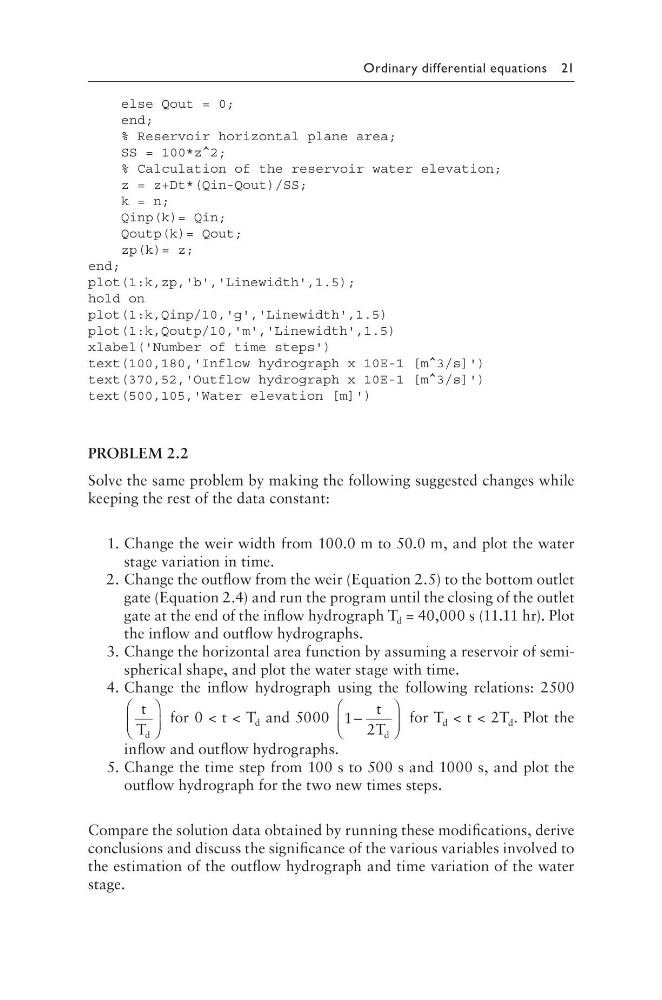
4. Change the inflow hydrograph using the following relations: 2500
t
T d
for 0 < t < T d and 5000 1 2
−
t
T d
for T d < t < 2T d . Plot the
inflow and outflow hydrographs.
5. Change the time step from 100 s to 500 s and 1000 s, and plot the
outflow hydrograph for the two new times steps.
Compare the solution data obtained by running these modifications, derive
conclusions and discuss the significance of the various variables involved to
the estimation of the outflow hydrograph and time variation of the water
stage.
else Qout = 0;
end;
% Reservoir horizontal plane area;
SS = 100*z^2;
% Calculation of the reservoir water elevation;
z = z+Dt*(Qin-Qout)/SS;
k = n;
Qinp(k)= Qin;
Qoutp(k)= Qout;
zp(k)= z;
end;
plot(1:k,zp,'b','Linewidth',1.5);
hold on
plot(1:k,Qinp/10,'g','Linewidth',1.5)
plot(1:k,Qoutp/10,'m','Linewidth',1.5)
xlabel('Number of time steps')
text(100,180,'Inflow hydrograph x 10E-1 [m^3/s]')
text(370,52,'Outflow hydrograph x 10E-1 [m^3/s]')
text(500,105,'Water elevation [m]')
PROBLEM 2.2
Solve the same problem by making the following suggested changes while
keeping the rest of the data constant:
1. Change the weir width from 100.0 m to 50.0 m, and plot the water
stage variation in time.
2. Change the outflow from the weir (Equation 2.5) to the bottom outlet
gate (Equation 2.4) and run the program until the closing of the outlet
gate at the end of the inflow hydrograph T d = 40,000 s (11.11 hr). Plot
the inflow and outflow hydrographs.
3. Change the horizontal area function by assuming a reservoir of semispherical shape, and plot the water stage with time.
4. Change the inflow hydrograph using the following relations: 2500
t
T d
for 0 < t < T d and 5000 1 2
−
t
T d
for T d < t < 2T d . Plot the
inflow and outflow hydrographs.
5. Change the time step from 100 s to 500 s and 1000 s, and plot the
outflow hydrograph for the two new times steps.
Compare the solution data obtained by running these modifications, derive
conclusions and discuss the significance of the various variables involved to
the estimation of the outflow hydrograph and time variation of the water
stage.