

Contaminant and sediment transport by advection and diffusion 239
Based on the Bagnold’s ‘power approach’ concept, various sediment
transport models have been developed that combine the action of both
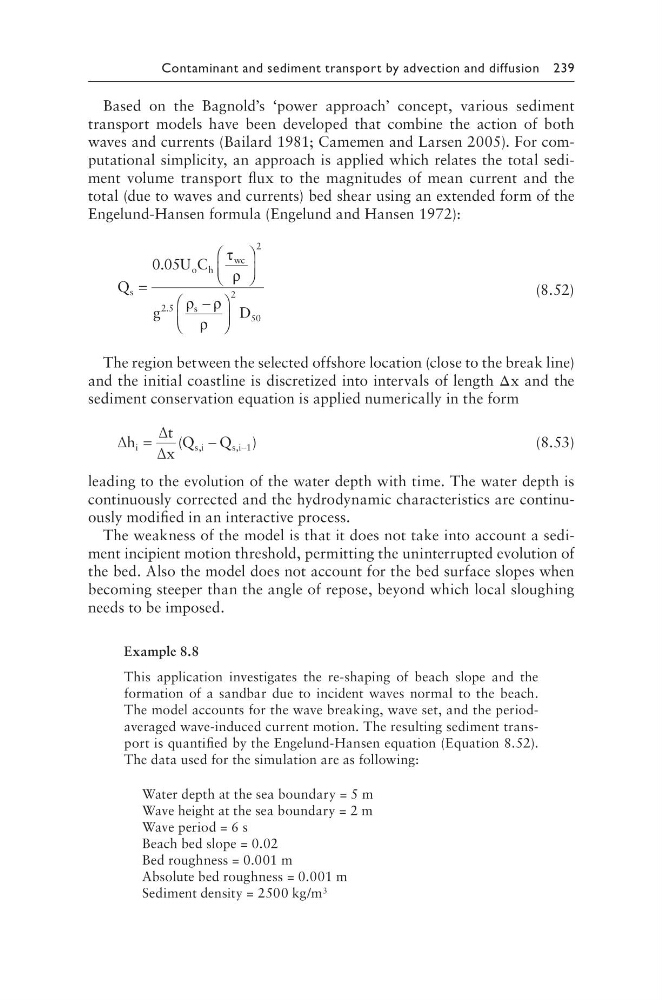
waves and currents (Bailard 1981; Camemen and Larsen 2005). For computational simplicity, an approach is applied which relates the total sediment volume transport flux to the magnitudes of mean current and the
total (due to waves and currents) bed shear using an extended form of the
Engelund-Hansen formula (Engelund and Hansen 1972):
Q
U C
g
D
s
o h
wc
s
=
−
0 05
2
2 5
2
50
.
.
τ
ρ
ρ ρ
ρ
(8.52)
The region between the selected offshore location (close to the break line)
and the initial coastline is discretized into intervals of length Δx and the
sediment conservation equation is applied numerically in the form
∆
∆
∆
h
t
x
Q
Q
i
s i
si
=
−
−
(
)
,
, 1
(8.53)
leading to the evolution of the water depth with time. The water depth is
continuously corrected and the hydrodynamic characteristics are continuously modified in an interactive process.
The weakness of the model is that it does not take into account a sediment incipient motion threshold, permitting the uninterrupted evolution of
the bed. Also the model does not account for the bed surface slopes when
becoming steeper than the angle of repose, beyond which local sloughing
needs to be imposed.
Example 8.8
This application investigates the re-shaping of beach slope and the
formation of a sandbar due to incident waves normal to the beach.
The model accounts for the wave breaking, wave set, and the periodaveraged wave-induced current motion. The resulting sediment transport is quantified by the Engelund-Hansen equation (Equation 8.52).
The data used for the simulation are as following:
Water depth at the sea boundary = 5 m
Wave height at the sea boundary = 2 m
Wave period = 6 s
Beach bed slope = 0.02
Bed roughness = 0.001 m
Absolute bed roughness = 0.001 m
Sediment density = 2500 kg/m 3
Based on the Bagnold’s ‘power approach’ concept, various sediment
transport models have been developed that combine the action of both
waves and currents (Bailard 1981; Camemen and Larsen 2005). For computational simplicity, an approach is applied which relates the total sediment volume transport flux to the magnitudes of mean current and the
total (due to waves and currents) bed shear using an extended form of the
Engelund-Hansen formula (Engelund and Hansen 1972):
Q
U C
g
D
s
o h
wc
s
=
−
0 05
2
2 5
2
50
.
.
τ
ρ
ρ ρ
ρ
(8.52)
The region between the selected offshore location (close to the break line)
and the initial coastline is discretized into intervals of length Δx and the
sediment conservation equation is applied numerically in the form
∆
∆
∆
h
t
x
Q
Q
i
s i
si
=
−
−
(
)
,
, 1
(8.53)
leading to the evolution of the water depth with time. The water depth is
continuously corrected and the hydrodynamic characteristics are continuously modified in an interactive process.
The weakness of the model is that it does not take into account a sediment incipient motion threshold, permitting the uninterrupted evolution of
the bed. Also the model does not account for the bed surface slopes when
becoming steeper than the angle of repose, beyond which local sloughing
needs to be imposed.
Example 8.8
This application investigates the re-shaping of beach slope and the
formation of a sandbar due to incident waves normal to the beach.
The model accounts for the wave breaking, wave set, and the periodaveraged wave-induced current motion. The resulting sediment transport is quantified by the Engelund-Hansen equation (Equation 8.52).
The data used for the simulation are as following:
Water depth at the sea boundary = 5 m
Wave height at the sea boundary = 2 m
Wave period = 6 s
Beach bed slope = 0.02
Bed roughness = 0.001 m
Absolute bed roughness = 0.001 m
Sediment density = 2500 kg/m 3