

Contaminant and sediment transport by advection and diffusion 231
j=1:ny;
dhplot=DD(i,j);
% figure
contour(i,j,dhplot')
% colorbar('vert')
PROBLEM 8.6
Solve the same problem by making the suggested modifications while keeping the rest of the data constant:
1. Change the sediment particle diameter from 0.001 m to 0.002, 0.003
and 0.0005 m.
2. Change the sediment density from 2.65 kg/m 3 to 1.65 and 3.65 kg/m 3 .
3. Change the bed friction coefficient from 0.001 to 0.005, 0.0005 and
0.00025.
4. Increase the magnitude of the velocity field by 20%.
5. Reduce the water depth of the entire domain by 25%.
Run the simulations, compare the results and comment on the changes
observed regarding the extent and shape of the bed scouring and shoaling.
8.4.3 Alongshore sediment transport
A very important management tool for coastal zones is the one-line alongshore sediment transport model (Pelnard-Considère 1956). This model is
based on the volumetric conservation principle coupled with an empirical sediment transport formula. Experimentally it has been found that the
alongshore transport formula can be written in the form
Q s = a s H m sin(2φ)
(8.35)
where Q s is the volumetric rate of transported sediments along the coast
and inside the breaker zone, H is the wave height, φ is the wave breaking
angle with respect to the coastline, m is an exponent varying between 2.0
and 3.5 and a s is an empirical coefficient incorporating the sediment particle diameter, beach slope and wave period (Kamphuis 1991).
8.4.3.1 One-line model
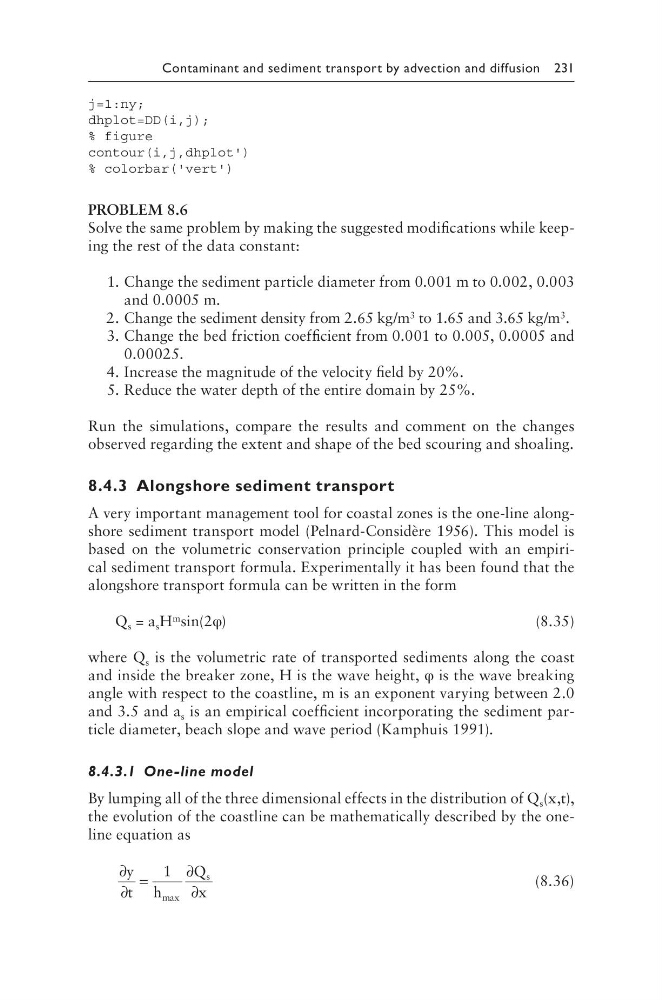
By lumping all of the three dimensional effects in the distribution of Q s (x,t),
the evolution of the coastline can be mathematically described by the oneline equation as
∂
∂
=
∂
∂
y
t h
Q
x
s
1
max
(8.36)
j=1:ny;
dhplot=DD(i,j);
% figure
contour(i,j,dhplot')
% colorbar('vert')
PROBLEM 8.6
Solve the same problem by making the suggested modifications while keeping the rest of the data constant:
1. Change the sediment particle diameter from 0.001 m to 0.002, 0.003
and 0.0005 m.
2. Change the sediment density from 2.65 kg/m 3 to 1.65 and 3.65 kg/m 3 .
3. Change the bed friction coefficient from 0.001 to 0.005, 0.0005 and
0.00025.
4. Increase the magnitude of the velocity field by 20%.
5. Reduce the water depth of the entire domain by 25%.
Run the simulations, compare the results and comment on the changes
observed regarding the extent and shape of the bed scouring and shoaling.
8.4.3 Alongshore sediment transport
A very important management tool for coastal zones is the one-line alongshore sediment transport model (Pelnard-Considère 1956). This model is
based on the volumetric conservation principle coupled with an empirical sediment transport formula. Experimentally it has been found that the
alongshore transport formula can be written in the form
Q s = a s H m sin(2φ)
(8.35)
where Q s is the volumetric rate of transported sediments along the coast
and inside the breaker zone, H is the wave height, φ is the wave breaking
angle with respect to the coastline, m is an exponent varying between 2.0
and 3.5 and a s is an empirical coefficient incorporating the sediment particle diameter, beach slope and wave period (Kamphuis 1991).
8.4.3.1 One-line model
By lumping all of the three dimensional effects in the distribution of Q s (x,t),
the evolution of the coastline can be mathematically described by the oneline equation as
∂
∂
=
∂
∂
y
t h
Q
x
s
1
max
(8.36)