

11
Chapter 2
Ordinary differential equations
2.1 WATER STORAGE RESERVOIR MANAGEMENT
The first application of the finite differences (FD) method is provided for
the solution of an ordinary differential equation (ODE) that mathematically describes the filling and emptying of a water reservoir, such as an artificial lake behind a dam. The reservoir is filling from upstream catchment
basins inflows, while at the same time being emptied by designed outflows
over a weir, under a sluice gate or through an orifice.
Reservoir management involves several safety operational practices.
Those practices include but are not limited to (1) maintaining a predetermined maximum water elevation for avoiding crest overtopping, (2) regulating water discharges for preventing downstream erosion or flooding,
(3) estimating the outflow hydrograph for emergency evacuation and/or
mitigation purposes, and (4) assessing the overall inflow–outflow storage responses of the reservoir to various hydrological inputs (Singh and
Scarlatos 1988).
The storage capacity of a reservoir depends on the time-dependent water
elevation, z(t), and the corresponding horizontal water surface area, S(z).
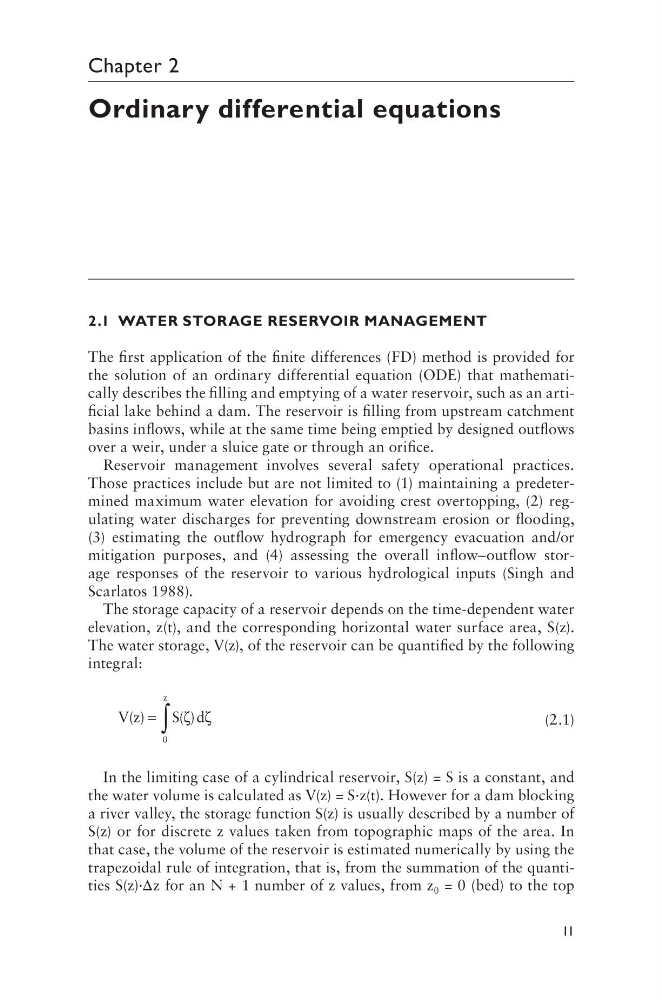
The water storage, V(z), of the reservoir can be quantified by the following
integral:
V z
S d
z
( )
( )
=
∫
ζ ζ
0
(2.1)
In the limiting case of a cylindrical reservoir, S(z) = S is a constant, and
the water volume is calculated as V(z) = S·z(t). However for a dam blocking
a river valley, the storage function S(z) is usually described by a number of
S(z) or for discrete z values taken from topographic maps of the area. In
that case, the volume of the reservoir is estimated numerically by using the
trapezoidal rule of integration, that is, from the summation of the quantities S(z)·Δz for an N + 1 number of z values, from z 0 = 0 (bed) to the top
Chapter 2
Ordinary differential equations
2.1 WATER STORAGE RESERVOIR MANAGEMENT
The first application of the finite differences (FD) method is provided for
the solution of an ordinary differential equation (ODE) that mathematically describes the filling and emptying of a water reservoir, such as an artificial lake behind a dam. The reservoir is filling from upstream catchment
basins inflows, while at the same time being emptied by designed outflows
over a weir, under a sluice gate or through an orifice.
Reservoir management involves several safety operational practices.
Those practices include but are not limited to (1) maintaining a predetermined maximum water elevation for avoiding crest overtopping, (2) regulating water discharges for preventing downstream erosion or flooding,
(3) estimating the outflow hydrograph for emergency evacuation and/or
mitigation purposes, and (4) assessing the overall inflow–outflow storage responses of the reservoir to various hydrological inputs (Singh and
Scarlatos 1988).
The storage capacity of a reservoir depends on the time-dependent water
elevation, z(t), and the corresponding horizontal water surface area, S(z).
The water storage, V(z), of the reservoir can be quantified by the following
integral:
V z
S d
z
( )
( )
=
∫
ζ ζ
0
(2.1)
In the limiting case of a cylindrical reservoir, S(z) = S is a constant, and
the water volume is calculated as V(z) = S·z(t). However for a dam blocking
a river valley, the storage function S(z) is usually described by a number of
S(z) or for discrete z values taken from topographic maps of the area. In
that case, the volume of the reservoir is estimated numerically by using the
trapezoidal rule of integration, that is, from the summation of the quantities S(z)·Δz for an N + 1 number of z values, from z 0 = 0 (bed) to the top