

Contaminant and sediment transport by advection and diffusion 225
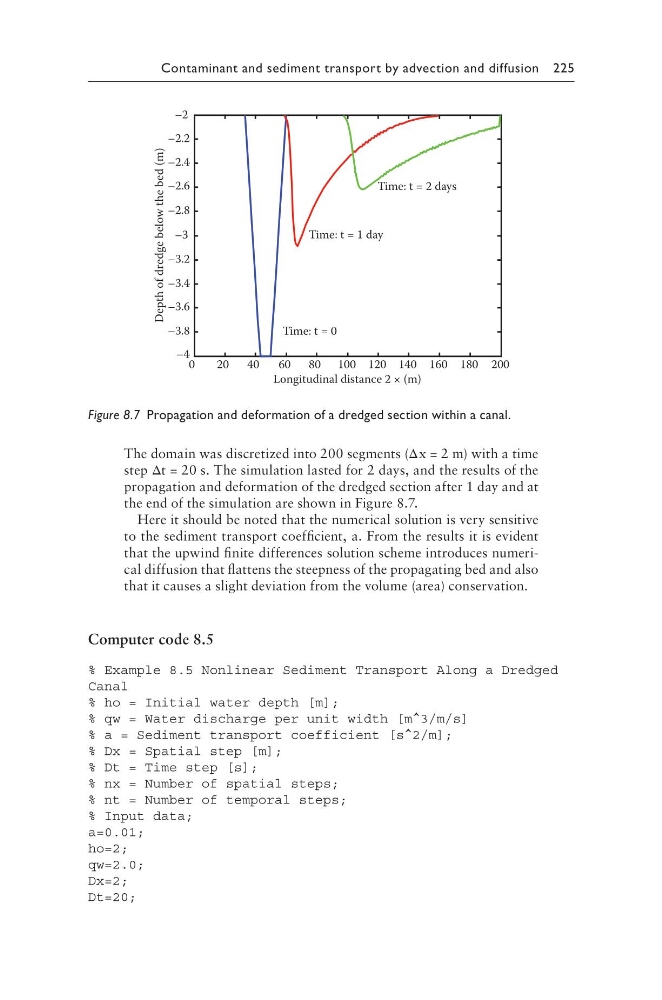
The domain was discretized into 200 segments (Δx = 2 m) with a time
step Δt = 20 s. The simulation lasted for 2 days, and the results of the
propagation and deformation of the dredged section after 1 day and at
the end of the simulation are shown in Figure 8.7.
Here it should be noted that the numerical solution is very sensitive
to the sediment transport coefficient, a. From the results it is evident
that the upwind finite differences solution scheme introduces numerical diffusion that flattens the steepness of the propagating bed and also
that it causes a slight deviation from the volume (area) conservation.
Computer code 8.5
% Example 8.5 Nonlinear Sediment Transport Along a Dredged
Canal
% ho = Initial water depth [m];
% qw = Water discharge per unit width [m^3/m/s]
% a = Sediment transport coefficient [s^2/m];
% Dx = Spatial step [m];
% Dt = Time step [s];
% nx = Number of spatial steps;
% nt = Number of temporal steps;
% Input data;
a=0.01;
ho=2;
qw=2.0;
Dx=2;
Dt=20;
–2
–2.2
–2.4
–2.6
–2.8
–3
–3.2
–3.4
–3.6
–3.8
–4
0
20
40
60 80 100 120 140 160 180 200
Longitudinal distance 2 × (m)
Depth of dredge below the bed (m)
Time: t = 0
Time: t = 1 day
Time: t = 2 days
Figure 8.7 Propagation and deformation of a dredged section within a canal.
The domain was discretized into 200 segments (Δx = 2 m) with a time
step Δt = 20 s. The simulation lasted for 2 days, and the results of the
propagation and deformation of the dredged section after 1 day and at
the end of the simulation are shown in Figure 8.7.
Here it should be noted that the numerical solution is very sensitive
to the sediment transport coefficient, a. From the results it is evident
that the upwind finite differences solution scheme introduces numerical diffusion that flattens the steepness of the propagating bed and also
that it causes a slight deviation from the volume (area) conservation.
Computer code 8.5
% Example 8.5 Nonlinear Sediment Transport Along a Dredged
Canal
% ho = Initial water depth [m];
% qw = Water discharge per unit width [m^3/m/s]
% a = Sediment transport coefficient [s^2/m];
% Dx = Spatial step [m];
% Dt = Time step [s];
% nx = Number of spatial steps;
% nt = Number of temporal steps;
% Input data;
a=0.01;
ho=2;
qw=2.0;
Dx=2;
Dt=20;
–2
–2.2
–2.4
–2.6
–2.8
–3
–3.2
–3.4
–3.6
–3.8
–4
0
20
40
60 80 100 120 140 160 180 200
Longitudinal distance 2 × (m)
Depth of dredge below the bed (m)
Time: t = 0
Time: t = 1 day
Time: t = 2 days
Figure 8.7 Propagation and deformation of a dredged section within a canal.