

198 Computational Modelling in Hydraulic and Coastal Engineering
For solutions the density difference between the dissolved matter and
the fluid is not important, except in case of very high concentrations.
The behaviour of suspensions is characterized by two mechanisms: (1) the
inertial transient behaviour of the suspended matter, before it obtains a
velocity equal to that of the carrying fluid, and (2) the tendency of the suspended particles to move vertically upwards (float) or downwards (settle).
Floating particles may arrive to the surface and stay there, while settling
particles may reach the bed and either stay there or be re-suspended. The
final deposition or re-suspension depends on the particle’s geometry and
density, the properties of the ambient fluid and the flow field. The intensity of the flow field, in terms of local turbulence, is quantified by the
value of the local eddy viscosity/diffusivity coefficient. A differentiation
between coarse sand and silt/clay (cohesive) particles has to be made since
cohesive particles are subject to surface electrochemical forces (Scarlatos
2002).
8.1.2 Mathematical formulation
The transport of matter is caused by advection and diffusion processes.
Advection, after some short ‘transient period’, results in the matter moving
with a velocity equal to the fluid velocity. Diffusive transport, according
to the Fick’s law, is always in the direction of the reducing concentrations,
controlled by the molecular diffusion or (in the case of turbulent flows) by
the eddy diffusion. Thus the transport components are quantified by the
advective flux (f a ) and the diffusive flux (f d ). In the x-axis direction, the
advective flux is described as
f ax = uc
(8.1)
where c is the concentration of matter and u is the local fluid velocity in the
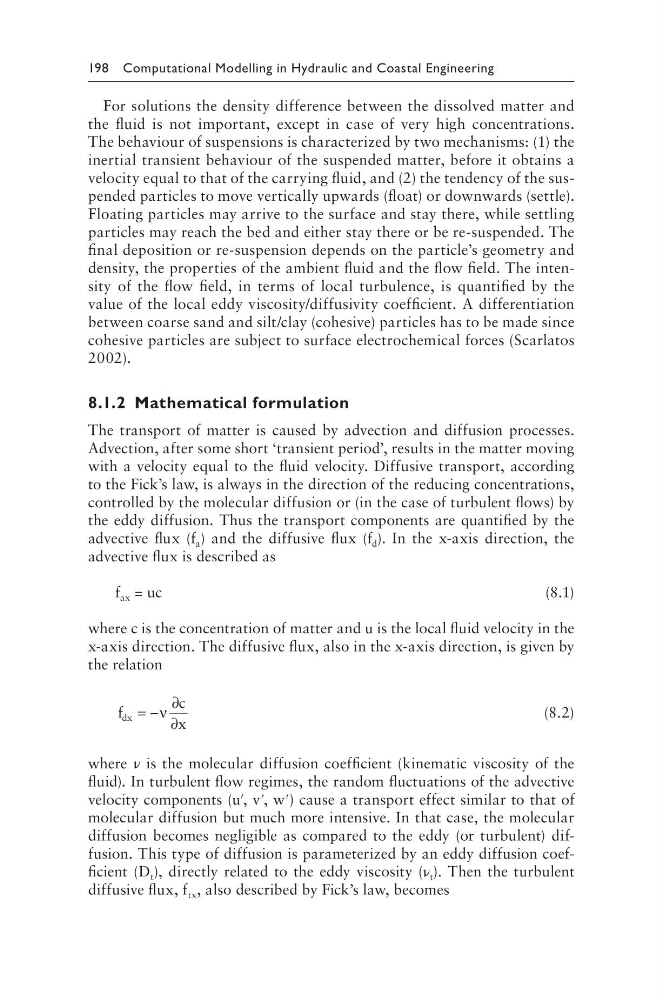
x-axis direction. The diffusive flux, also in the x-axis direction, is given by
the relation
f
c
x
dx = −
∂
∂
ν
(8.2)
where ν is the molecular diffusion coefficient (kinematic viscosity of the
fluid). In turbulent flow regimes, the random fluctuations of the advective
velocity components (u′, v′, w′) cause a transport effect similar to that of
molecular diffusion but much more intensive. In that case, the molecular
diffusion becomes negligible as compared to the eddy (or turbulent) diffusion. This type of diffusion is parameterized by an eddy diffusion coefficient (D t ), directly related to the eddy viscosity (ν t ). Then the turbulent
diffusive flux, f tx , also described by Fick’s law, becomes
For solutions the density difference between the dissolved matter and
the fluid is not important, except in case of very high concentrations.
The behaviour of suspensions is characterized by two mechanisms: (1) the
inertial transient behaviour of the suspended matter, before it obtains a
velocity equal to that of the carrying fluid, and (2) the tendency of the suspended particles to move vertically upwards (float) or downwards (settle).
Floating particles may arrive to the surface and stay there, while settling
particles may reach the bed and either stay there or be re-suspended. The
final deposition or re-suspension depends on the particle’s geometry and
density, the properties of the ambient fluid and the flow field. The intensity of the flow field, in terms of local turbulence, is quantified by the
value of the local eddy viscosity/diffusivity coefficient. A differentiation
between coarse sand and silt/clay (cohesive) particles has to be made since
cohesive particles are subject to surface electrochemical forces (Scarlatos
2002).
8.1.2 Mathematical formulation
The transport of matter is caused by advection and diffusion processes.
Advection, after some short ‘transient period’, results in the matter moving
with a velocity equal to the fluid velocity. Diffusive transport, according
to the Fick’s law, is always in the direction of the reducing concentrations,
controlled by the molecular diffusion or (in the case of turbulent flows) by
the eddy diffusion. Thus the transport components are quantified by the
advective flux (f a ) and the diffusive flux (f d ). In the x-axis direction, the
advective flux is described as
f ax = uc
(8.1)
where c is the concentration of matter and u is the local fluid velocity in the
x-axis direction. The diffusive flux, also in the x-axis direction, is given by
the relation
f
c
x
dx = −
∂
∂
ν
(8.2)
where ν is the molecular diffusion coefficient (kinematic viscosity of the
fluid). In turbulent flow regimes, the random fluctuations of the advective
velocity components (u′, v′, w′) cause a transport effect similar to that of
molecular diffusion but much more intensive. In that case, the molecular
diffusion becomes negligible as compared to the eddy (or turbulent) diffusion. This type of diffusion is parameterized by an eddy diffusion coefficient (D t ), directly related to the eddy viscosity (ν t ). Then the turbulent
diffusive flux, f tx , also described by Fick’s law, becomes