

Flow in porous media 189
4. Change the (i, 0) boundary to constant head of 45 m.
5. Using the Darcy equation, modify the code of the program to estimate and plot the flow velocity field towards the well.
7.2.3 Saltwater intrusion in coastal aquifers
An important problem of coastal aquifers is the intrusion of salt water
(saline wedge) into the groundwater, due to any prolonged operation of
discharging (production) wells. This is a very common phenomenon during the summer months in Mediterranean coastal aquifers, when both the
increase of the population (due to summer vacations) and the use of irrigation water reach an annual peak. By the end of the summer period, water
of increased salinity enters the production wells, to the disadvantage of the
local residents and the degradation of agricultural yield.
Based on the Dupuit assumption of nearly horizontal flow in an aquifer
with horizontal dimensions much larger than the vertical ones, a simulation model can be derived utilizing hydrostatic pressure distribution and
almost uniform seepage velocities throughout the porous medium (Bear
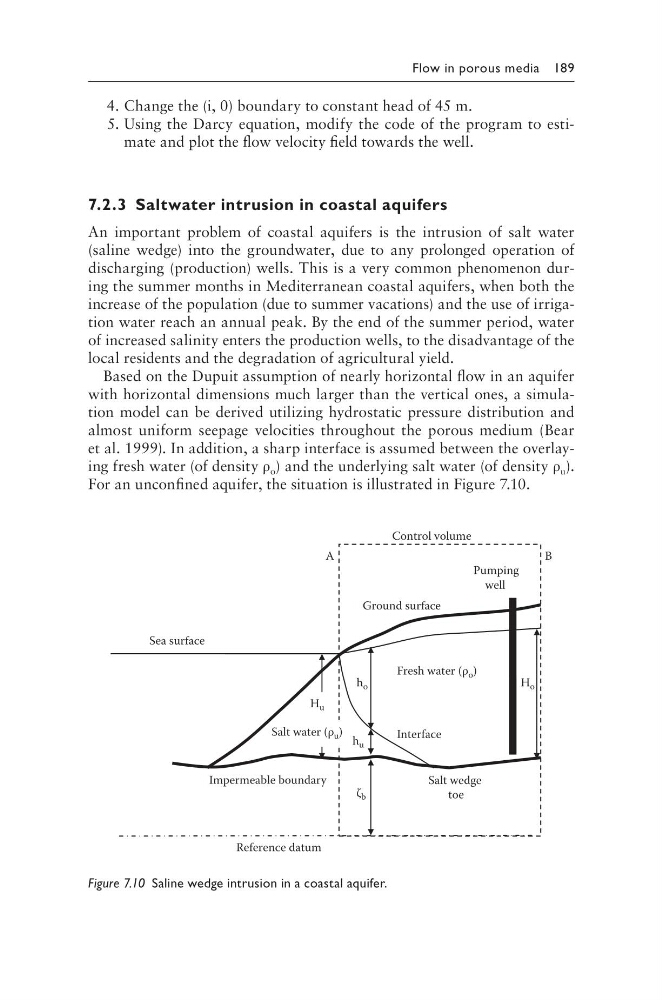
et al. 1999). In addition, a sharp interface is assumed between the overlaying fresh water (of density ρ o ) and the underlying salt water (of density ρ u ).
For an unconfined aquifer, the situation is illustrated in Figure 7.10.
H o
H u
B
A
Control volume
Ground surface
ζ b
Reference datum
h o
Salt water (ρ u ) h u
Pumping
well
Interface
Sea surface
Impermeable boundary
Fresh water (ρ o )
Salt wedge
toe
Figure 7.10 Saline wedge intrusion in a coastal aquifer.
4. Change the (i, 0) boundary to constant head of 45 m.
5. Using the Darcy equation, modify the code of the program to estimate and plot the flow velocity field towards the well.
7.2.3 Saltwater intrusion in coastal aquifers
An important problem of coastal aquifers is the intrusion of salt water
(saline wedge) into the groundwater, due to any prolonged operation of
discharging (production) wells. This is a very common phenomenon during the summer months in Mediterranean coastal aquifers, when both the
increase of the population (due to summer vacations) and the use of irrigation water reach an annual peak. By the end of the summer period, water
of increased salinity enters the production wells, to the disadvantage of the
local residents and the degradation of agricultural yield.
Based on the Dupuit assumption of nearly horizontal flow in an aquifer
with horizontal dimensions much larger than the vertical ones, a simulation model can be derived utilizing hydrostatic pressure distribution and
almost uniform seepage velocities throughout the porous medium (Bear
et al. 1999). In addition, a sharp interface is assumed between the overlaying fresh water (of density ρ o ) and the underlying salt water (of density ρ u ).
For an unconfined aquifer, the situation is illustrated in Figure 7.10.
H o
H u
B
A
Control volume
Ground surface
ζ b
Reference datum
h o
Salt water (ρ u ) h u
Pumping
well
Interface
Sea surface
Impermeable boundary
Fresh water (ρ o )
Salt wedge
toe
Figure 7.10 Saline wedge intrusion in a coastal aquifer.