

162 Computational Modelling in Hydraulic and Coastal Engineering
where ζ is the oscillation of the free surface, h is the static water depth, and
f b is a dimensionless bed friction coefficient.
The phenomenon can be analysed by monitoring the excitation of
the basin water that caused a localized initial impulse, that is, a sudden
increase of the free surface at one location of the basin. This local perturbation, in the form of a Dirac spike, mobilizes the water masses and
generates a complex wave pattern, as the initial perturbation contains
a large number of Fourier components, and the energy passes from one
period to another while affected by the non-linear terms. The time series
of the free surface elevation ζ n (for a time step Δt) at a location (the same
with the impulse location or another) is analysed using a Fourier series of
sine and cosine components. The local maxima of the amplitude of the
various Fourier components in the periodogram reveal the natural periods of oscillation.
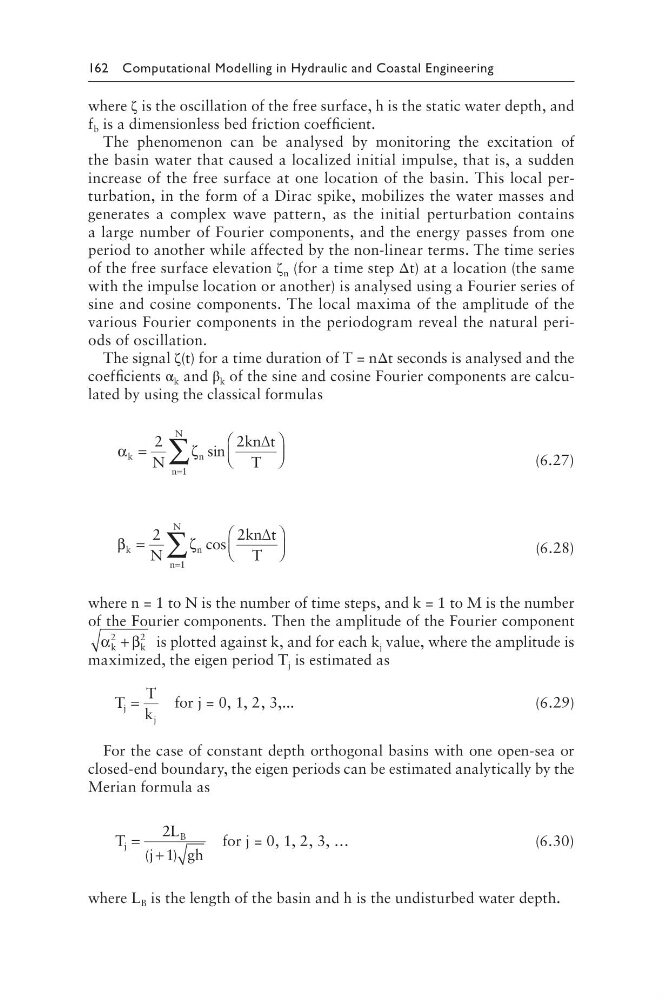
The signal ζ(t) for a time duration of T = nΔt seconds is analysed and the
coefficients α k and β k of the sine and cosine Fourier components are calculated by using the classical formulas
α
ζ
k
n
n
N
N
kn t
T
=
=
∑
2
2
1
sin
∆
(6.27)
β
ζ
k
n
n
N
N
kn t
T
=
=
∑
2
2
1
cos
∆
(6.28)
where n = 1 to N is the number of time steps, and k = 1 to M is the number
of the Fourier components. Then the amplitude of the Fourier component
α β
k
k
2
2
+
is plotted against k, and for each k j value, where the amplitude is
maximized, the eigen period T j is estimated as
T
T
k
j
j
=
for j = 0, 1, 2, 3,...
(6.29)
For the case of constant depth orthogonal basins with one open-sea or
closed-end boundary, the eigen periods can be estimated analytically by the
Merian formula as
T
L
j
gh
j
B
= +
2
1
(
)
for j = 0, 1, 2, 3, …
(6.30)
where L B is the length of the basin and h is the undisturbed water depth.
where ζ is the oscillation of the free surface, h is the static water depth, and
f b is a dimensionless bed friction coefficient.
The phenomenon can be analysed by monitoring the excitation of
the basin water that caused a localized initial impulse, that is, a sudden
increase of the free surface at one location of the basin. This local perturbation, in the form of a Dirac spike, mobilizes the water masses and
generates a complex wave pattern, as the initial perturbation contains
a large number of Fourier components, and the energy passes from one
period to another while affected by the non-linear terms. The time series
of the free surface elevation ζ n (for a time step Δt) at a location (the same
with the impulse location or another) is analysed using a Fourier series of
sine and cosine components. The local maxima of the amplitude of the
various Fourier components in the periodogram reveal the natural periods of oscillation.
The signal ζ(t) for a time duration of T = nΔt seconds is analysed and the
coefficients α k and β k of the sine and cosine Fourier components are calculated by using the classical formulas
α
ζ
k
n
n
N
N
kn t
T
=
=
∑
2
2
1
sin
∆
(6.27)
β
ζ
k
n
n
N
N
kn t
T
=
=
∑
2
2
1
cos
∆
(6.28)
where n = 1 to N is the number of time steps, and k = 1 to M is the number
of the Fourier components. Then the amplitude of the Fourier component
α β
k
k
2
2
+
is plotted against k, and for each k j value, where the amplitude is
maximized, the eigen period T j is estimated as
T
T
k
j
j
=
for j = 0, 1, 2, 3,...
(6.29)
For the case of constant depth orthogonal basins with one open-sea or
closed-end boundary, the eigen periods can be estimated analytically by the
Merian formula as
T
L
j
gh
j
B
= +
2
1
(
)
for j = 0, 1, 2, 3, …
(6.30)
where L B is the length of the basin and h is the undisturbed water depth.