

Surface gravity water waves 155
middle of the flow domain (behind the breakwater) shows that a quasisteady periodic state is established after 10 wave periods, resulting in
a reduction of the wave amplitude by half (Figure 6.6). The impact of
the breakwater and the free wave radiation boundary conditions on
the wave propagation are captured in the three-dimensional spatial
distribution of the free surface elevation taken at time t = 2400 Δt
(Figure 6.7).
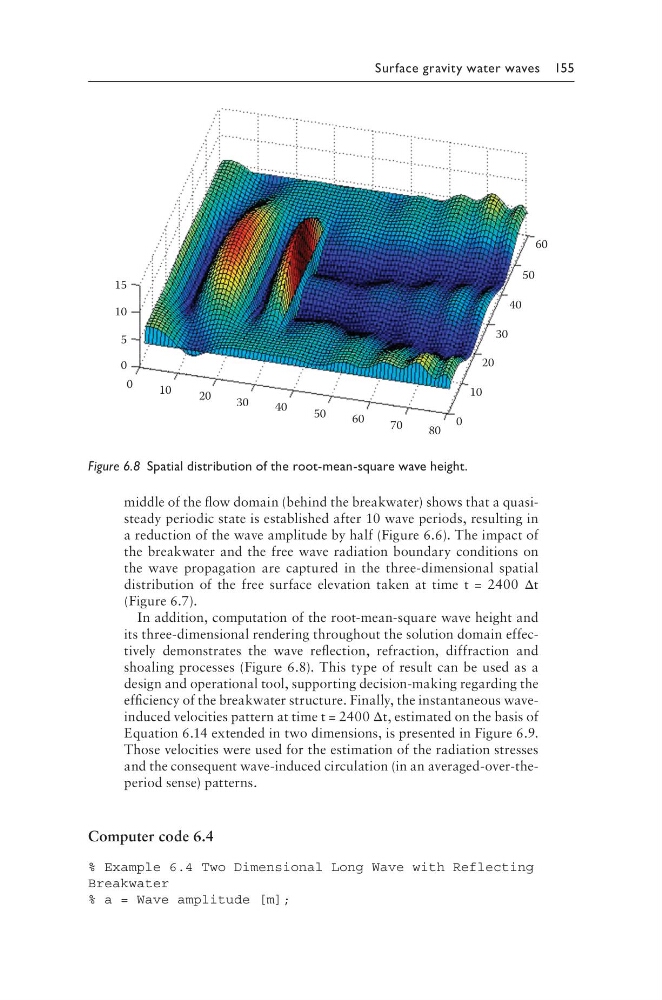
In addition, computation of the root-mean-square wave height and
its three-dimensional rendering throughout the solution domain effectively demonstrates the wave reflection, refraction, diffraction and
shoaling processes (Figure 6.8). This type of result can be used as a
design and operational tool, supporting decision-making regarding the
efficiency of the breakwater structure. Finally, the instantaneous waveinduced velocities pattern at time t = 2400 Δt, estimated on the basis of
Equation 6.14 extended in two dimensions, is presented in Figure 6.9.
Those velocities were used for the estimation of the radiation stresses
and the consequent wave-induced circulation (in an averaged-over-theperiod sense) patterns.
Computer code 6.4
% Example 6.4 Two Dimensional Long Wave with Reflecting
Breakwater
% a = Wave amplitude [m];
15
10
5
0
0
10
20
30
40
50
60
70
80
0
10
20
30
40
50
60
Figure 6.8 Spatial distribution of the root-mean-square wave height.
middle of the flow domain (behind the breakwater) shows that a quasisteady periodic state is established after 10 wave periods, resulting in
a reduction of the wave amplitude by half (Figure 6.6). The impact of
the breakwater and the free wave radiation boundary conditions on
the wave propagation are captured in the three-dimensional spatial
distribution of the free surface elevation taken at time t = 2400 Δt
(Figure 6.7).
In addition, computation of the root-mean-square wave height and
its three-dimensional rendering throughout the solution domain effectively demonstrates the wave reflection, refraction, diffraction and
shoaling processes (Figure 6.8). This type of result can be used as a
design and operational tool, supporting decision-making regarding the
efficiency of the breakwater structure. Finally, the instantaneous waveinduced velocities pattern at time t = 2400 Δt, estimated on the basis of
Equation 6.14 extended in two dimensions, is presented in Figure 6.9.
Those velocities were used for the estimation of the radiation stresses
and the consequent wave-induced circulation (in an averaged-over-theperiod sense) patterns.
Computer code 6.4
% Example 6.4 Two Dimensional Long Wave with Reflecting
Breakwater
% a = Wave amplitude [m];
15
10
5
0
0
10
20
30
40
50
60
70
80
0
10
20
30
40
50
60
Figure 6.8 Spatial distribution of the root-mean-square wave height.