

136 Computational Modelling in Hydraulic and Coastal Engineering
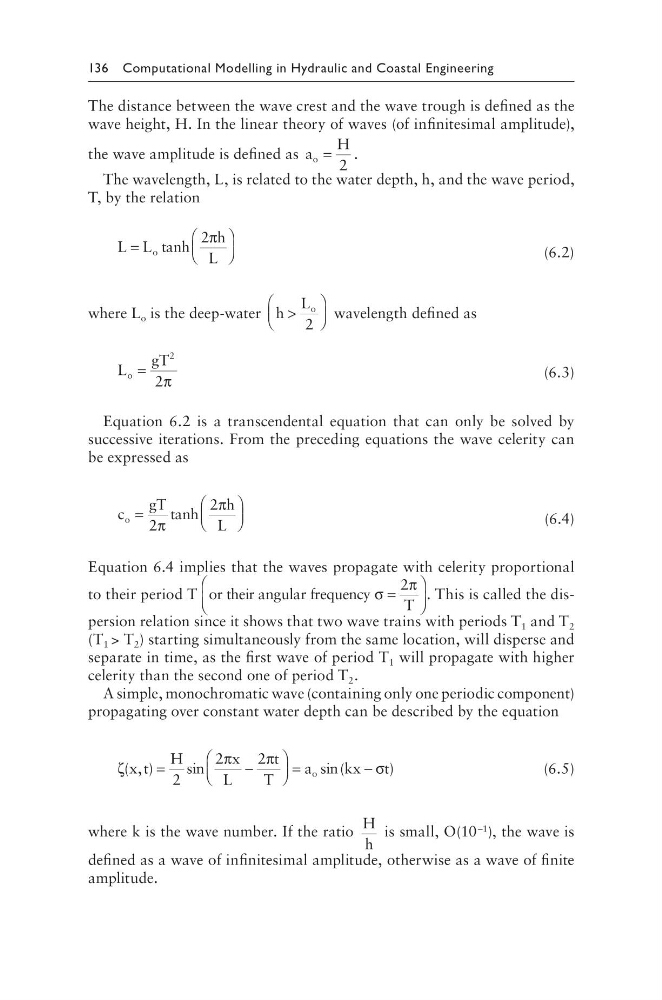
The distance between the wave crest and the wave trough is defined as the
wave height, H. In the linear theory of waves (of infinitesimal amplitude),
the wave amplitude is defined as a
H
o = 2
.
The wavelength, L, is related to the water depth, h, and the wave period,
T, by the relation
L L
h
L
o
=
tanh
2π
(6.2)
where L o is the deep-water h
L o
>
2
wavelength defined as
L
gT
o =
2
2π
(6.3)
Equation 6.2 is a transcendental equation that can only be solved by
successive iterations. From the preceding equations the wave celerity can
be expressed as
c
gT
h
L
o =
2
2
π
π
tanh
(6.4)
Equation 6.4 implies that the waves propagate with celerity proportional
to their period T or their angular frequency
T
σ
π
=
2 . This is called the dispersion relation since it shows that two wave trains with periods T 1 and T 2
(T 1 > T 2 ) starting simultaneously from the same location, will disperse and
separate in time, as the first wave of period T 1 will propagate with higher
celerity than the second one of period T 2 .
A simple, monochromatic wave (containing only one periodic compo nent)
propagating over constant water depth can be described by the equation
ζ
π
π
σ
( , )
sin
sin(
)
x t
H
x
L
t
T
a
kx
t
o
=
−
=
−
2
2
2
(6.5)
where k is the wave number. If the ratio
H
h
is small, O(10 –1 ), the wave is
defined as a wave of infinitesimal amplitude, otherwise as a wave of finite
amplitude.
The distance between the wave crest and the wave trough is defined as the
wave height, H. In the linear theory of waves (of infinitesimal amplitude),
the wave amplitude is defined as a
H
o = 2
.
The wavelength, L, is related to the water depth, h, and the wave period,
T, by the relation
L L
h
L
o
=
tanh
2π
(6.2)
where L o is the deep-water h
L o
>
2
wavelength defined as
L
gT
o =
2
2π
(6.3)
Equation 6.2 is a transcendental equation that can only be solved by
successive iterations. From the preceding equations the wave celerity can
be expressed as
c
gT
h
L
o =
2
2
π
π
tanh
(6.4)
Equation 6.4 implies that the waves propagate with celerity proportional
to their period T or their angular frequency
T
σ
π
=
2 . This is called the dispersion relation since it shows that two wave trains with periods T 1 and T 2
(T 1 > T 2 ) starting simultaneously from the same location, will disperse and
separate in time, as the first wave of period T 1 will propagate with higher
celerity than the second one of period T 2 .
A simple, monochromatic wave (containing only one periodic compo nent)
propagating over constant water depth can be described by the equation
ζ
π
π
σ
( , )
sin
sin(
)
x t
H
x
L
t
T
a
kx
t
o
=
−
=
−
2
2
2
(6.5)
where k is the wave number. If the ratio
H
h
is small, O(10 –1 ), the wave is
defined as a wave of infinitesimal amplitude, otherwise as a wave of finite
amplitude.