

78
DETERMINISTIC DESCRIPTIONS OF OFFSHORE WAVES
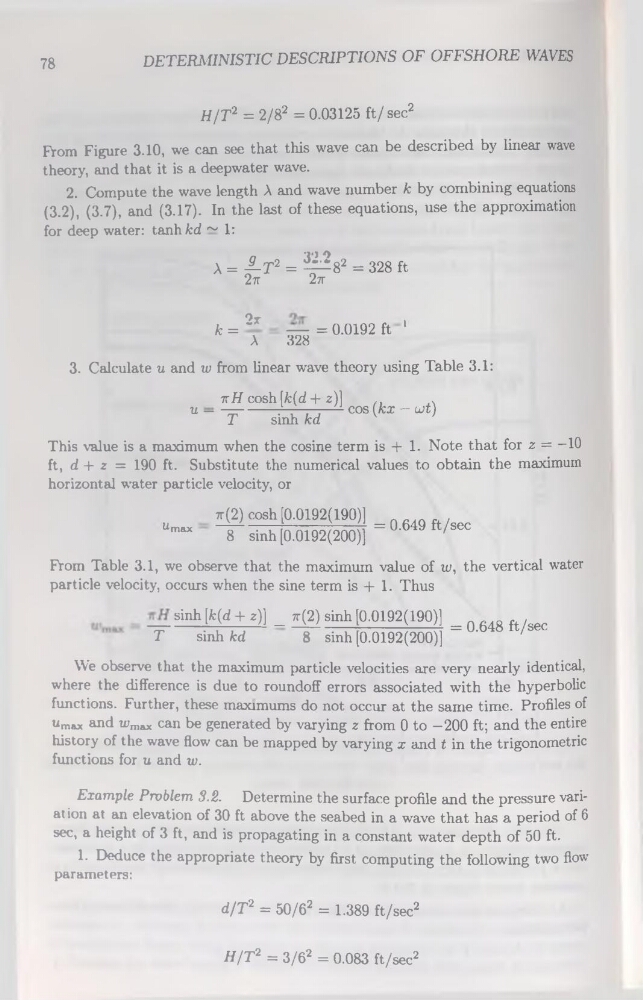
H/T2 = 2/82 = 0.03125 ft/sec2
FYom Figure 3.10, we can see that this wave can be described by linear wave
theory, and that it is a deepwater wave.
2. Compute the wave length A and wave number k by combining équations
(3.2), (3.7), and (3.17). In the last of these équations, use the approximation
for deep water: tanh/cd ~ 1:
A = ^-T2
Z7T
'{•) O
= ïr±82 = 328 ft
2tt
k=*
A
— = 0.0192 ft 1
328
3.
Calculate u and w from linear wave theory using Table 3.1:
u —
7rH cosh [k(d + z)]
T
sinh kd
cos (kx — ait)
This value is a maximum when the cosine term is + 1. Note that for z = -10
ft, d + z = 190 ft. Substitute the numerical values to obtain the maximum
horizontal water particle velocity, or
tt(2) cosh [0.0192(190)]
Umax
8 sinh [0.0192(200)] = 0.649 ft/sec
From Table 3.1, we observe that the maximum value of w, the vertical water
particle velocity, occurs when the sine term is + 1. Thus
sinh [fc(d + z)] _ tt(2) sinh [0.0192(190)]
T
sinh kd
8 sinh [0.0192(200)]
= 0.648 ft/sec
We observe that the maximum particle velocities are very nearly identical,
where the différence is due to roundoff errors associated with the hyperbolic
functions. Further, these maximums do not occur at the same time. Profiles of
Umiu< and wmax can be generated by varying z from 0 to —200 ft; and the entire
history of the wave flow can be mapped by varying x and t in the trigonométrie
functions for u and w.
Example Problem 3.2. Détermine the surface profile and the pressure variât ion at an élévation of 30 ft above the seabed in a wave that has a period of 6
sec, a height of 3 ft, and is propagating in a constant water depth of 50 ft.
1. Deduce the appropriate theory by first computing the following two flow
parameters:
d/T2 = 50/62 = 1.389 ft/sec2
H/T2 = 3/62 = 0.083 ft/sec2
DETERMINISTIC DESCRIPTIONS OF OFFSHORE WAVES
H/T2 = 2/82 = 0.03125 ft/sec2
FYom Figure 3.10, we can see that this wave can be described by linear wave
theory, and that it is a deepwater wave.
2. Compute the wave length A and wave number k by combining équations
(3.2), (3.7), and (3.17). In the last of these équations, use the approximation
for deep water: tanh/cd ~ 1:
A = ^-T2
Z7T
'{•) O
= ïr±82 = 328 ft
2tt
k=*
A
— = 0.0192 ft 1
328
3.
Calculate u and w from linear wave theory using Table 3.1:
u —
7rH cosh [k(d + z)]
T
sinh kd
cos (kx — ait)
This value is a maximum when the cosine term is + 1. Note that for z = -10
ft, d + z = 190 ft. Substitute the numerical values to obtain the maximum
horizontal water particle velocity, or
tt(2) cosh [0.0192(190)]
Umax
8 sinh [0.0192(200)] = 0.649 ft/sec
From Table 3.1, we observe that the maximum value of w, the vertical water
particle velocity, occurs when the sine term is + 1. Thus
sinh [fc(d + z)] _ tt(2) sinh [0.0192(190)]
T
sinh kd
8 sinh [0.0192(200)]
= 0.648 ft/sec
We observe that the maximum particle velocities are very nearly identical,
where the différence is due to roundoff errors associated with the hyperbolic
functions. Further, these maximums do not occur at the same time. Profiles of
Umiu< and wmax can be generated by varying z from 0 to —200 ft; and the entire
history of the wave flow can be mapped by varying x and t in the trigonométrie
functions for u and w.
Example Problem 3.2. Détermine the surface profile and the pressure variât ion at an élévation of 30 ft above the seabed in a wave that has a period of 6
sec, a height of 3 ft, and is propagating in a constant water depth of 50 ft.
1. Deduce the appropriate theory by first computing the following two flow
parameters:
d/T2 = 50/62 = 1.389 ft/sec2
H/T2 = 3/62 = 0.083 ft/sec2