

64
DETERMINISTIC DESCRIPTIONS OF OFFSHORE WAVES
where iv is the angular frequency. From équations (3.2) and (3.5) it follows that
À = cT
(3.7)
Equation (3.7), which could hâve been inferred directly, is a fondamental relationship in wave theory and has general application regardless of wave form.
Equation (3.6) enables us to rewrite équation (3.3) as
q(x, t) = A cos(kæ - ait)
(3.8)
If we now compare two similar waves of identical form that pass the sanie place
at different times, we hâve for one at t = 0
î)j=0 = A cos kx
(3.9a)
and for the other
’vJLo = A cos(^æ + £)
(3.9b)
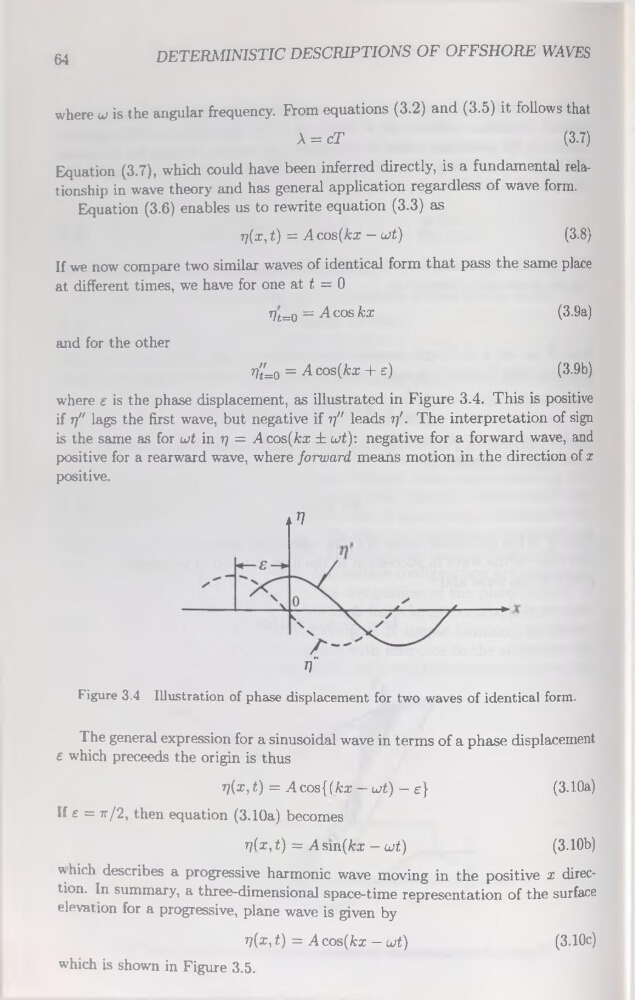
where £ is the phase displacement, as illustrated in Figure 3.4. This is positive
if q" lags the first wave, but négative if q” leads q'. The interprétation of sign
is the same as for ivt in q = Acos(krr ± ait): négative for a forward wave, and
positive for a rearward wave, where forward means motion in the direction of x
positive.
♦ *7
l”
Figure 3.4 Illustration of phase displacement for two waves of identical form.
The general expression for a sinusoïdal wave in terms of a phase displacement
e which preceeds the origin is thus
q(x,t) = Acos{(kx ~ ait) — s}
(3.10a)
If £ = 7t/2, then équation (3.10a) becomes
q(x, t) = A sm(kx — ait)
(3.10b)
which describes a progressive harmonie wave moving in the positive x direction. In summary, a three-dimensional space-time représentation of the surface
élévation for a progressive, plane wave is given by
q(x, t) = A cos(fcz - at)
(3.10c)
which is shown in Figure 3.5.
DETERMINISTIC DESCRIPTIONS OF OFFSHORE WAVES
where iv is the angular frequency. From équations (3.2) and (3.5) it follows that
À = cT
(3.7)
Equation (3.7), which could hâve been inferred directly, is a fondamental relationship in wave theory and has general application regardless of wave form.
Equation (3.6) enables us to rewrite équation (3.3) as
q(x, t) = A cos(kæ - ait)
(3.8)
If we now compare two similar waves of identical form that pass the sanie place
at different times, we hâve for one at t = 0
î)j=0 = A cos kx
(3.9a)
and for the other
’vJLo = A cos(^æ + £)
(3.9b)
where £ is the phase displacement, as illustrated in Figure 3.4. This is positive
if q" lags the first wave, but négative if q” leads q'. The interprétation of sign
is the same as for ivt in q = Acos(krr ± ait): négative for a forward wave, and
positive for a rearward wave, where forward means motion in the direction of x
positive.
♦ *7
l”
Figure 3.4 Illustration of phase displacement for two waves of identical form.
The general expression for a sinusoïdal wave in terms of a phase displacement
e which preceeds the origin is thus
q(x,t) = Acos{(kx ~ ait) — s}
(3.10a)
If £ = 7t/2, then équation (3.10a) becomes
q(x, t) = A sm(kx — ait)
(3.10b)
which describes a progressive harmonie wave moving in the positive x direction. In summary, a three-dimensional space-time représentation of the surface
élévation for a progressive, plane wave is given by
q(x, t) = A cos(fcz - at)
(3.10c)
which is shown in Figure 3.5.