

62
DETERMINISTIC DESCRIPTIONS OF OFFSHORE WAVES
DETERMINISTIC
NUMERIC
ANALYT1C
PROBABILISTIC
WAVE
SPECTRA
LINEAR
THEORIES
NONLINEAR
THEORIES
Figure 3.1 Alternative approaches for describing surface gravity waves.
3.1 DESCRIPTION OF PLANE WAVES
Before discussing the most important classical wave théories, we first introduce
some fondamental définitions and concepts. The natural occurrence of waves
is usually complicated by the simultaneous superposition of waves of many different shapes and energies. Thus we define a single wave or a train of waves of
pure form that always behaves in exactly the same way on passing any given
point, and that propagates without change of shape when the surrounding conditions remain the same. Further, we consider only plane or long-crested waves
of permanent form, waves that are independent of the coordinate normal to the
wave propagation direction. Therefore their crests or troughs can be represented
by straight lines in a horizontal plane. By permanent form, we mean that the
field of motion, pressure distribution, and surface configuration are maintained
as one follows the wave at a speed c, the désignation of the phase velocity or
celerity. (In a strict sense ail real waves hâve finite length crests, a factor that
is ignored herein.) Consider a wave form that is simple harmonie so that at
any time t the wave has a sinusoïdal shape with référencé to the still water line
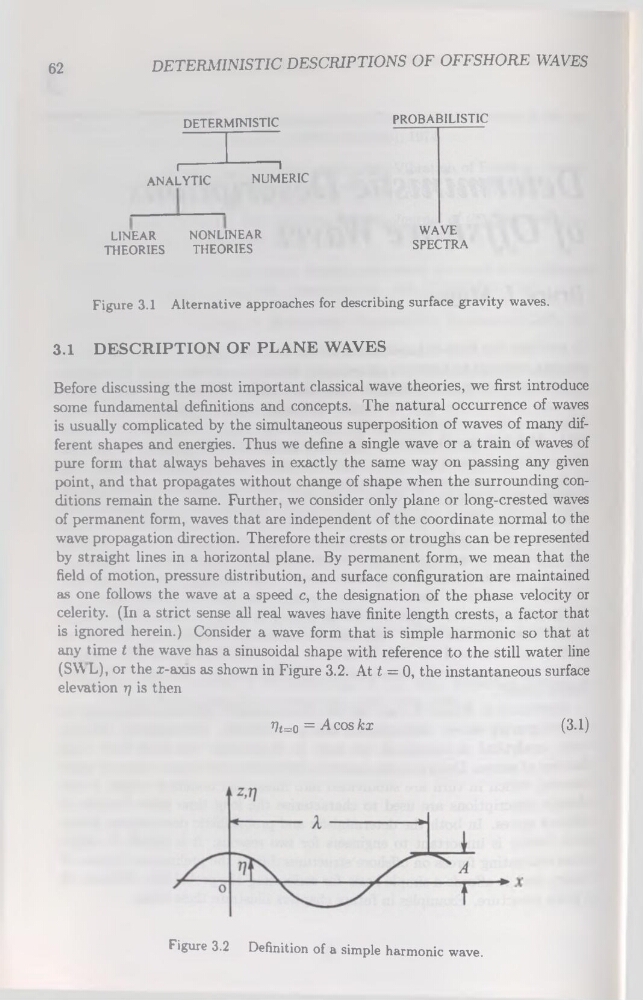
(SW L), or the z-axis as shown in Figure 3.2. At t = 0, the instantaneous surface
élévation T] is then
r)t=o = A cos kx
(3.1)
Figure 3.2 Définition of a simple harmonie wave.
DETERMINISTIC DESCRIPTIONS OF OFFSHORE WAVES
DETERMINISTIC
NUMERIC
ANALYT1C
PROBABILISTIC
WAVE
SPECTRA
LINEAR
THEORIES
NONLINEAR
THEORIES
Figure 3.1 Alternative approaches for describing surface gravity waves.
3.1 DESCRIPTION OF PLANE WAVES
Before discussing the most important classical wave théories, we first introduce
some fondamental définitions and concepts. The natural occurrence of waves
is usually complicated by the simultaneous superposition of waves of many different shapes and energies. Thus we define a single wave or a train of waves of
pure form that always behaves in exactly the same way on passing any given
point, and that propagates without change of shape when the surrounding conditions remain the same. Further, we consider only plane or long-crested waves
of permanent form, waves that are independent of the coordinate normal to the
wave propagation direction. Therefore their crests or troughs can be represented
by straight lines in a horizontal plane. By permanent form, we mean that the
field of motion, pressure distribution, and surface configuration are maintained
as one follows the wave at a speed c, the désignation of the phase velocity or
celerity. (In a strict sense ail real waves hâve finite length crests, a factor that
is ignored herein.) Consider a wave form that is simple harmonie so that at
any time t the wave has a sinusoïdal shape with référencé to the still water line
(SW L), or the z-axis as shown in Figure 3.2. At t = 0, the instantaneous surface
élévation T] is then
r)t=o = A cos kx
(3.1)
Figure 3.2 Définition of a simple harmonie wave.