

50
STRUCTURE-ENVIRONMENTAL FORCE INTERACTIONS
Numerical results for 3r = 45 and 60 deg are shown in Figure 2.21. For
the single cable, the nondimensional horizontal restoring force Fx is small for
négative nondimensional displacements v and increases at a growing rate as
v becomes positive. For the broken-line curves which correspond to opposing
pairs of cables 180 deg apart, Fx is antisymmetric about v — 0 and behaves
as a “hardening” spring for both positive and négative displacements v. For
these opposing cables, if the actual displacement v is less than about 5 percent
of the attachment height Zq, the horizontal force-displacement relationship is
linear, for practical purposes. In general for such diametrically opposed cable
Systems, the horizontal restoring force q(y) can be approximated by an odd
order polynomial in v, or
q(v) = ki + k$v3
(2.69)
Calculations of ç(v) for other 0T values and for muliple pairs of identical, symmetric arrays of cables, with their ultimate approximation in the form of équation (2.69), are left for the reader. In making such calculations, it is recalled
that this analysis is valid only for cables that are relatively inextensible. Calculations by Irvine (1981) imply that for steel cables over 13 cm in diameter,
where 45 < 9r < 85 deg, the cable extension strain is less than 0.1 percent. In
such cases the assumption of cable inextensibility is a reasonable one and the
results obtained herein are valid.
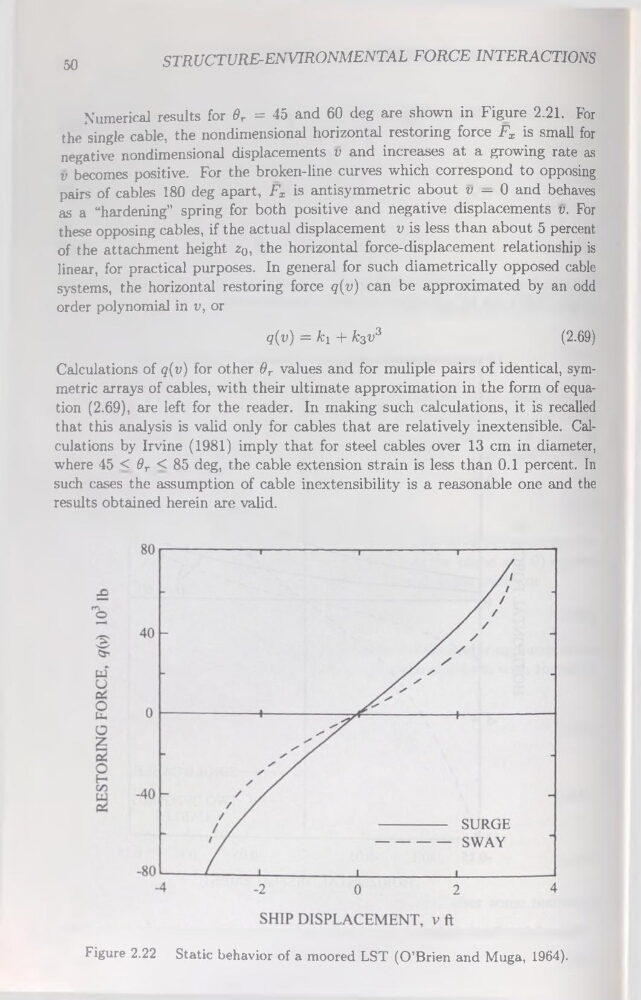
Figure 2.22 Static behavior of a moored LST (O’Brien and Muga, 1964).
STRUCTURE-ENVIRONMENTAL FORCE INTERACTIONS
Numerical results for 3r = 45 and 60 deg are shown in Figure 2.21. For
the single cable, the nondimensional horizontal restoring force Fx is small for
négative nondimensional displacements v and increases at a growing rate as
v becomes positive. For the broken-line curves which correspond to opposing
pairs of cables 180 deg apart, Fx is antisymmetric about v — 0 and behaves
as a “hardening” spring for both positive and négative displacements v. For
these opposing cables, if the actual displacement v is less than about 5 percent
of the attachment height Zq, the horizontal force-displacement relationship is
linear, for practical purposes. In general for such diametrically opposed cable
Systems, the horizontal restoring force q(y) can be approximated by an odd
order polynomial in v, or
q(v) = ki + k$v3
(2.69)
Calculations of ç(v) for other 0T values and for muliple pairs of identical, symmetric arrays of cables, with their ultimate approximation in the form of équation (2.69), are left for the reader. In making such calculations, it is recalled
that this analysis is valid only for cables that are relatively inextensible. Calculations by Irvine (1981) imply that for steel cables over 13 cm in diameter,
where 45 < 9r < 85 deg, the cable extension strain is less than 0.1 percent. In
such cases the assumption of cable inextensibility is a reasonable one and the
results obtained herein are valid.
Figure 2.22 Static behavior of a moored LST (O’Brien and Muga, 1964).