

STRUCTURAL MASS, DAMPING, AND RESTRAINT
47
Example Problem 2.9. The floating structure of Figure 2.19, representing
a moored ship or a semisubmersible platform, is restrained by symmetrically
placed, uniform cables separated by equal angles /3. Assume that the platform
motion v(t) is not excessive so that a portion at the lower end of each cable
always remains fiat. Thus, vertical pull forces on the anchors do not occur. The
problem is to calculate the stiffness q(v), first for one of the pair of opposing
cables in line with the deflection coordinate v(t), and then for the other cable
of the pair. The calculation of the stiffness due to the full array of cables is left
to the reader.
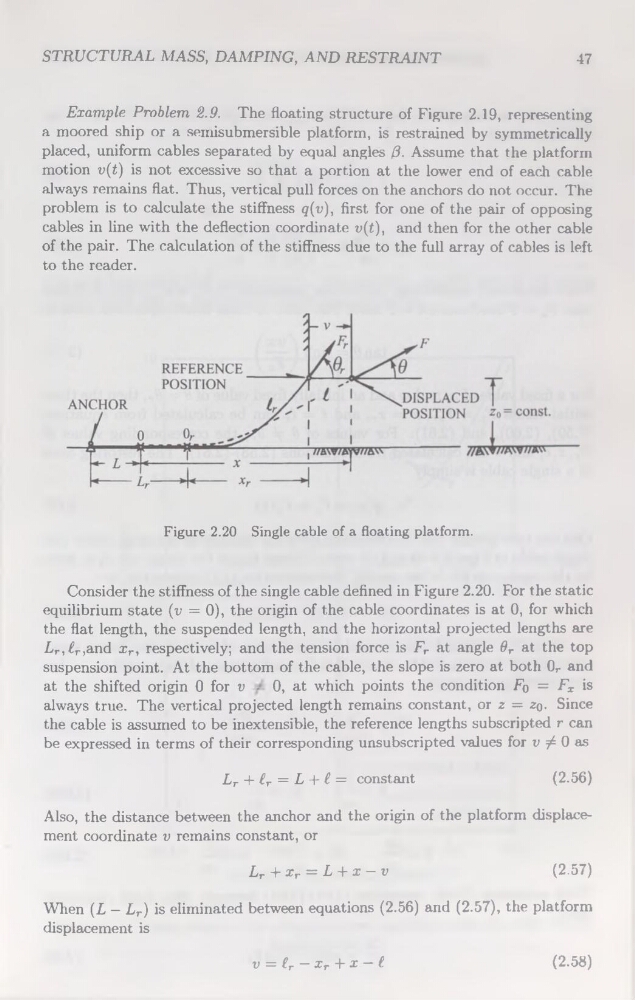
Figure 2.20 Single cable of a floating platform.
Consider the stiffness of the single cable defined in Figure 2.20. For the static
equilibrium State (v = 0), the origin of the cable coordinates is at 0, for which
the fiat length, the suspended length, and the horizontal projected lengths are
Lr,£r,and xr, respectively; and the tension force is Fr at angle 9r at the top
suspension point. At the bottom of the cable, the slope is zéro at both 0r and
at the shifted origin 0 for v - 0, at which points the condition Fo = Fx is
always true. The vertical projected length remains constant, or z = zq. Since
the cable is assumed to be inextensible, the reference lengths subscripted r can
be expressed in terms of their corresponding unsubscripted values for v 0 0 as
Lr 4- tr = L 4- £ = constant
(2.56)
Also, the distance between the anchor and the origin of the platform displacement coordinate v remains constant, or
Lr + xr = L + x — v
(2.57)
When (L — Lr) is eliminated between équations (2.56) and (2.57), the platform
displacement is
v = (r — xr + x ~ ?
(2.58)
47
Example Problem 2.9. The floating structure of Figure 2.19, representing
a moored ship or a semisubmersible platform, is restrained by symmetrically
placed, uniform cables separated by equal angles /3. Assume that the platform
motion v(t) is not excessive so that a portion at the lower end of each cable
always remains fiat. Thus, vertical pull forces on the anchors do not occur. The
problem is to calculate the stiffness q(v), first for one of the pair of opposing
cables in line with the deflection coordinate v(t), and then for the other cable
of the pair. The calculation of the stiffness due to the full array of cables is left
to the reader.
Figure 2.20 Single cable of a floating platform.
Consider the stiffness of the single cable defined in Figure 2.20. For the static
equilibrium State (v = 0), the origin of the cable coordinates is at 0, for which
the fiat length, the suspended length, and the horizontal projected lengths are
Lr,£r,and xr, respectively; and the tension force is Fr at angle 9r at the top
suspension point. At the bottom of the cable, the slope is zéro at both 0r and
at the shifted origin 0 for v - 0, at which points the condition Fo = Fx is
always true. The vertical projected length remains constant, or z = zq. Since
the cable is assumed to be inextensible, the reference lengths subscripted r can
be expressed in terms of their corresponding unsubscripted values for v 0 0 as
Lr 4- tr = L 4- £ = constant
(2.56)
Also, the distance between the anchor and the origin of the platform displacement coordinate v remains constant, or
Lr + xr = L + x — v
(2.57)
When (L — Lr) is eliminated between équations (2.56) and (2.57), the platform
displacement is
v = (r — xr + x ~ ?
(2.58)