

FLUID-INDUCED STRUCTURAL FORCES
27
large comparée! to T, then data show that Cd and Cm are fonctions of three
parameters, expressed as
Cd = C*D(Re, Kc, cylinder roughness)
(2.18a)
Cm — Cm(R&, Kc, cylinder roughness)
(2.18b)
Further, Sarpkaya (1976) proposed that
those relationships, where
a frequency parameter fl replace Re in
Re_ _ pD2
Kc “ pT
(2-19)
Cd — Cd(0, Kc, cylinder roughness)
(2.20a)
Cm = Cm (fl, Kc, cylinder roughness)
(2.20b)
The main advantage of Sarpkaya’s forms is that «o, the free stream amplitude of
the periodic velocity, then appears only once in each fonction of équations (2.20),
instead of twice in each function of équations (2.18). For periodic flows, this
alternative gives efficient corrélations of measured cylinder forces with Cd and
Cm ■ Among the phenomena neglected in both of these functional relationships
are cavitation, fluid compressibility, three-dimensional flow, proximity effects,
and ail movement of the cylinder. In the following example problem, Morison’s
équation is modified to account for one of these neglected factors: the latéral
vibrations of the cylinder.
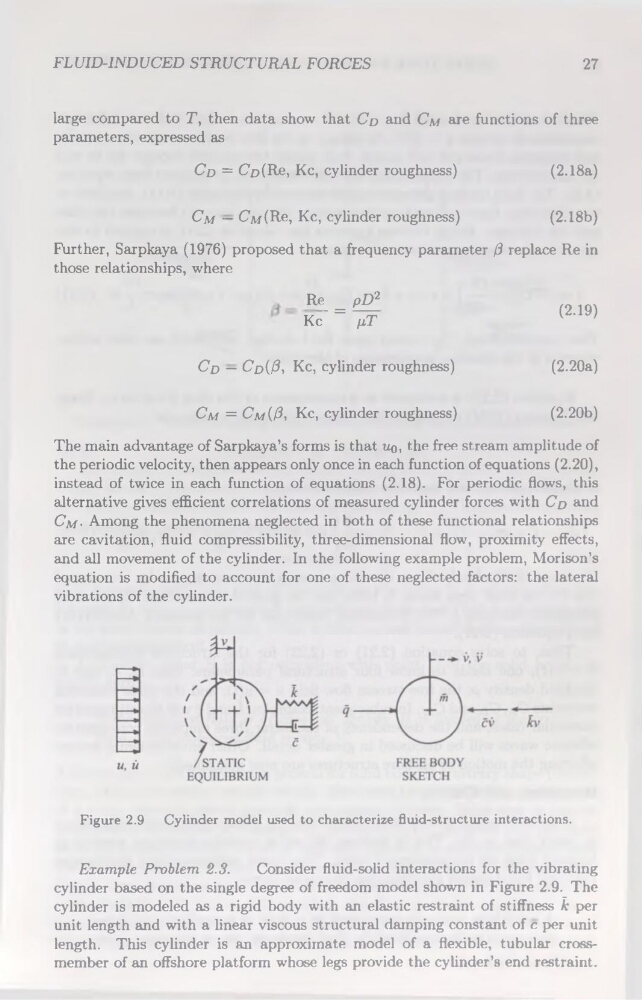
Figure 2.9 Cylinder model used to characterize fluid-structure interactions.
Example Problem 2.3.
Consider fluid-solid interactions for the vibrating
cylinder based on the single degree of freedom model shown in Figure 2.9. The
cylinder is modeled as a rigid body with an elastic restraint of stiffness k per
unit length and with a linear viscous structural damping constant of c per unit
length. This cylinder is an approximate model of a flexible, tubular crossmember of an offshore platform whose legs provide the cylinder’s end restraint.
27
large comparée! to T, then data show that Cd and Cm are fonctions of three
parameters, expressed as
Cd = C*D(Re, Kc, cylinder roughness)
(2.18a)
Cm — Cm(R&, Kc, cylinder roughness)
(2.18b)
Further, Sarpkaya (1976) proposed that
those relationships, where
a frequency parameter fl replace Re in
Re_ _ pD2
Kc “ pT
(2-19)
Cd — Cd(0, Kc, cylinder roughness)
(2.20a)
Cm = Cm (fl, Kc, cylinder roughness)
(2.20b)
The main advantage of Sarpkaya’s forms is that «o, the free stream amplitude of
the periodic velocity, then appears only once in each fonction of équations (2.20),
instead of twice in each function of équations (2.18). For periodic flows, this
alternative gives efficient corrélations of measured cylinder forces with Cd and
Cm ■ Among the phenomena neglected in both of these functional relationships
are cavitation, fluid compressibility, three-dimensional flow, proximity effects,
and ail movement of the cylinder. In the following example problem, Morison’s
équation is modified to account for one of these neglected factors: the latéral
vibrations of the cylinder.
Figure 2.9 Cylinder model used to characterize fluid-structure interactions.
Example Problem 2.3.
Consider fluid-solid interactions for the vibrating
cylinder based on the single degree of freedom model shown in Figure 2.9. The
cylinder is modeled as a rigid body with an elastic restraint of stiffness k per
unit length and with a linear viscous structural damping constant of c per unit
length. This cylinder is an approximate model of a flexible, tubular crossmember of an offshore platform whose legs provide the cylinder’s end restraint.