

302
BEHAVIOR OF PILES SUPPORTING OFFSHORE STRUCTURES
where El is the flexural rigidity of the pile and kpy is a constant relating the
sécant modulus of soil reaction to depth (Epy — kpyx).
3.
Compute the depth coefficient Zmax as follows:
^max
(11-14)
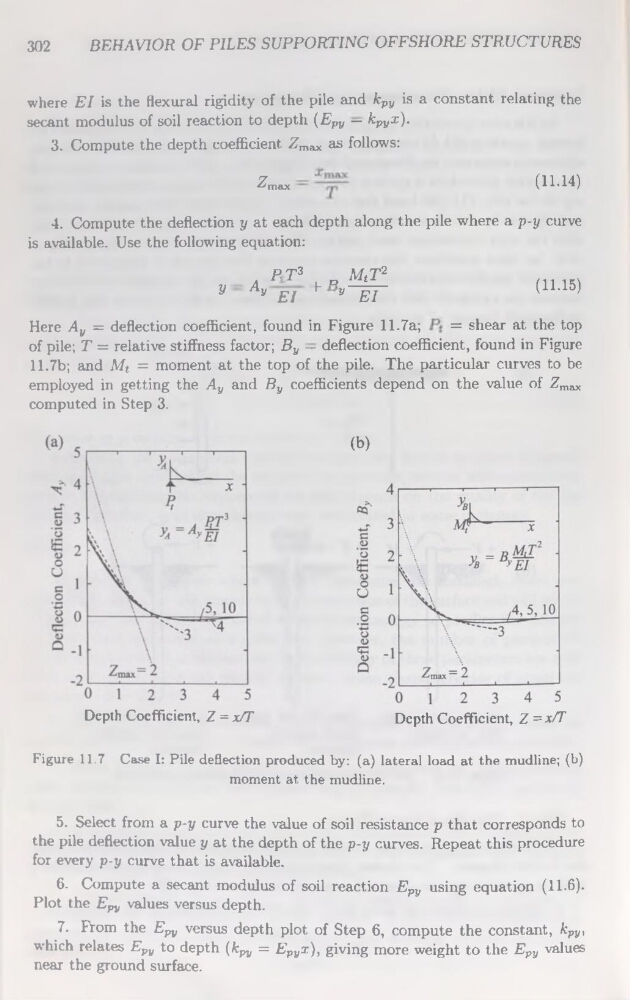
4. Compute the deflection y at each depth along the pile where a p-y curve
is available. Use the following équation:
.RT3
n MtT2
y Ay El *■ ’ El
(11.15)
Here Ay = deflection coefficient, found in Figure 11.7a;
= shear at the top
of pile; T = relative stiffness factor; By — deflection coefficient, found in Figure
11.7b; and Mt = moment at the top of the pile. The particular curves to be
employed in getting the Ay and By coefficients dépend on the value of Zmax
computed in Step 3.
Depth Coefficient, Z = x/T
(b)
Depth Coefficient, Z = x/T
Figure 11.7 Case I: Pile deflection produced by: (a) latéral load at the mudline; (b)
moment at the mudline.
5. Select from a p-y curve the value of soil résistance p that corresponds to
the pile deflection value y at the depth of the p-y curves. Repeat this procedure
for every p-y curve that is available.
6. Compute a sécant modulus of soil reaction Epy using équation (11.6).
Plot the En values versus depth.
7. From the Epy versus depth plot of Step 6, compute the constant, fcpî/)
which relates Epv to depth (kpy = Epyx), giving more weight to the Epy values
near the ground surface.
BEHAVIOR OF PILES SUPPORTING OFFSHORE STRUCTURES
where El is the flexural rigidity of the pile and kpy is a constant relating the
sécant modulus of soil reaction to depth (Epy — kpyx).
3.
Compute the depth coefficient Zmax as follows:
^max
(11-14)
4. Compute the deflection y at each depth along the pile where a p-y curve
is available. Use the following équation:
.RT3
n MtT2
y Ay El *■ ’ El
(11.15)
Here Ay = deflection coefficient, found in Figure 11.7a;
= shear at the top
of pile; T = relative stiffness factor; By — deflection coefficient, found in Figure
11.7b; and Mt = moment at the top of the pile. The particular curves to be
employed in getting the Ay and By coefficients dépend on the value of Zmax
computed in Step 3.
Depth Coefficient, Z = x/T
(b)
Depth Coefficient, Z = x/T
Figure 11.7 Case I: Pile deflection produced by: (a) latéral load at the mudline; (b)
moment at the mudline.
5. Select from a p-y curve the value of soil résistance p that corresponds to
the pile deflection value y at the depth of the p-y curves. Repeat this procedure
for every p-y curve that is available.
6. Compute a sécant modulus of soil reaction Epy using équation (11.6).
Plot the En values versus depth.
7. From the Epy versus depth plot of Step 6, compute the constant, fcpî/)
which relates Epv to depth (kpy = Epyx), giving more weight to the Epy values
near the ground surface.