

278
CONTINUOUS SYSTEMS
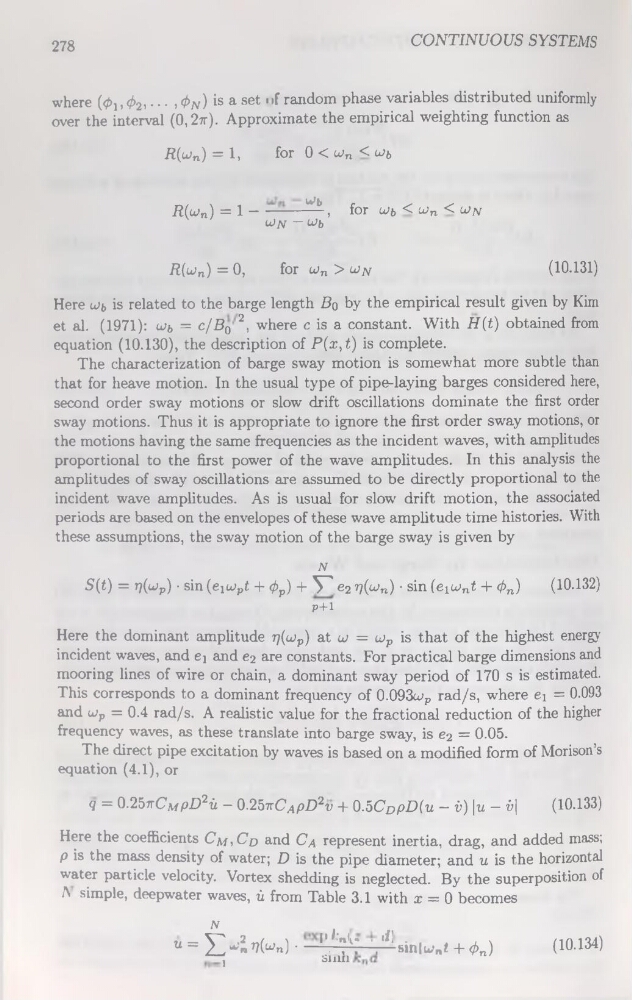
where (0,, d>2,. -. , N) is a set < >f random phase variables distributed uniformly
over the interval (0, 2tt). Approximate the empirical weighting function as
Æ(wn) = 1,
for 0 < Un < ub
RM = 1 -
u>t>
UN — <^b ’
for Ub < un < un
R(un) = 0,
for un > un
(10.131)
Here ub is related to the barge length Bq by the empirical resuit given by Kim
et al. (1971): ub = c/Bq2, where c is a constant. With H(t) obtained from
équation (10.130), the description of P(x,t) is complété.
The characterization of barge sway motion is somewhat more subtle than
that for heave motion. In the usual type of pipe-laying barges considered here,
second order sway motions or slow drift oscillations dominate the first order
sway motions. Thus it is appropriate to ignore the first order sway motions, or
the motions having the same frequencies as the incident waves, with amplitudes
proportional to the first power of the wave amplitudes. In this analysis the
amplitudes of sway oscillations are assumed to be directly proportional to the
incident wave amplitudes. As is usual for slow drift motion, the associated
periods are based on the envelopes of these wave amplitude time historiés. With
these assumptions, the sway motion of the barge sway is given by
N
S(t) = T?(wp) ■ sin (eiWpt + d>p) + V e2 ^n) ■ sin (erunt + <£n)
(10.132)
p+i
Here the dominant amplitude 7](up) at u = up is that of the highest energy
incident waves, and ej and e? are constants. For practical barge dimensions and
mooring lines of wire or chain, a dominant sway period of 170 s is estimated.
This corresponds to a dominant frequency of 0.093wp rad/s, where ei = 0.093
and up = 0.4 rad/s. A realistic value for the fractional réduction of the higher
frequency waves, as these translate into barge sway, is e2 = 0.05.
The direct pipe excitation by waves is based on a modified form of Morison’s
équation (4.1), or
g = 0.2SttCmpD2ù — 0.25ttCapD2v + O.âCppDfu — û) |u — û|
(10.133)
Here the coefficients Cm,Cq and C& represent inertia, drag, and added mass;
p is the mass density of water; D is the pipe diameter; and u is the horizontal
water particle velocity. Vortex shedding is neglected. By the superposition of
A simple, deepwater waves, ù from Table 3.1 with x =■ 0 becomes
N
i
« = E4>1M ■ -‘‘.'Y; /'^sinl^f + <£n)
(10.134)
I
S11UQ
CONTINUOUS SYSTEMS
where (0,, d>2,. -. , N) is a set < >f random phase variables distributed uniformly
over the interval (0, 2tt). Approximate the empirical weighting function as
Æ(wn) = 1,
for 0 < Un < ub
RM = 1 -
u>t>
UN — <^b ’
for Ub < un < un
R(un) = 0,
for un > un
(10.131)
Here ub is related to the barge length Bq by the empirical resuit given by Kim
et al. (1971): ub = c/Bq2, where c is a constant. With H(t) obtained from
équation (10.130), the description of P(x,t) is complété.
The characterization of barge sway motion is somewhat more subtle than
that for heave motion. In the usual type of pipe-laying barges considered here,
second order sway motions or slow drift oscillations dominate the first order
sway motions. Thus it is appropriate to ignore the first order sway motions, or
the motions having the same frequencies as the incident waves, with amplitudes
proportional to the first power of the wave amplitudes. In this analysis the
amplitudes of sway oscillations are assumed to be directly proportional to the
incident wave amplitudes. As is usual for slow drift motion, the associated
periods are based on the envelopes of these wave amplitude time historiés. With
these assumptions, the sway motion of the barge sway is given by
N
S(t) = T?(wp) ■ sin (eiWpt + d>p) + V e2 ^n) ■ sin (erunt + <£n)
(10.132)
p+i
Here the dominant amplitude 7](up) at u = up is that of the highest energy
incident waves, and ej and e? are constants. For practical barge dimensions and
mooring lines of wire or chain, a dominant sway period of 170 s is estimated.
This corresponds to a dominant frequency of 0.093wp rad/s, where ei = 0.093
and up = 0.4 rad/s. A realistic value for the fractional réduction of the higher
frequency waves, as these translate into barge sway, is e2 = 0.05.
The direct pipe excitation by waves is based on a modified form of Morison’s
équation (4.1), or
g = 0.2SttCmpD2ù — 0.25ttCapD2v + O.âCppDfu — û) |u — û|
(10.133)
Here the coefficients Cm,Cq and C& represent inertia, drag, and added mass;
p is the mass density of water; D is the pipe diameter; and u is the horizontal
water particle velocity. Vortex shedding is neglected. By the superposition of
A simple, deepwater waves, ù from Table 3.1 with x =■ 0 becomes
N
i
« = E4>1M ■ -‘‘.'Y; /'^sinl^f + <£n)
(10.134)
I
S11UQ