

A FIXED LEG PLATFORM: STATISTICAL RESPONSES
243
7.35 x 10⁷
-1.15 x 10⁸
-1.15 x 10⁸ 1 [ 4,
3.59 x 1O8 ] [ £2 ~
Pi
P2
(9.82)
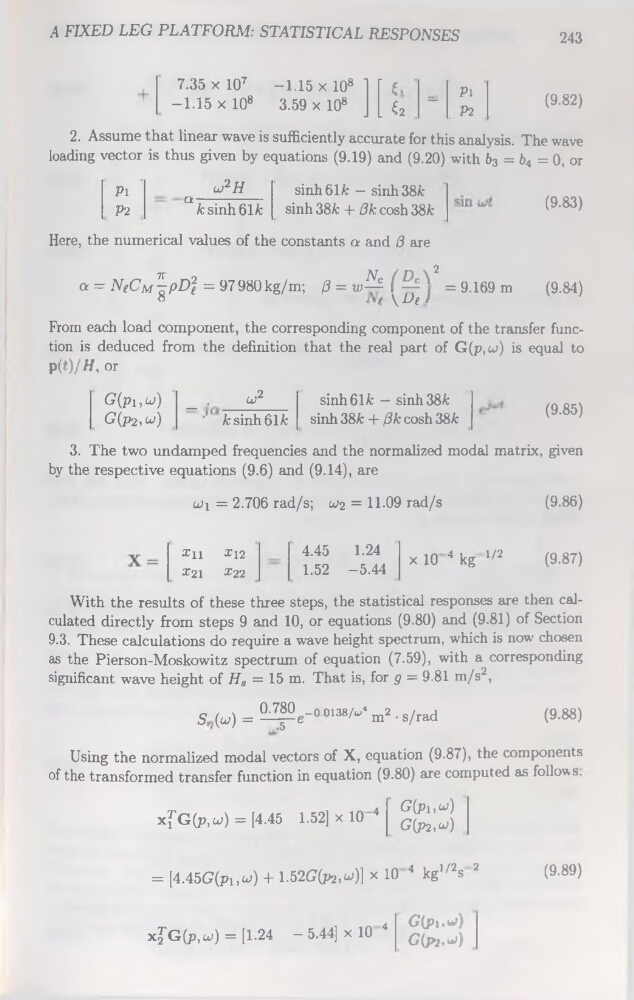
2. Assume that linear wave is sufficiently accurate for this analysis. The wave
loading vector is thus given by équations (9.19) and (9.20) with b3 = 64 = 0, or
Pi
P2
J2 H
Cl-------------------k sinh 61k
sinh 61k — sinh 38k
sinh 38k + 3k cosh 38k
(9.83)
Here, the numerical values of the constants a and 3 are
a = NeCM^pD2 e = 97980kg/m;
O
a
Nc (D'\2
0 = w— I —
= 9.169 m
\ 1311
(9.84)
From each load component, the corresponding component of the transfer function is deduced from the définition that the real part of G(p,w) is equal to
p(t)/W, or
G(pi,w)
_ .
w2
G(p2>w)
•' k sinh 61k
sinh 61k — sinh 38k
sinh 38k + /3k cosh 38k
(9.85)
3. The two undamped frequencies and the normalized modal matrix, given
by the respective équations (9.6) and (9.14), are
a>i = 2.706 rad/s; u>2 = 11.09 rad/s
(9.86)
£n
æ21
æl2
£22
4.45
1.52
1.24
-5.44
x 10 4 kg 1/2
(9.87)
With the results of these three steps, the statistical responses are then calculated directly from steps 9 and 10, or équations (9.80) and (9.81) of Section
9.3. These calculations do require a wave height spectrum, which is now chosen
as the Pierson-Moskowitz spectrum of équation (7.59), with a corresponding
significant wave height of Hs = 15 m. That is, for g = 9.81 m/s2,
S (w) = 02|2e-0 0138/u,‘m2.s/rad
. «O
(9.88)
Using the normalized modal vectors of X, équation (9.87), the components
of the transformed transfer function in équation (9.80) are computed as follows.
x^G(p, w) = [4.45 1.52] x 10 4
G(pi,w)
G(P2,ü2)
= [4.45G(pi,w) + 1.52G(p2,w)] x 10 4 kg1/2s 2
(9.89)
x^G(p,w) = [1.24 — 5.44] x 10
G(pi.<*>)
G(P2,u>)
4
243
7.35 x 10⁷
-1.15 x 10⁸
-1.15 x 10⁸ 1 [ 4,
3.59 x 1O8 ] [ £2 ~
Pi
P2
(9.82)
2. Assume that linear wave is sufficiently accurate for this analysis. The wave
loading vector is thus given by équations (9.19) and (9.20) with b3 = 64 = 0, or
Pi
P2
J2 H
Cl-------------------k sinh 61k
sinh 61k — sinh 38k
sinh 38k + 3k cosh 38k
(9.83)
Here, the numerical values of the constants a and 3 are
a = NeCM^pD2 e = 97980kg/m;
O
a
Nc (D'\2
0 = w— I —
= 9.169 m
\ 1311
(9.84)
From each load component, the corresponding component of the transfer function is deduced from the définition that the real part of G(p,w) is equal to
p(t)/W, or
G(pi,w)
_ .
w2
G(p2>w)
•' k sinh 61k
sinh 61k — sinh 38k
sinh 38k + /3k cosh 38k
(9.85)
3. The two undamped frequencies and the normalized modal matrix, given
by the respective équations (9.6) and (9.14), are
a>i = 2.706 rad/s; u>2 = 11.09 rad/s
(9.86)
£n
æ21
æl2
£22
4.45
1.52
1.24
-5.44
x 10 4 kg 1/2
(9.87)
With the results of these three steps, the statistical responses are then calculated directly from steps 9 and 10, or équations (9.80) and (9.81) of Section
9.3. These calculations do require a wave height spectrum, which is now chosen
as the Pierson-Moskowitz spectrum of équation (7.59), with a corresponding
significant wave height of Hs = 15 m. That is, for g = 9.81 m/s2,
S (w) = 02|2e-0 0138/u,‘m2.s/rad
. «O
(9.88)
Using the normalized modal vectors of X, équation (9.87), the components
of the transformed transfer function in équation (9.80) are computed as follows.
x^G(p, w) = [4.45 1.52] x 10 4
G(pi,w)
G(P2,ü2)
= [4.45G(pi,w) + 1.52G(p2,w)] x 10 4 kg1/2s 2
(9.89)
x^G(p,w) = [1.24 — 5.44] x 10
G(pi.<*>)
G(P2,u>)
4