

STRUCTURAL RESPONSE STATISTICS
241
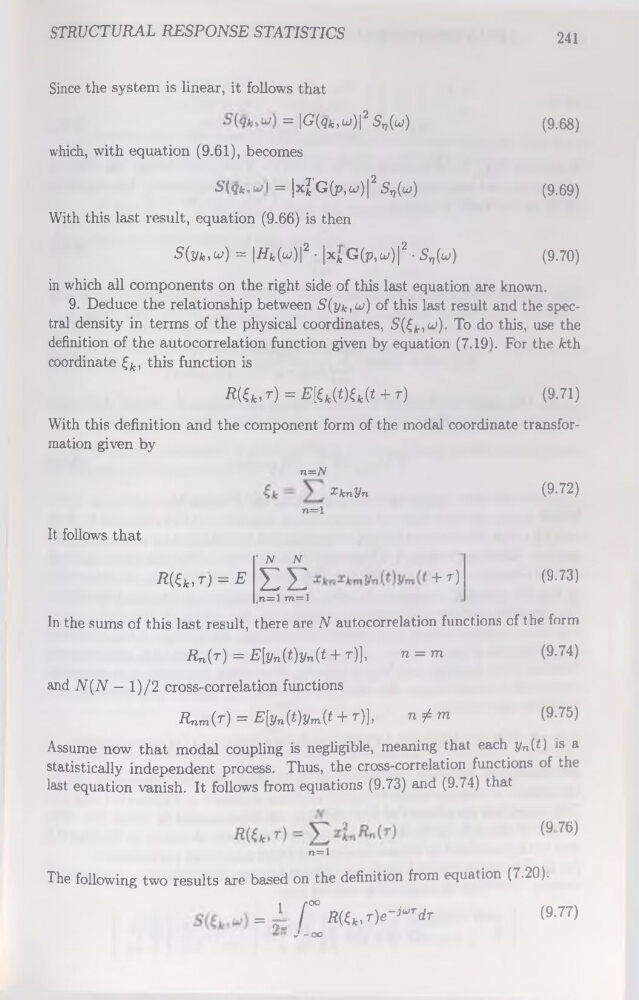
Since the System is linear, it follows that
= \G(qk, w)|2 S^(w)
(9.68)
which, with équation (9.61), becomes
S(qk.^l = |x^'G(p,w)|2S^(w)
(9.69)
With this last resuit, équation (9.66) is then
S(yk,w) = l^(^)|2 • |x[G(p,w)|2 ■ S^u)
(9.70)
in which ail components on the right side of this last équation are known.
9. Deduce the relationship between S(yk,ui) of this last resuit and the spectral density in terms of the physical coordinates, S(£*.,w). To do this, use the
définition of the autocorrélation function given by équation (7.19). For the fcth
coordinate Çk, this function is
R^k,T) = E[^k(t + r)
(9-71)
With this définition and the component form of the modal coordinate transformation given by
n=N
xkn1/n
n=l
It follows that
R(^T) = E
' N
N
EE“h 7")
,n=l m=l
(9-72)
(9.73)
In the sums of this last resuit, there are N autocorrélation functions of the form
Æn(r) = E[yn(t)yn(t + r)],
n = m
and N(N — l)/2 cross-correlation functions
Rnm^^Ely^ym^t + T)],
n^m
(9-74)
(9.75)
Assume now that modal coupling is negligible, meaning that each yn{t) is a
statistically independent process. Thus, the cross-correlation functions of the
last équation vanish. It follows from équations (9.73) and (9.74) that
<9™>
n=l
The following two results are based on the définition from équation (7.20).
= é C R^k,r)e-juTdT
(9-77)
J—oo
241
Since the System is linear, it follows that
= \G(qk, w)|2 S^(w)
(9.68)
which, with équation (9.61), becomes
S(qk.^l = |x^'G(p,w)|2S^(w)
(9.69)
With this last resuit, équation (9.66) is then
S(yk,w) = l^(^)|2 • |x[G(p,w)|2 ■ S^u)
(9.70)
in which ail components on the right side of this last équation are known.
9. Deduce the relationship between S(yk,ui) of this last resuit and the spectral density in terms of the physical coordinates, S(£*.,w). To do this, use the
définition of the autocorrélation function given by équation (7.19). For the fcth
coordinate Çk, this function is
R^k,T) = E[^k(t + r)
(9-71)
With this définition and the component form of the modal coordinate transformation given by
n=N
xkn1/n
n=l
It follows that
R(^T) = E
' N
N
EE“h 7")
,n=l m=l
(9-72)
(9.73)
In the sums of this last resuit, there are N autocorrélation functions of the form
Æn(r) = E[yn(t)yn(t + r)],
n = m
and N(N — l)/2 cross-correlation functions
Rnm^^Ely^ym^t + T)],
n^m
(9-74)
(9.75)
Assume now that modal coupling is negligible, meaning that each yn{t) is a
statistically independent process. Thus, the cross-correlation functions of the
last équation vanish. It follows from équations (9.73) and (9.74) that
<9™>
n=l
The following two results are based on the définition from équation (7.20).
= é C R^k,r)e-juTdT
(9-77)
J—oo