

8
STRUCTURES IN THE OFFSHORE ENVIRONMENT
was built 150 km off the coast of Scotland in the mid-1980s. Conoco installed
the Juillet in 1989, and Saga Petroleum installed the Snorre near Norway in
1991. The tethers for the Snorre are 137 cm in diameter. By the late 1990s,
a total of eleven TLPs were installed, three in the North Sea and eight in the
Gulf of Mexico.
For water depths of about 1500 m, a subsea production System provides an
excellent alternative to a fixed surface facility. Much of a subsea System rests
on the océan floor, and its production of oil and gas is controlled by computer
from a ship or other buoyant structure above the subsea unit. The buoyant
structure and the subsea unit are often connected by a marine riser, which will
be discussed presently.
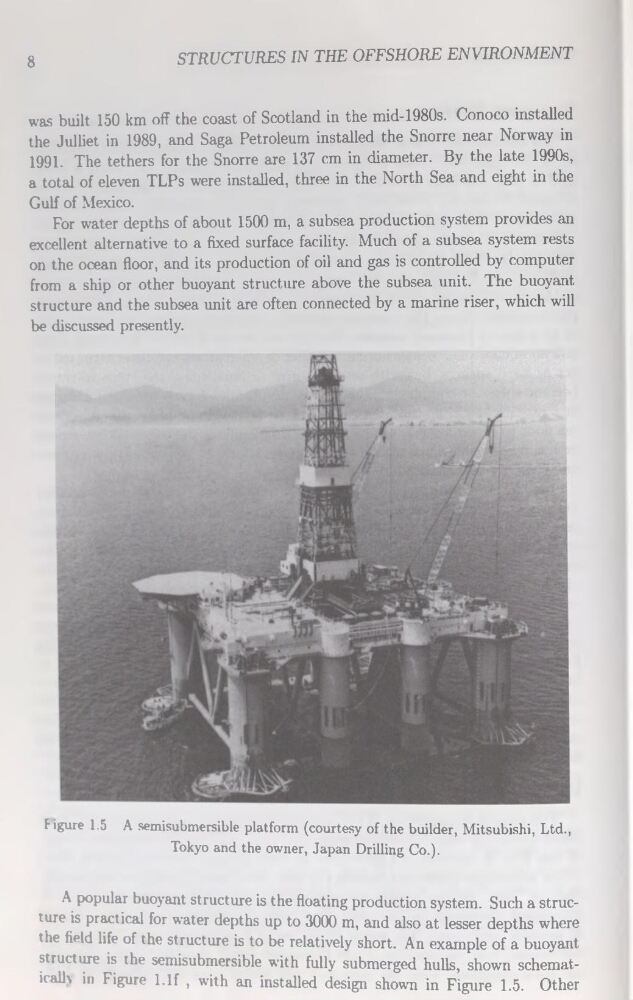
Figure 1.5 A semisubmersible platform (courtesy of the builder, Mitsubishi, Ltd.,
Tokyo and the owner, Japan Drilling Co.).
A popular buoyant structure is the floating production System. Such a structure is practical for water depths up to 3000 m, and also at lesser depths where
the field life of the structure is to be relatively short. An example of a buoyant
structiye is the semisubmersible with fully submerged hulls, shown schematicalh in Figure l.lf , with an installed design shown in Figure 1.5. Other
STRUCTURES IN THE OFFSHORE ENVIRONMENT
was built 150 km off the coast of Scotland in the mid-1980s. Conoco installed
the Juillet in 1989, and Saga Petroleum installed the Snorre near Norway in
1991. The tethers for the Snorre are 137 cm in diameter. By the late 1990s,
a total of eleven TLPs were installed, three in the North Sea and eight in the
Gulf of Mexico.
For water depths of about 1500 m, a subsea production System provides an
excellent alternative to a fixed surface facility. Much of a subsea System rests
on the océan floor, and its production of oil and gas is controlled by computer
from a ship or other buoyant structure above the subsea unit. The buoyant
structure and the subsea unit are often connected by a marine riser, which will
be discussed presently.
Figure 1.5 A semisubmersible platform (courtesy of the builder, Mitsubishi, Ltd.,
Tokyo and the owner, Japan Drilling Co.).
A popular buoyant structure is the floating production System. Such a structure is practical for water depths up to 3000 m, and also at lesser depths where
the field life of the structure is to be relatively short. An example of a buoyant
structiye is the semisubmersible with fully submerged hulls, shown schematicalh in Figure l.lf , with an installed design shown in Figure 1.5. Other