

STRUCTURAL RESPONSE STATISTICS: PART I
181
Sp. (œ)
SPl(co)
Spfsû)
(a)
(b)
(c)
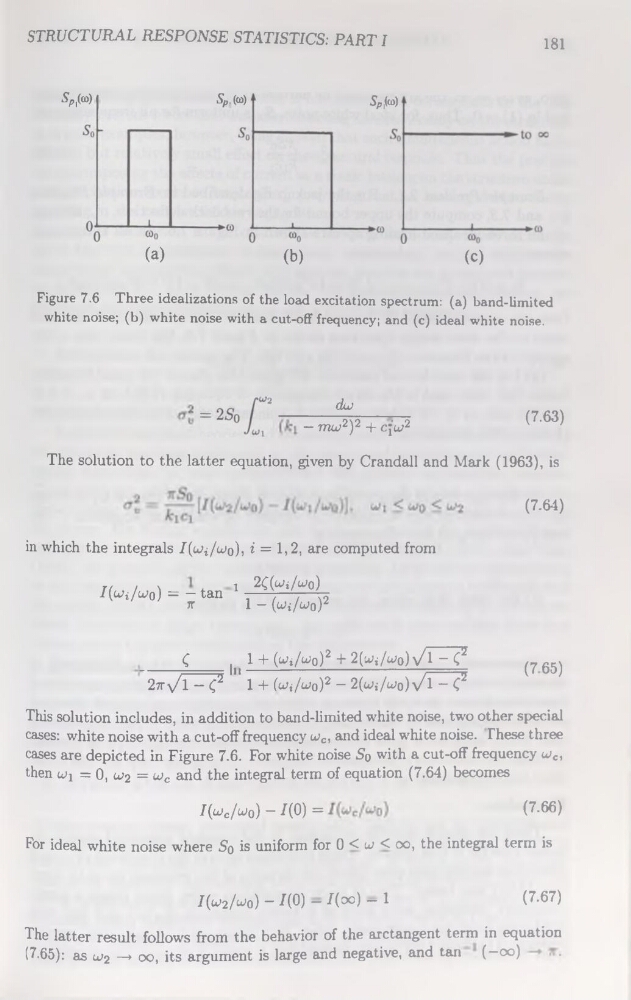
Figure 7.6 Three idealizations of the load excitation spectrum: (a) band-limited
white noise; (b) white noise with a cut-off frequency; and (c) idéal white noise.
— 7774V2)2 + Cj'lV2
dw
(7.63)
The solution to the latter équation, given by Crandall and Mark (1963), is
(7-64)
in which the intégrais /(u^/tvo), i = 1,2, are computed from
/(cvi/cvo) = - tan 1
TT
2Ç(^i/tvo)
1 - (iVj/Tvo)2
_____ C
ljt 1 + (ivj/ivo)2 + 2(cVi/4Vo)\/l - Ç2
(7 65)
2%x/1 - C2
1 + (cvj/ivo)2 - 2(iVj/u7o)x/l ~ <2
This solution includes, in addition to band-limited wdiite noise, two other spécial
cases: white noise with a cut-off frequency ivc, and idéal white noise. These three
cases are depicted in Figure 7.6. For white noise Sq with a cut-off frequency 4VC,
then u»! = 0, cv2 = ivc and the intégral term of équation (7.64) becomes
7(ujc/ivo) - /(O) =
(7.66)
For idéal white noise where Sq is uniform for 0 < uj < oo, the intégral term is
7(cv2/4Vo) ~ 7(0) — 7(oc) — 1
(7.67)
The latter resuit follows from the behavior of the arrangent term in équation
(7.65): as 4V2 —+ oo, its argument is large and négative, and tan (— oo)
181
Sp. (œ)
SPl(co)
Spfsû)
(a)
(b)
(c)
Figure 7.6 Three idealizations of the load excitation spectrum: (a) band-limited
white noise; (b) white noise with a cut-off frequency; and (c) idéal white noise.
— 7774V2)2 + Cj'lV2
dw
(7.63)
The solution to the latter équation, given by Crandall and Mark (1963), is
(7-64)
in which the intégrais /(u^/tvo), i = 1,2, are computed from
/(cvi/cvo) = - tan 1
TT
2Ç(^i/tvo)
1 - (iVj/Tvo)2
_____ C
ljt 1 + (ivj/ivo)2 + 2(cVi/4Vo)\/l - Ç2
(7 65)
2%x/1 - C2
1 + (cvj/ivo)2 - 2(iVj/u7o)x/l ~ <2
This solution includes, in addition to band-limited wdiite noise, two other spécial
cases: white noise with a cut-off frequency ivc, and idéal white noise. These three
cases are depicted in Figure 7.6. For white noise Sq with a cut-off frequency 4VC,
then u»! = 0, cv2 = ivc and the intégral term of équation (7.64) becomes
7(ujc/ivo) - /(O) =
(7.66)
For idéal white noise where Sq is uniform for 0 < uj < oo, the intégral term is
7(cv2/4Vo) ~ 7(0) — 7(oc) — 1
(7.67)
The latter resuit follows from the behavior of the arrangent term in équation
(7.65): as 4V2 —+ oo, its argument is large and négative, and tan (— oo)